What Is the Most Expensive Diamond Cut Shape?
The round brilliant is the priciest diamond shape per carat. Here is why, how every other shape compares, and which gives the most size.
Ask any jeweller which diamond shape costs the most and you will get the same one-word answer: round. But that answer is only useful once you know what “most expensive” is actually measuring, and why a round costs more than a pear of exactly the same weight and quality.
This is the full explanation, in plain English, with no assumed knowledge.
What is the difference between diamond cut and diamond shape?
The trade uses the word “cut” to mean two different things, which causes endless confusion.
Cut as shape means the outline — round, oval, pear, emerald, marquise and so on. This is what people usually mean when they say “cut shape”.
Cut as quality means how well the stone was proportioned and polished: whether the angles are right, whether the facets meet cleanly, whether light comes back out of the top instead of leaking through the bottom. This is graded Excellent down to Poor, and it is the single biggest influence on how much a diamond sparkles.
When we say round is the most expensive cut shape, we are talking about the outline. When we say cut quality matters more than anything, we are talking about the workmanship. Both are true at once.
Which diamond shape is the most expensive?
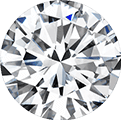
Priced per carat, at equal colour and clarity, the round brilliant is consistently the most expensive shape. That holds for lab-grown and natural stones alike. There are three reasons, and none of them are marketing.
Why does cutting a round diamond waste the most rough?
Diamond rough does not arrive as a neat cube. It arrives as an irregular crystal, most often an octahedron — think of two four-sided pyramids joined base to base.
To carve a perfectly circular outline out of that, the cutter has to grind away the corners and the girdle in every direction. A very large proportion of the original crystal ends up as dust. Elongated shapes such as pear, oval and marquise follow the natural geometry of the rough far more closely, so the cutter keeps considerably more of what they started with.
That lost weight has to be paid for by the finished stone. A one carat round has consumed more raw material than a one carat pear, so it costs more.
Why are round diamonds the hardest to cut well?
A round brilliant has 57 or 58 facets, and its beauty depends entirely on those facets being cut to tight angles and meeting precisely. There is nowhere to hide. A round with sloppy proportions looks visibly dull and glassy, and the grading laboratories publish a formal cut grade for rounds precisely because the standard is so well defined.
Fancy shapes — the trade term for anything that is not round — are not given a full cut grade in the same way, because there is no single agreed ideal outline for a pear or an oval. That gives cutters more latitude, and latitude is cheaper than precision.
How does demand affect the price of a round diamond?
The round brilliant has been the default engagement ring shape for the better part of a century. High, steady demand keeps prices firm. Shapes drift in and out of fashion around it, but the round never really leaves.
How do the diamond shapes compare on price per carat?
Below is the general pattern per carat, all else being equal. Treat it as a guide to relative position rather than a fixed price list — the market moves, and quality differences swamp shape differences.
| Shape | Relative price per carat | Why |
|---|---|---|
| Round brilliant | Highest | Most rough lost, strictest cutting standard, strongest demand. |
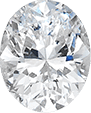
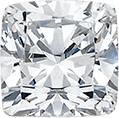
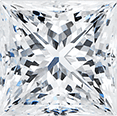
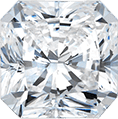
| Oval, cushion, radiant | Upper middle | Popular, reasonably rough-efficient, brilliant-style faceting hides flaws well. |
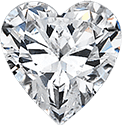
| Heart, hexagon, rose cut | Middle | Specialist shapes; cost driven more by skill and demand than by rough loss. |
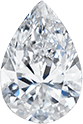
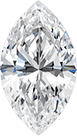
| Pear, marquise | Lower | Very rough-efficient elongated outlines; less mainstream demand. |
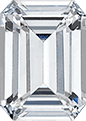
| Emerald, Asscher, baguette | Lowest | Step cuts retain a lot of weight and use simpler faceting. |
Are the cheapest shapes per carat actually cheaper overall?
Here is where the simple answer needs qualifying. The cheapest shapes per carat are often the ones that force you to spend more on the other grades.
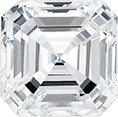
Emerald, Asscher and baguette are step cuts. Instead of lots of small triangular facets, they have long parallel facets running around the stone like steps, which creates broad flashes of light rather than fine sparkle. Those wide open facets act like windows into the stone. Inclusions — the tiny internal features every diamond has — show up plainly, and any faint body tint shows plainly too.
So an emerald cut may cost less per carat, but to look genuinely clean it usually needs a higher clarity and colour grade than a round would. Once you account for that, the saving narrows. A Solitaire Emerald Cut Engagement Ring is a beautiful, architectural piece — but it earns its beauty from clean lines and a clean stone, not from sparkle covering for it.
A round, by contrast, is the most forgiving shape there is. Its churning brilliance disguises small inclusions, which is why you can safely drop a clarity grade or two on a Solitaire Round Cut Engagement Ring in White Gold without seeing a difference.
Which diamond shape looks biggest for the money?
If your real question is “how do I get the most visible ring for my budget”, the answer is not the most expensive shape — it is the most efficient one.
Carat is a measure of weight, not size. Elongated shapes such as marquise, pear and oval spread their weight across a wider face-up outline, so they look larger than a round of identical weight. A marquise in particular has the largest apparent surface area of the common shapes, and it also lengthens the finger. A Solitaire Marquise Cut Engagement Ring and a round of the same weight are not remotely the same size on a hand.
So if visual impact per pound is the goal, the honest advice is to look away from round, not towards it.
Does the same price order apply to lab-grown diamonds?
The shape hierarchy above is driven by cutting physics and demand, and lab-grown diamonds are cut from rough by the same cutters using the same wheels — so the same pattern applies. Rounds still lose the most material. Rounds are still held to the strictest standard.
What changes is scale. Because lab-grown prices sit far below natural, the gap between the priciest and the cheapest shape shrinks to something most people can simply absorb. In practice this means shape becomes a decision about taste rather than budget, which is how it should be. Choose the outline you love, then put the money you save into cut quality, a higher colour grade or a heavier metal.
Frequently asked questions
Is the most expensive shape the most beautiful?
No. Price reflects rough wastage, cutting difficulty and demand — not beauty. Plenty of people prefer the calm, glassy elegance of an emerald cut to the fireworks of a round, and pay less for the privilege.
Which shape sparkles the most?
A well-cut round brilliant. Its facet pattern was designed specifically to maximise the light returned through the top of the stone, and nothing else quite matches it. Ovals, cushions and radiants come closest, as they use brilliant-style faceting.
Do fancy shapes get a cut grade on the certificate?
Generally not a full cut grade in the way rounds do. You will still see polish and symmetry grades, plus the measurements. For fancy shapes, the length-to-width ratio on the report tells you a lot about the outline — whether a pear is slim or plump, for example.
Is a round always the most expensive, whatever the size?
Per carat, at matched colour, clarity and cut quality, essentially yes. But a big fancy-shaped stone will of course cost more than a small round. Compare like for like before drawing conclusions.
Which shape should a first-time buyer choose?
If you want maximum sparkle and maximum forgiveness on clarity, round. If you want maximum apparent size, an elongated shape such as oval, pear or marquise. If you want clean, understated lines, a step cut — and budget for a higher clarity grade to go with it.
Where can you compare diamond shapes side by side?
You can browse by shape across our whole range — start with the round cut collection or the full run of engagement rings and compare the outlines side by side.
Every centre stone comes with a free IGI certificate, every ring is hand-made in solid gold or platinum at our North Harrow workshop, and UK delivery is free and insured with 30 days to change your mind. If you want a shape we do not have on the shelf, we design bespoke at no extra design cost.
More guides on this topic
Ready to find your perfect ring?
Explore our lab-grown diamond collection or book a virtual appointment with our team.