
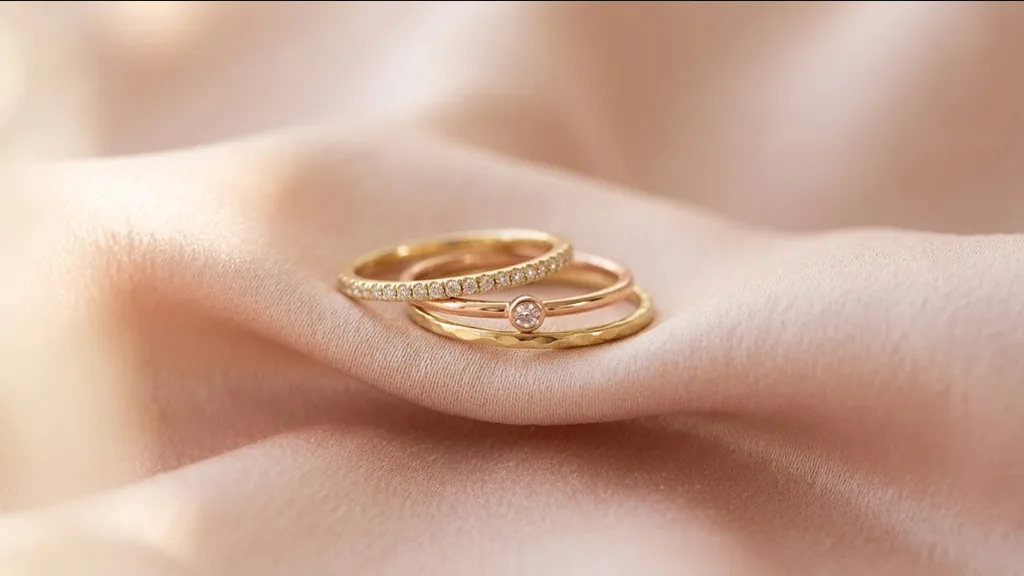
How Many Promise Rings Should You Give?
One is the usual answer, because a second ring dilutes the first. Some couples do give 2, marking different stages, and no tradition forbids it.
Most people give one promise ring, and there is no etiquette, rule or tradition that sets a number. A second ring given later tends to dilute the first rather than double it. Where 2 rings genuinely make sense, it is because the relationship itself changed, not because a custom said so.
Why does a second ring weaken the first?
A second promise ring weakens the first because the first ring’s whole value was that it stood alone. One ring says a particular thing on a particular day. Two rings invite the question of what changed, and whether the first promise held. That is not superstition, it is simply how people read objects. Couples who give a second ring almost always end up explaining it to somebody.
None of that makes a second ring wrong. It makes it a thing that needs a reason attached, which the first ring never did. If you are still working out what the first one is meant to stand for, our guide to what a promise ring actually means is the place to start, because a ring given without an agreed meaning is the one most likely to need a second.
When does giving another ring make sense?
Giving another ring makes sense when the relationship has genuinely moved and the first ring no longer describes it. Moving in together, a long separation ending, a recovery, or simply years stacking up are all real reasons. What does not work is a second ring given to settle an argument, or because a birthday arrived and nothing else came to mind. The reason has to be visible to both of you.
The wording matters more than the metal here, and it is the part people find hardest. Our piece on how to word a promise ring moment covers what to say when a ring is doing something the last one did not, which is exactly the situation a second ring creates.
The table below sets out the realistic options and what each one tends to say to the person receiving it.
| What you do | What it usually says | What we see happen |
|---|---|---|
| Give one and leave it | The promise still stands | Worn daily for years |
| Give a second alongside | Something has changed | Needs explaining to family |
| Reset the first into a new design | The same promise, grown up | Most common request at the bench |
| Add an engraving to the first | A date or a stage marked | Cheapest option by far |
| Move the first to another finger | The ring has a new role | Often done at engagement |
What do you do with the first ring afterwards?
The first ring should keep a job rather than go into a drawer, and the neatest answer is to move it to the other hand or wear it stacked below the newer one. Some people have the original band reshaped, or the stone reset into a pendant worn on a chain. Putting it away quietly says the first promise expired, which is almost never what anybody meant.
Selling it is a different decision again, and one worth taking slowly rather than in the first week. Our page on upgrading or selling a diamond engagement ring sets out what actually happens to the money when a ring goes back to the trade, and the same arithmetic applies to a promise ring.
Does any tradition set a number of promise rings?
No tradition sets a number of promise rings, and we are not going to invent one for you. Promise rings have no governing body, no church rule and no settled etiquette in the UK, unlike wedding rings, which carry centuries of custom behind them. Anyone telling you that two rings are acceptable and three are not is stating a personal opinion dressed up as a rule.
Where custom does have something useful to say is on how a pair looks together rather than how many there are. Our guide to whether promise rings should match covers the four levels of matching we see in practice, and it answers a far more common question than counting ever does.
How many promise rings do couples actually give?
Most couples we serve give exactly one promise ring, and a small minority give a second years later. That is what we see across the counter, not a measured figure, and no reliable public survey exists on how many promise rings people give in the UK. Anyone quoting you a percentage has made it up. Treat the number as custom and opinion, because that is genuinely all it is.
Who gives the ring turns out to matter more than how many are given, and it is the question we are asked far more often. Our page on who buys the promise ring covers the giver, the payer and whether both of you need one at all.
Can you replace a promise ring instead of adding one?
Replacing a promise ring is usually a better answer than adding one, and it is the route we are asked about most often. The original stone or band comes back to the bench and goes into a new design, so the ring on the hand is still the first ring in every sense that matters. Bespoke design carries no extra design cost with us, so you pay for metal and labour.
A reset also solves the problem a second ring creates, because there is only ever one ring to explain. The old band can be kept whole, cut down into a stacking ring, or melted into the new piece, and we will tell you honestly which of those the metal is actually fit for.
What works better than a second promise ring?
Better than a second promise ring, in most cases, is something that adds to what is already on the hand rather than competing with it. A stacking band worn beside the original reads as growth instead of replacement. An engraving added inside the first ring does the same job for far less money. So does moving the ring to a different finger and saying out loud why.
A stackable rose cut band in sterling silver at £489 sits beside almost anything, and a stackable pear cut ring at £503 does the same with a little more presence. A minimalist round cut ring at £587 works if the first ring was plain. All three prices are correct at the time of writing. Money is its own conversation, and who actually pays for the engagement ring covers it honestly. The full range sits in our plain and set band collection.
Frequently asked questions
Can you give more than 1 promise ring?
Yes, nothing stops you, and no custom forbids it. A second promise ring is a personal choice rather than a breach of any rule, and plenty of couples mark a new stage that way. The practical catch is that two rings invite a question the first ring never had to answer, so give the second one a clear reason.
Do the rings need to match?
No, and matching matters less than most people expect. A pair sharing a metal and a finish reads as a set without being identical, which usually looks better than two copies of one band. Where one of you wants stones and the other does not, agreeing on the metal alone is enough to make them read as a pair.
Can a promise ring become an engagement ring?
Yes, and it happens often. Some people simply move the promise ring to the other hand once they are engaged, while others bring it back to the bench to have the stone reset into an engagement design. Either route keeps the original piece in the story rather than retiring it to a drawer for good.
How many promise rings are you supposed to get?
No fixed number exists, and we will not invent one. No tradition, church or etiquette guide sets how many promise rings a person may give or receive. One is what most people give, because a single ring carries a single clear meaning. Any number above that is a private decision between two people, not a custom you are failing.
What happens to a promise ring after a proposal?
Most people move it to the right hand and carry on wearing it, which is the neatest answer we see. Others stack it below the engagement ring, and a few bring it in to have the stone reset into the new piece. Very few put it away entirely, and the ones who do often regret it later.
Is one promise ring enough?
Yes, for almost everyone. One promise ring carries the whole meaning on its own, and adding a second rarely doubles it. If the promise itself has changed, the stronger move is usually to change the ring you already have rather than buy another one and leave the first without any job to do.
Ready to find your perfect ring?
Explore our lab-grown diamond collection or book a virtual appointment with our team.