What Wedding Band Goes With an Emerald Cut Engagement Ring?
Which wedding band suits an emerald cut engagement ring, why straight and baguette bands sit flush, plus metal, width and fit advice.
An emerald cut engagement ring is all straight lines. That is what makes it beautiful, and it is also what makes choosing a wedding band slightly different from choosing one for a round diamond. Get the pairing right and the two rings look like they were always meant to sit together. Get it wrong and you will see a gap, or the band will rock on your finger.
This guide explains, in plain language, which wedding bands suit an emerald cut, why they work, and what to check before you buy. No jargon without an explanation.
First, what an emerald cut actually is
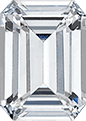
An emerald cut is a rectangle with the corners cut off. Instead of lots of tiny triangular facets (the small flat surfaces cut into a diamond), it has long, flat, parallel facets that run in steps down the stone. Jewellers call this a step cut.
The result is less sparkle and more of a clear, glassy flash, a bit like looking into a hall of mirrors. It looks elegant, architectural and calm. Because the outline is a clean rectangle, the sides of the stone are straight rather than curved.
That single fact decides almost everything about your wedding band.
The short answer
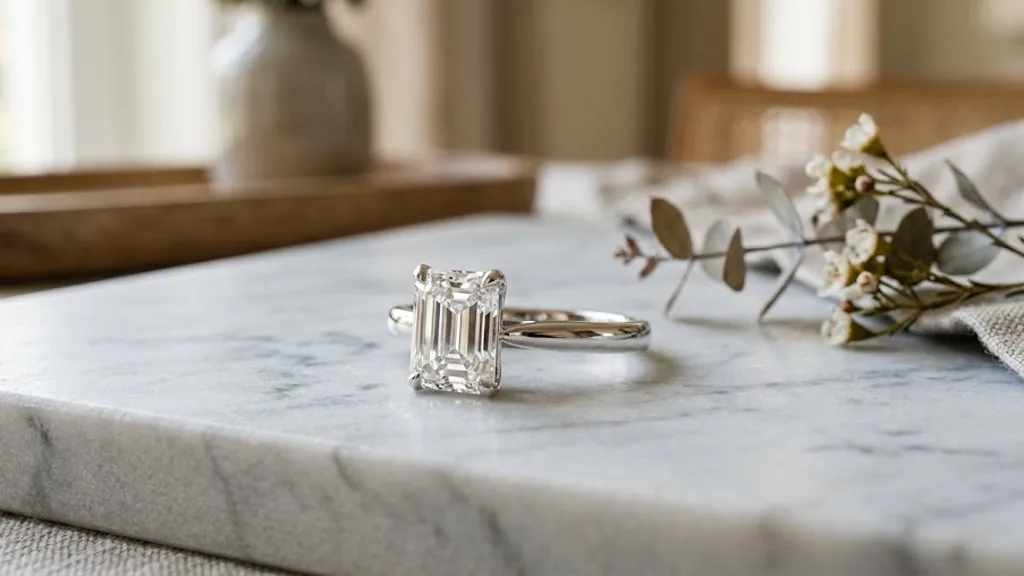
A straight band is the natural partner for an emerald cut engagement ring. Because the edge of the stone is a straight line, a straight band can sit right up against it without leaving an awkward gap.
This is genuinely good news. Straight bands are the most versatile, the easiest to wear on their own, and usually the simplest to get right. You do not need a specially shaped ring.
The one exception is when your engagement ring sits very high off the finger, or has a halo (a ring of small diamonds around the centre stone) that overhangs the band. Then you may want a slight notch or curve. More on that below.
Band styles that suit an emerald cut
Plain straight band
A simple polished band in the same metal is the quietest, most timeless choice. It lets the emerald cut do the talking. If you want the engagement ring to look bolder, a plain band is the way to do it, because nothing competes with it.
Baguette band
Baguettes are small rectangular step-cut diamonds, so they are miniature versions of your centre stone. Setting them in a row along the band creates a run of clean parallel lines that echo the engagement ring exactly. This is the most flattering pairing for an emerald cut, and it is the one we recommend most often.
Have a look at the Pavé Baguette Cut Wedding Band. The straight top edge sits flush against an emerald cut, and the rectangular stones repeat the shape of the diamond above.
Emerald cut eternity band
An eternity band is a band set with diamonds all the way around. A half eternity has stones across the top half only; a three-quarter eternity goes about three-quarters of the way round. Half and three-quarter versions are more practical, because the plain underside is easier to resize and more comfortable against the neighbouring finger.
The Stackable Emerald Cut Half Eternity Band uses the same cut as your centre stone in miniature. Worn together, the ring and band read as one continuous run of step-cut diamonds.
If you want more presence, the Stackable Emerald Cut Three Quarter Eternity Band carries the stones further round the finger, so you still see diamonds when your hand is at rest.
Pavé band
Pavé (say “pa-vay”) means lots of tiny round diamonds set close together so the metal almost disappears. A fine pavé band adds sparkle without changing the shape of anything. It is a good middle ground if a full row of baguettes feels like too much.
Contoured or notched band
A contoured band has a dip or a shaped cut-out so it can tuck under a stone. For an emerald cut this is only needed when the setting is unusually low, or when a halo sticks out past the shoulders of the ring. It is easy to have made, but do not assume you need one.
Shape and band matching at a glance
| Engagement ring | Best band shape | Why |
|---|---|---|
| Emerald cut solitaire | Straight | Straight stone edge meets straight band with no gap |
| Emerald cut with hidden halo | Straight, or slightly notched | The halo sits under the stone, so it rarely blocks the band |
| Emerald cut three stone | Straight, plain or fine pavé | The ring is already busy, so a quiet band balances it |
| Pear | Curved or chevron | The pointed tip needs a band that curves away from it |
| Marquise | Chevron (V shape) | Two points, so the band needs to dip at an angle |
| Oval | Straight or gently curved | The curve is shallow, so a straight band usually sits fine |
| Round | Straight | Most round settings are raised enough to clear a flat band |
Does the band have to sit flush?
Flush means the two rings touch along their whole length with no daylight between them. It looks neat, but it is not compulsory.
Plenty of people deliberately leave a small gap, or wear a spacer, which is a very thin plain band placed between the engagement ring and the wedding band. A spacer stops the two rings rubbing against each other, which slowly wears the metal away over the years.
What matters more than a perfect fit is that the band does not rock. If the band only touches the engagement ring at one point, it will pivot every time you move your hand, and that is what wears the metal.
Matching your metals
The simplest rule: match the wedding band to the engagement ring. White gold with white gold, yellow with yellow, platinum with platinum.
There is one thing worth knowing about hardness. Different metals wear at different rates, so if you wear a harder band against a softer ring, the softer one will pick up marks faster. Sticking to the same metal keeps the wear even.
Mixing metals on purpose is completely fine and looks deliberate rather than accidental if you repeat the mix somewhere else, for example a rose gold band against rose gold prongs on the engagement ring.
All CarbonstoneUK rings are hand-made in solid gold or platinum, so you are matching real metal throughout, not plating that wears off.
Comfort and everyday wear
Two rings on one finger feel different from one. A few practical points:
- Width. A band of around 1.8mm to 2.5mm sits comfortably next to most engagement rings. Wider than that and the pair can feel bulky.
- Profile. A court profile (rounded inside and out) is the most comfortable for all-day wear. Flat profiles look crisper but can feel sharper against the next finger.
- Sizing. Order both rings in the same size. Wearing two rings does not change your finger size, but a very wide band can feel tighter, so consider going up a quarter size if your band is over 4mm.
- Which side? Traditionally the wedding band goes on first, closest to the heart, with the engagement ring above it. Nobody will mind if you do the opposite.
If your emerald cut is a three stone or hidden halo
A three stone ring has a centre diamond with a smaller stone on each side. Because the ring already has a lot going on, a plain or very fine band usually looks better than another row of large stones.
A hidden halo has a circle of tiny diamonds set underneath the centre stone, facing sideways. You see it from the side, not from above. It sits above the band, so it almost never gets in the way. If you are starting from scratch, the Hidden Halo Emerald Cut Engagement Ring pairs beautifully with a straight baguette band, and the Solitaire Emerald Cut Engagement Ring is the cleanest starting point of all.
Having a band made to fit
If nothing off the shelf sits quite right, a band can be made to your exact ring. We design bespoke pieces at no extra design cost from our workshop in North Harrow, London, so you pay for the metal and the diamonds rather than the drawing board. Send us a photograph of your engagement ring and we will tell you honestly whether a straight band will work or whether a shaped one is worth it.
Every centre stone comes with a free IGI certificate, all our diamonds are lab-grown, UK delivery is free and insured, and you have 30 days to return anything that is not right.
Frequently asked questions
Can I wear a curved band with an emerald cut ring?
You can, but it usually looks unbalanced. A curve reads as a mismatch against a straight-edged stone, and it leaves a small crescent-shaped gap at each end. Save curved bands for pear, marquise and some oval rings.
Should the wedding band be thinner than the engagement ring?
Not necessarily, but matching or slightly thinner is the safest choice. A band that is noticeably wider than the engagement ring band tends to make the centre stone look smaller.
Can I buy the wedding band later?
Yes, and many people do. Bring or send your engagement ring when you choose the band so you can check they sit together. If your engagement ring was made for you, keep the details on file so the band can be made to match years later.
Do I need two bands, one either side?
Only if you like the look. Two slim bands framing the engagement ring is a lovely style, and it also stops the engagement ring spinning. It does add height and bulk on the finger, so try it before committing.
Will a diamond band scratch my engagement ring?
Diamonds are harder than gold and platinum, so a diamond-set band can gradually mark the metal of a ring sitting against it. A spacer band, or having the two rings soldered together, prevents this.
Other shapes, other bands
Every diamond shape has its own rules. If you are still deciding, or you are buying for someone with a different ring, these guides cover the rest:
- What Wedding Band Goes With a Pear Shaped Engagement Ring?
- What Wedding Band Goes With an Oval Engagement Ring?
- What Wedding Band Goes With a Marquise Engagement Ring?
- How to Wear a Pear Shaped Ring With a Wedding Band
When you are ready, browse our full range of wedding rings or start from the beginning with our engagement rings. If you would like a second opinion on a pairing, send us a photograph and we will give you a straight answer.
More guides on this topic
Ready to find your perfect ring?
Explore our lab-grown diamond collection or book a virtual appointment with our team.