
How to Wear a Pear Cut Diamond Ring: A Styling Guide
Which way the point should face, how to stop a pear ring spinning, protecting the tip, and the bands that pair with it best.
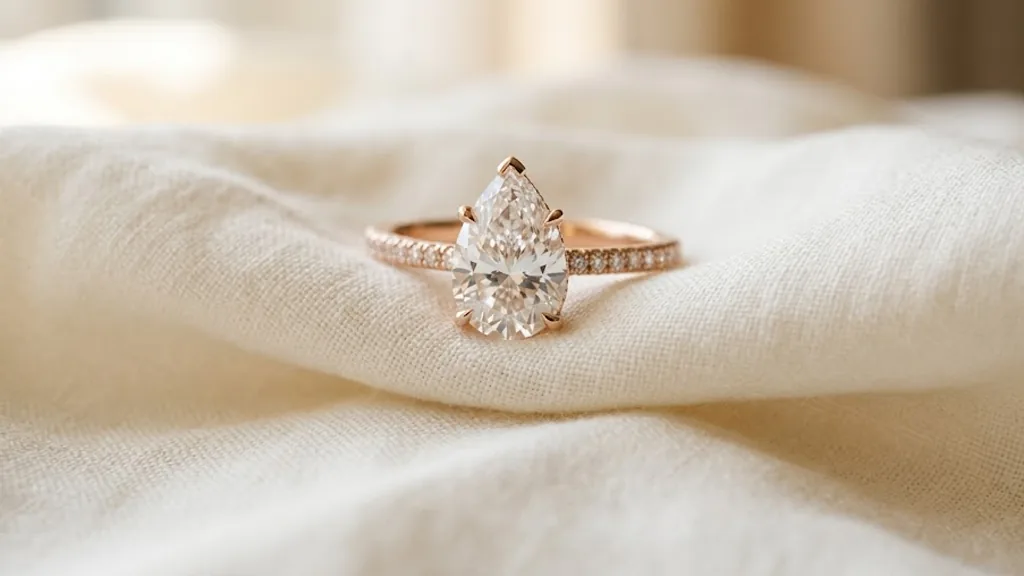
A pear cut diamond is a teardrop: round at one end, tapering to a single point at the other. It is one of the most flattering shapes on a hand, and also the one people worry about most, because there is a right way and a wrong way to wear it.
This guide covers which way the point should face, what to stack alongside it, which settings protect it, and how to keep it sitting straight.
Which way should the point face?
The traditional answer, and the one most people choose, is point facing away from you, towards the fingernail.
There is a practical reason. Worn this way, the taper draws the eye up the finger and makes the hand look longer and slimmer. It is the same trick a pointed shoe plays.
Wearing it the other way, with the point towards the wrist, is not wrong. Some people prefer it because the rounded end sits at the top of the finger and looks softer. Others do it simply because that is how it feels comfortable.
Our honest advice: try both for a day each before deciding. There is no rule you can break here, only a convention.
Stopping a pear ring from spinning
This is the single most common complaint about pear rings, and it is easily solved. A pear stone is heavier at one end, so an ill-fitting band lets the stone rotate to the side of the finger.
What works:
- A properly sized band. Most spinning is a fit problem, not a shape problem. Get sized properly, in the afternoon when fingers are at their normal size.
- A slightly wider band. Wider bands sit more stably and rotate less than very thin ones.
- A matching curved wedding band. A band shaped to nest against the pear holds the ring upright as well as looking deliberate.
- A lower setting. Tall settings have more leverage to tip over. Bezel and lower claw settings sit steadier.
Protecting the point
The point of a pear is the most vulnerable part of the stone. Diamonds are extremely hard, but hardness is not the same as toughness: a sharp point can chip if it takes a knock at the wrong angle.
The standard solution is a V-shaped claw, sometimes called a V-tip, which wraps the point in metal. It is barely visible from above and it removes the risk almost entirely. If you are choosing a pear ring for everyday wear, ask for one.
Bezel settings, where a rim of metal surrounds the whole stone, are the most protective option of all, and they sit very low, which suits an active life.
Stacking and pairing
Pear rings stack well because the tapering shape leaves a natural gap for a second band.
| Pairing | Effect |
|---|---|
| Curved or chevron band | Nests against the point, looks purpose-made, stops rotation |
| Straight plain band | Sits flush against the rounded end; simple and versatile |
| Matching bridal set | Designed as a pair from the start, no gap and no fiddling |
| Eternity band on the other hand | Balances the look without competing |
If you like the idea of a set that is designed together, our Curved Pear Cut Bridal Set is £999, and the Teardrop Pear Cut Bridal Set in Rose Gold is also £999. Prices correct at the time of writing.
Which finger and which hand
In the UK, engagement and wedding rings are traditionally worn on the fourth finger of the left hand. A pear looks particularly good there because the finger is naturally slim.
Worn as a dress ring rather than an engagement ring, a pear on the index or middle finger looks modern and deliberate, especially in a bezel setting. There is no obligation to keep it on the traditional finger.
Matching the pear to your hand
- Shorter fingers. A longer, narrower pear elongates them. Wear it point-up.
- Longer fingers. A plumper pear balances the length and stops the ring looking spindly.
- Wider fingers. A larger stone or a halo, which is a ring of small diamonds around the centre stone, keeps the proportions right.
- Smaller hands. A slim band and a modest stone keep it elegant rather than overwhelming.
Everyday practicalities
A few habits that keep a pear ring looking its best:
- Take it off for hand cream, cleaning products and the gym. Cream dulls the stone faster than anything else.
- Clean it every few weeks in warm water with a drop of washing-up liquid and a soft baby toothbrush, in a plugged sink. Brush the underside, where the dirt that dulls a stone actually sits.
- Have the claws checked once a year, and pay particular attention to the V-tip over the point.
- Store it separately from other jewellery. Diamonds scratch everything, including other diamonds.
Pear rings we make, with prices
Pear is our second largest collection, with eleven designs. All lab-grown diamonds, hand-made in solid metal, free IGI certificate on the centre stone. Prices correct at the time of writing.
| Ring | Style | Price |
|---|---|---|
| Stackable Pear Cut Engagement Ring | Slim, designed to be worn with others | £503 |
| Toi et Moi Pear Cut Engagement Ring in White Gold | Two stones side by side | £685 |
| Curved Pear Cut Bridal Set | Ring and matching curved band | £999 |
| 5 Stone Pear Cut Engagement Ring in Yellow Gold | Five pear stones in a row | £528 |
See the full pear cut collection, or browse matching sets in bridal sets.
Frequently asked questions
Which way does a pear shaped ring point?
Most people wear it with the point facing away from the body, towards the fingernail, because it makes the finger look longer. Pointing it towards the wrist is a personal preference and perfectly acceptable.
Why does my pear ring keep twisting?
Almost always a sizing issue. The stone is heavier at one end, so a band that is even slightly loose lets it rotate. A correct fit, a slightly wider band, or a nesting curved wedding band all fix it.
Can I wear a pear ring every day?
Yes, provided the point is protected. Ask for a V-shaped claw over the tip, or choose a bezel setting where a rim of metal surrounds the stone. Both make a pear as practical as any other shape.
What wedding band goes with a pear engagement ring?
A curved or chevron band nests neatly against the point and looks intentional. A plain straight band works too, sitting against the rounded end. Buying a matched bridal set removes the guesswork entirely.
Do pear cut diamonds cost less than round?
Generally yes, per carat, because cutting a pear wastes less of the rough crystal and demand for round is higher. A lab-grown pear costs a fraction of a natural one of comparable colour and clarity.
Wearing it well
A pear is a shape with personality, and the styling rules are lighter than people assume. Get the fit right, protect the point, and then wear it whichever way makes you smile when you look down at your hand.
Every piece is hand-made in solid gold, platinum or sterling silver at our North Harrow workshop in London, with free insured UK delivery and 30-day returns. Bespoke work carries no extra design cost if you want something built around your own hand.
More guides on this topic
Ready to find your perfect ring?
Explore our lab-grown diamond collection or book a virtual appointment with our team.











