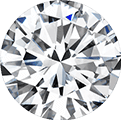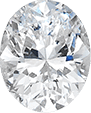
Are Round or Oval Diamonds More Expensive?
Round diamonds cost more than ovals of the same weight. Here is why, by how much, and when an oval is the smarter buy. Real UK prices.
Round and oval are the two shapes we get asked about most, and price is nearly always the first question. So let us answer it straight away: if you compare a round diamond and an oval diamond of the same weight and the same quality, the round one will almost always cost more.
But “more expensive” is not the same as “worse value”, and the gap is smaller than a lot of websites make out. Below is what actually drives the difference, what you can expect to pay in the UK, and how to decide which shape suits you.
The short answer
Round diamonds carry a price premium over ovals. Compare like for like and a round usually costs somewhere in the region of 15 to 30 per cent more than an oval of the same carat weight and quality. That is a rule of thumb from years of buying stones, not a fixed figure, and it moves around depending on size and grade.
One quick word on carat, because it trips people up. Carat is a measure of weight, not size. One carat is 0.2 grams. Two diamonds can weigh exactly the same and still look different sizes on the hand, and that matters a great deal in this comparison.
Why round diamonds cost more
There are two reasons, and they are both simple.
More of the raw stone is thrown away. To cut a perfectly round brilliant, the cutter has to grind a rough crystal down into a circle. A large amount of the material ends up as dust. An oval is a longer, stretched shape, so the cutter keeps more of what they started with. Less waste means a lower price for the finished stone.
Round is the shape everyone wants. Round brilliants are by a wide margin the most requested shape for engagement rings. High demand keeps prices firm. Ovals are popular, but they are not competing with that same level of demand.
Put those together and you get a consistent premium on round, in both mined and lab-grown diamonds.
Where ovals save you money twice
This is the part most guides miss. An oval is not just cheaper per carat. It also looks bigger than a round of the same weight.
Because an oval is stretched out, more of its weight sits on the top surface where you can see it. A round diamond carries more of its weight in the depth, underneath the setting. In practice, a one carat oval typically shows a top surface roughly 8 to 12 per cent larger than a one carat round.
So you can either spend less for the same visual size, or spend the same and get a noticeably larger looking ring. That is why ovals have become so popular with buyers who want presence on the finger without stretching the budget.
Round versus oval at a glance
| Round | Oval | |
|---|---|---|
| Price for the same carat and quality | Highest of all shapes | Roughly 15-30% less |
| Looks bigger for the weight? | No | Yes, around 8-12% more surface on top |
| Sparkle | The benchmark. Nothing returns light better | Very close behind, with longer flashes of light |
| Hides a slightly warm colour? | Best at hiding it | Good, though warmth can gather at the points |
| Effect on the finger | Classic, balanced, timeless | Lengthens and slims the finger |
| The thing to watch | A poor cut grade looks dull | The bow-tie shadow, see below |
| Choice of designs | Enormous | Wide, though smaller than round |
What you would actually pay
Finished ring prices depend far more on the setting, the metal and the size of the centre stone than on shape alone. To give you real numbers rather than vague ranges, here is what our own rings cost.
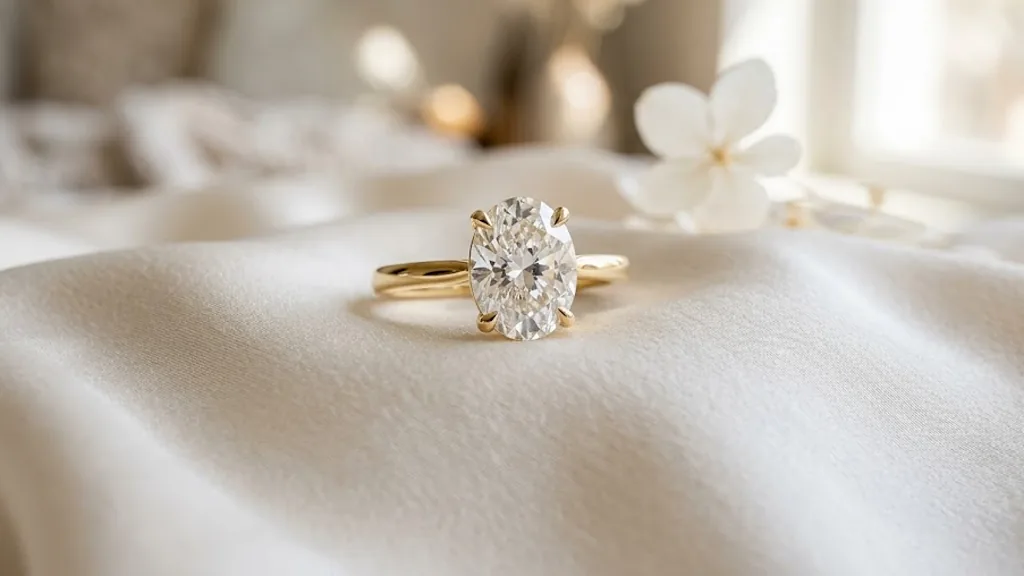
Our Solitaire Oval Cut Engagement Ring starts at £557. A solitaire simply means one diamond on its own, with no side stones. For comparison, our Solitaire Round Cut Engagement Ring in White Gold starts at £563, and several other round solitaires in the collection sit around £657.
Notice that the finished prices are close. That is because at these sizes the gold, the platinum and the hand-making are a big share of the cost. The shape premium becomes much more obvious once you go up in carat weight. At two or three carats, choosing an oval instead of a round can save you several hundred pounds on the stone alone.
If you want the oval to look larger still, a hidden halo is worth a look. A halo is a ring of small diamonds around the centre stone; a hidden halo sits underneath it, so you only really see it from the side. Our Hidden Halo Oval Cut Engagement Ring is £1,021 and lifts the stone up beautifully.
All of our centre stones are lab-grown and come with a free IGI certificate. IGI is an independent laboratory that grades the diamond, so the quality is confirmed by someone other than us.
The bow-tie: the one thing to check on an oval
Every long shape has a possible flaw called a bow-tie. It is a dark shadow across the middle of the stone, shaped a bit like a bow tie, caused by your own head blocking light as you look down at it.
Almost all ovals have one to some degree. On a well cut stone it is faint and you barely notice it. On a badly cut stone it is a dark band that never goes away, and no certificate will warn you about it, because bow-ties are not graded.
The only reliable check is to look at the actual stone, or a video of the actual stone, and tilt it. If the dark area stays fixed and heavy, walk away. If it moves and breaks up into sparkle, you are fine. We are happy to send video of any centre stone before you commit.
Things that change the price far more than shape
Shape is only one of five levers, and honestly it is not the biggest one.
- Carat weight. Price climbs steeply with weight, and it jumps at the round numbers. A stone just under 1.00 carat costs noticeably less than one just over, and nobody will ever be able to tell the difference by eye.
- Cut quality. How well the stone is proportioned and polished. This is the one thing never to economise on. A poorly cut diamond looks lifeless no matter what shape it is.
- Colour. Graded from D, which means completely colourless, and then down the alphabet as a faint warmth creeps in. For white gold and platinum, D to F looks crisp. For yellow or rose gold, G or H is plenty, because the warm metal masks any faint tint anyway.
- Clarity. How free the stone is of tiny natural marks. VS1 or VS2 means nothing is visible to the naked eye. Paying for flawless is usually money spent on something only a jeweller’s loupe will ever see.
- Setting and metal. Platinum costs more than gold. Pavé settings, where a row of tiny diamonds is set into the band, add stones and add labour.
So which should you choose?
Choose round if you want maximum sparkle and a design that will never look dated, and you are comfortable paying for it. It is also the safest choice if you are buying as a surprise and genuinely do not know their taste.
Choose oval if you want the largest looking stone for your budget, you like a softer and more elongated shape, or you have shorter fingers and want a lengthening effect.
And if you are torn, one honest piece of advice: try both on. Photographs flatten everything. Five minutes with the two shapes side by side on a real hand settles the argument almost every time.
Frequently asked questions
Is an oval diamond cheaper than a round one of the same carat?
Yes, in nearly every case. Expect to pay roughly 15 to 30 per cent less for an oval of the same weight, colour, clarity and cut quality. The saving grows as the stone gets bigger.
Does an oval look bigger than a round?
Yes. For the same carat weight, an oval shows around 8 to 12 per cent more surface area when you look down at it, and the elongated outline makes it read as larger still.
Do round diamonds sparkle more than ovals?
Round brilliants return light better than any other shape, because their proportions have been refined for exactly that purpose. Ovals sparkle very well too, just with longer, broader flashes rather than lots of small pinpoints. Most people would not call one better, only different.
Are lab-grown diamonds cheaper in every shape?
Yes. Lab-grown diamonds are chemically and optically the same as mined ones and cost a fraction of the price across all shapes. The round premium still exists in lab-grown, it is simply applied to a much lower starting price.
Which shape holds its value better?
Be careful with anyone who promises resale value on any diamond, mined or lab-grown. Round is the easiest shape to sell on because demand is broadest, but buy a ring because you love wearing it, not as an investment.
Have a look for yourself
Every ring we make is hand-made to order in solid gold or platinum, with a free IGI certificate on the centre stone, free insured UK delivery and 30 days to change your mind. If you would like something that is not on the site, our bespoke design service carries no extra design cost.
You can browse the full oval collection or see everything side by side in our engagement rings. We are based in North Harrow, London, and we are always happy to talk it through before you decide.
More guides on this topic
Ready to find your perfect ring?
Explore our lab-grown diamond collection or book a virtual appointment with our team.