How to Clean a White Gold Wedding Ring (and When It Needs Re-Plating)
Safely clean a white gold ring at home, tell dirt from worn rhodium plating, and know when re-plating is due and what it costs.
A white gold ring that has gone dull or slightly yellow is not dirty in the way most people assume. Cleaning will fix a lot of it. But part of what you are seeing is the ring’s plating wearing away, and no amount of scrubbing brings that back.
Understanding the difference saves a lot of frustration. Here is how to clean a white gold wedding ring safely at home, what cleaning can and cannot do, and when the ring genuinely needs a jeweller.
What white gold actually is
Gold is naturally yellow. There is no such thing as white gold ore.
White gold is made by mixing gold with paler metals — usually palladium, silver, nickel or zinc. That mix produces an alloy that is much lighter in colour than yellow gold, but it still carries a faint warm or greyish tint. It is not the bright, cool white most people picture.
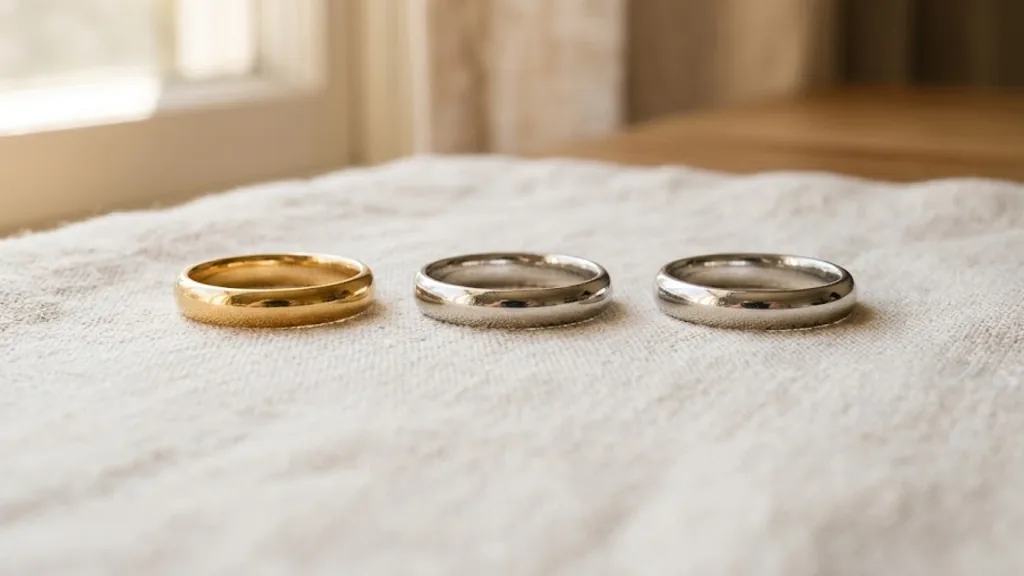
To get that brilliant white, finished white gold jewellery is coated with a very thin layer of rhodium. Rhodium is a hard, bright, highly reflective metal from the platinum family. The process is called rhodium plating, and it is standard practice across the entire jewellery trade — not a shortcut and not a sign of a cheap ring.
The important part: rhodium plating is measured in microns. It is a coating, and coatings wear. On a ring worn every day, particularly on the underside where it rubs against everything, the plating gradually thins and the slightly warmer gold beneath begins to show through.
Is my ring dirty, or is the plating wearing?
These look similar at a glance but behave differently.
| What you see | Likely cause | Does cleaning fix it? |
|---|---|---|
| Overall dullness, stones look cloudy | Skin oils, soap film, hand cream, cosmetics | Yes — a proper clean restores it |
| Dark grey build-up in crevices and around claws | Trapped dirt and dead skin | Yes, with a soft brush |
| A faint yellow or straw tint appearing on the underside | Rhodium plating wearing through | No — needs re-plating |
| Uneven patchy colour across the band | Plating worn in places, intact in others | No — needs re-plating |
| Fine scratches and a matt surface | Normal wear on the metal itself | Partly — needs professional polishing |
A quick test: look at the ring in daylight, comparing the top surface with the underside. If the underside is warmer in colour than the top, that is plating wear, not dirt.
How to clean a white gold ring at home
This is the method for a plain white gold band or a diamond-set ring. It takes about ten minutes.
You need: a small bowl, warm (not hot) water, a few drops of plain washing-up liquid, a soft baby toothbrush, and a lint-free cloth or a microfibre cloth.
- Half fill the bowl with warm water and add two or three drops of washing-up liquid. Warm, not boiling — sudden heat is bad for stones and for settings.
- Put the ring in and leave it for 15 to 20 minutes. Most of the work is done by soaking, not scrubbing.
- Lift the ring out and brush gently, paying attention to the underside of the setting where the stone sits. That is where dirt collects and it is exactly the part that stops light entering a diamond.
- Rinse thoroughly in clean warm water. Put the plug in the sink first. Every jeweller has heard the story about the plughole.
- Pat dry with a lint-free cloth and leave it on a soft surface for a few minutes to air-dry completely, so no moisture sits under the stones.
Repeat every two to four weeks if you wear the ring daily. That single habit does more for how a diamond looks than anything else. A halo setting such as our Halo Marquise Cut Engagement Ring in White Gold has more small stones and more gaps for dirt to hide in, so it benefits from cleaning a little more often than a simple solitaire.
What never to use
- Bleach or any chlorine-based cleaner. Chlorine attacks the alloys in gold and can cause the metal to become brittle and crack over time. Take rings off before using bleach-based bathroom cleaners, and before getting into a chlorinated swimming pool or a hot tub.
- Toothpaste. It is mildly abrasive. People recommend it constantly and it slowly scratches the surface and dulls the plating.
- Bicarbonate of soda paste. Same problem — abrasive.
- Silver dip. Formulated for silver, and it can mark rhodium plating and damage some stones.
- Ammonia, vinegar or acetone. Too harsh for regular use, and acetone can dissolve any adhesive used in a setting.
- Ultrasonic cleaners, unless you are confident. They work well on plain gold with well-set diamonds, but the vibration can loosen claws that were already slightly weak, and they can damage softer stones. If you have never had the ring checked, do not put it in one.
Rhodium re-plating: the honest version
Sooner or later, a white gold ring worn every day will need re-plating. This is not a defect and it is not something a better ring avoids. It is how white gold works.
How often? There is no fixed schedule, because it depends entirely on how you live. A ring worn constantly by someone who works with their hands, washes them often, or wears the ring in the shower may show wear within a year. A ring worn more gently, or one made from a whiter alloy with a high palladium content, can go several years. Engagement rings usually need it sooner than plain bands, because the raised setting catches on everything.
What happens? The jeweller cleans and polishes the ring, then places it in an electroplating bath where a fresh layer of rhodium is deposited electrically. It comes back looking essentially new.
What it costs. As general UK guidance rather than a quotation, expect roughly £40 to £90 for a single ring, more for a ring with intricate settings or if significant polishing is needed first. Many jewellers offer it free or discounted alongside other work.
One caution. Each re-plate is preceded by a polish, and polishing removes a small amount of metal. Done every year for decades, that adds up. Re-plate when the ring actually needs it, not on a calendar.
If you are having the ring resized anyway, get both done at once — the polishing that follows a resize strips plating regardless. Our guide to how jewellers resize wedding rings covers that in full.
Everyday habits that keep it bright for longer
Take it off for the messy jobs. Cleaning, gardening, DIY, gym weights. Ten seconds of removing it beats a year of plating wear.
Put creams and perfume on first. Hand cream, sunscreen, fake tan and perfume all leave films that dull a stone and build up around a setting. Let them dry, then put the ring on.
Do not sleep in it, if you can help it. Rings rub against bedding all night and catch in hair. It is also the most common way claws get bent.
Store it separately. Diamond is far harder than gold, so a loose diamond ring in a jewellery box will scratch every white gold item next to it. A soft pouch or a lined box with individual slots solves this.
Have the claws checked once a year. Most jewellers will do this in a couple of minutes. A loose claw caught early costs nothing; a lost diamond costs a great deal.
If you wear two rings on one finger, they rub against each other constantly and the plating between them wears fastest. Our guide to wearing and stacking an engagement ring and wedding band explains how to reduce that. And if you are thinking about a diamond band to sit alongside, it is worth reading whether eternity rings can be resized before you choose one.
Frequently asked questions
Why has my white gold ring gone yellow?
The rhodium plating has worn through and you are seeing the natural colour of the white gold alloy underneath. It is normal, it is not damage, and re-plating restores the bright white finish.
Can I clean my ring with vodka or gin?
It is a popular tip and it will not harm gold or diamonds, but it is not doing anything warm soapy water does not do better and more cheaply.
Is it safe to wear a white gold ring in the shower?
Occasionally, yes. Daily, it is one of the fastest ways to wear the plating and to build up a soap film that dulls the stone. Getting into the habit of taking it off is worth it.
How do I clean underneath the diamond?
Soak the ring first, then brush from underneath, angling the toothbrush up into the setting. This is the part that matters most — a diamond takes in light from below, and a film of grease there makes a good stone look flat.
Does platinum need plating too?
No. Platinum is naturally white all the way through, so it never changes colour. It does develop a soft satin surface over the years, which many people prefer and which a jeweller can polish back to a high shine.
A quick word on our rings
Every Carbonstone ring is hand-made in solid gold or platinum with lab-grown diamonds, and every centre stone comes with a free IGI certificate. If a lifetime of re-plating does not appeal, platinum is worth considering — a piece such as our Solitaire Round Cut Engagement Ring in White Gold can be made in platinum instead, at no extra design cost.
If you are buying ring and band together, a matched set like our Dutch Marquise Cut Bridal Set in White Gold keeps the two pieces ageing at the same rate, which is one less thing to think about. Browse the full range of wedding rings or the bridal sets. UK delivery is free and insured, with 30 days to return, and you are always welcome to speak to us in North Harrow.
Clean it monthly, take it off for the rough jobs, and have it re-plated when it tells you it needs it. That is genuinely the whole of it.
Ready to find your perfect ring?
Explore our lab-grown diamond collection or book a virtual appointment with our team.