How to Wear an Engagement Ring and Wedding Band: Order, Stacking and What Really Works
Which ring goes on first? The traditional order, how to stack a wedding band and engagement ring, and how to close the gap between them.
Once the wedding is over and you are wearing two rings on one finger, a very ordinary question turns up: which one goes on first? It is the sort of thing nobody explains at the time, and plenty of people quietly worry they are doing it wrong.
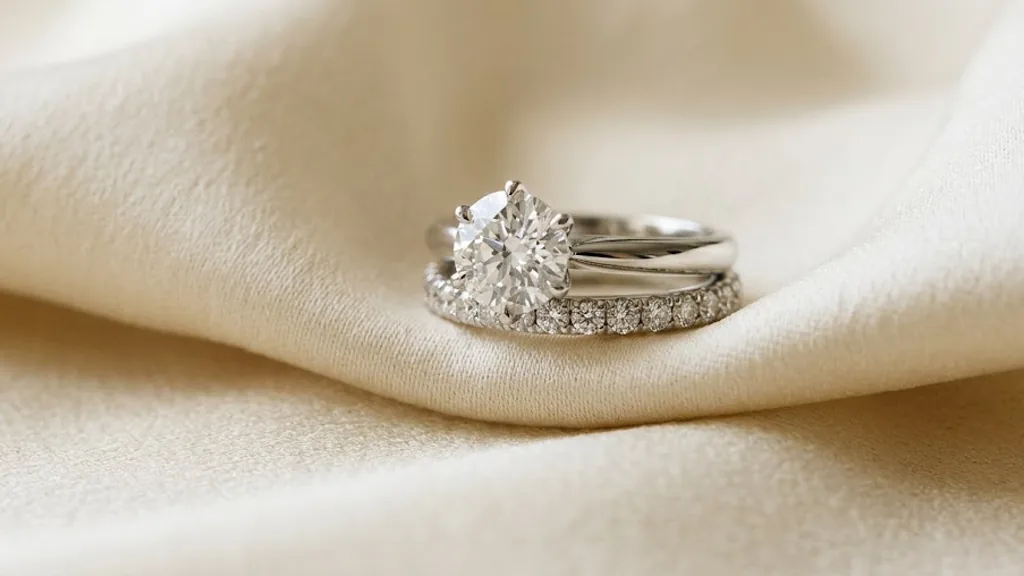
The short answer is that the wedding band usually goes on first, closest to your hand, with the engagement ring sitting above it. But that is a custom, not a rule, and there are good practical reasons why some people do the opposite. Here is how it works, why the tradition exists, and how to make two rings sit together comfortably without one wearing the other down.
The traditional order: wedding band first, engagement ring on top
In the UK, the usual order is:
- The wedding band goes on the ring finger first, sitting nearest the knuckle-side of your hand.
- The engagement ring goes on afterwards, sitting above the band, further up the finger.
The reason is simply the order of the ceremony. On the wedding day, many people move the engagement ring to the other hand for an hour or so. The band is then placed on a bare finger during the vows, and the engagement ring goes back on top afterwards. The band ends up closest to the hand and stays there.
The romantic explanation you will hear is that the wedding band sits “closest to the heart”. It is a lovely line, and it is the reason the custom stuck, but it is folklore rather than anything you are obliged to follow.
Do you wear the wedding band under the engagement ring?
Yes, in the traditional arrangement the band sits underneath. “Underneath” here means closer to your palm and knuckle, not physically below in any structural sense.
There is a practical benefit too. The engagement ring is normally the taller of the two, with a raised centre stone. When it sits on the outside, you can slide it off on its own — for cleaning, for gardening, for a swim — while the plain band stays put. If the band were on top, you would have to remove both.
Plenty of people wear them the other way round because they prefer the look, or because their band is the more decorative of the two. Nothing goes wrong if you do.
Which hand, which finger
In the UK, Ireland, the US, Australia and much of Western Europe, both rings go on the fourth finger of the left hand. In Germany, Norway, Poland, Russia and several other countries, the wedding band traditionally goes on the right hand instead.
If you are left-handed and find the rings take a beating, swapping to the right hand is a perfectly reasonable thing to do. Many people do it and it raises no eyebrows.
The realistic options, compared
There is no single correct arrangement. These are the ones we see most often, and what each one is genuinely good for.
| Arrangement | How it looks | Best if | Watch out for |
|---|---|---|---|
| Band below, engagement ring on top (traditional) | Engagement ring is the star; band frames it from beneath | You have a raised solitaire or halo setting | Nothing much — this is the default for good reason |
| Engagement ring below, band on top | Band becomes the visible outer ring | Your band is a diamond eternity band you want on show | You must remove both rings to take the engagement ring off |
| Band on the other hand | Two separate rings, two hands | The two rings clash in style or metal, or the stack feels bulky | Some people find a lone band on the right hand reads as unusual in the UK |
| Stacked with a third ring | Band, engagement ring, then an eternity or anniversary band above | You want to add a ring later for an anniversary or a birth | Three rings rub against each other; expect faster metal wear |
| Engagement ring only, band kept for occasions | One ring day to day | Your job involves gloves, tools or frequent hand washing | Store the spare ring properly, not loose in a drawer |
Getting the two rings to sit flush
The most common complaint is a gap. The engagement ring has a raised setting, or a shank that widens where the stone sits, and the wedding band cannot get close to it. The result is a visible wedge of daylight between the two rings, and the band tends to rock and spin.
There are three ways to solve it.
A curved band. This is a band with a gentle U-shape cut into it so it nests around the base of a solitaire or a pear-shaped stone. Our Curved Round Cut Wedding Band in Yellow Gold is the classic version of this — a soft arc that closes the gap without drawing attention to itself.
A chevron or V-shaped band. A sharper angle, which suits marquise, pear and other pointed stones where a soft curve is not enough.
Buying the pair together. A bridal set is an engagement ring and a matching band designed as one piece, so they meet perfectly with no gap and no compromise. Our Curved Pear Cut Bridal Set is a good example. If you are still choosing, our full range of bridal sets is worth a look before you commit to buying two rings separately.
If you already own the engagement ring and want a straight band to sit alongside, a slim diamond band works well because the narrower profile forgives a small gap. Something like our Stackable Baguette Cut Half Eternity Band sits low and reads as part of the same ring rather than an addition to it.
How to build a stack that still looks intentional
Stacking has become popular, and it is easy to end up with three or four rings that fight each other. A few things genuinely help.
Keep the metals deliberate. Mixing yellow, white and rose gold can look wonderful, but it needs to look chosen. Two metals reads as a decision. Four reads as an accident.
Vary the width, not the height. A slim band next to a wider one creates rhythm. Two tall settings next to each other just catch on jumpers.
Put the tallest ring in the middle or at the top. If a raised centre stone sits between two flat bands, it is protected on both sides and less likely to snag.
Leave room to grow. Many people add an eternity band for an anniversary or the birth of a child. If you like the idea, leave one slot free rather than filling the finger now.
The wear-and-tear question nobody mentions
Two rings on one finger rub against each other, thousands of times a day. Over years, that shows. Softer metals wear faster, so a 9ct gold band against a platinum ring will lose material first. Diamond-set edges can also scratch the plain metal beside them, because diamond is far harder than gold.
This is normal and it is not a fault. It is worth knowing about because it affects two things:
- Thinning shanks. After ten or fifteen years, a well-worn band may need a new section of metal fitted to the bottom. A jeweller calls this reshanking. It is routine work.
- Resizing. If your finger size changes and both rings need adjusting, the type of ring matters enormously. A plain band is straightforward. A full eternity ring set with diamonds all the way round usually cannot be resized at all. We cover this properly in can eternity rings be resized, and the workshop side of it in how jewellers resize wedding rings.
If your rings are white gold, there is one more thing to know: white gold is plated with rhodium to give it that bright white finish, and the plating wears off with time — faster where two rings rub. Our guide to cleaning a white gold wedding ring explains what to expect and when re-plating is due.
Frequently asked questions
Do you wear the wedding band first, then the engagement ring?
Traditionally yes. The band goes on first so it sits closest to your hand, and the engagement ring goes on above it. If you prefer the other order, wear it that way — no rule is being broken.
Should the two rings be the same metal?
They do not have to be. Mixing metals is a genuine style choice and looks intentional when the shapes relate to each other. The one thing to consider is wear: a much softer metal beside a much harder one will show wear sooner.
What if my rings leave a gap?
A curved or chevron band solves it, or a jeweller can add small metal beads inside the shank so the rings sit tight against one another. Buying a matched bridal set avoids the problem entirely.
Can I wear my engagement ring on its own after the wedding?
Absolutely. Many people wear only the engagement ring day to day and add the band for occasions, or wear only the band at work and both at weekends. Neither choice means anything about the marriage.
Which finger does the engagement ring go on before the wedding?
The same one — the fourth finger of the left hand in the UK. It simply moves up the finger when the band joins it.
Choosing a band that works with your ring
If you are looking for a band to pair with a ring you already own, take the engagement ring with you or send us clear photographs from the side. The side profile is what determines whether a straight band will sit flush or need a curve.
Every Carbonstone piece is hand-made in solid gold or platinum with lab-grown diamonds, and every centre stone comes with a free IGI certificate. Our wedding rings and engagement rings can all be made to your finger size from the start, and bespoke work carries no extra design cost — so if you need a band shaped precisely around your existing ring, we can make one. Delivery across the UK is free and insured, with 30 days to return.
Wear the two rings in whatever order feels right on your hand. The tradition is a nice story, not an instruction.
More guides on this topic
Ready to find your perfect ring?
Explore our lab-grown diamond collection or book a virtual appointment with our team.