How Much Is a 1 Carat Emerald Cut Diamond Worth?
A 1 carat emerald cut has three different values: purchase price, insurance value and resale. Here are all three, honestly.
“Worth” is a slippery word when it comes to diamonds, because a 1 carat emerald cut has three different values at the same time. There is what you pay for it, what it would cost to replace, and what someone would hand you for it if you sold it tomorrow. Those three numbers are nowhere near each other.
Most articles only tell you the first one. Here you get all three, plus the reasons behind them, in language that assumes you have never bought a diamond before.
What is an emerald cut diamond, briefly?
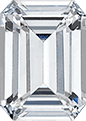
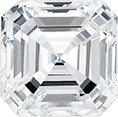
An emerald cut is a rectangular diamond with its corners cut off and long, straight, flat facets running down the stone in steps. Facets are the polished flat surfaces cut into a diamond.
Because those facets are long and open rather than tiny and triangular, an emerald cut does not glitter like a round diamond. It flashes broad panels of light instead — an effect often called the hall of mirrors. It looks calm, elegant and architectural.
One consequence matters enormously for value: an emerald cut is see-through. Tiny internal marks and faint yellow warmth that would disappear inside a sparkly round are clearly visible in an emerald cut. So the grades on the certificate carry more weight, and they move the price more.
Value one: how much does a 1 carat emerald cut cost to buy?
The single biggest factor is whether the diamond is lab-grown or natural.
A lab-grown diamond is a real diamond. Identical carbon crystal, identical hardness, identical sparkle. The difference is that it formed in a laboratory over a few weeks instead of underground over millions of years. You cannot tell by looking; it takes specialist equipment.
Here is guide pricing for the loose stone alone, before any ring is made around it.
| Grade of 1 carat emerald cut | Lab-grown (guide) | Natural (guide) |
|---|---|---|
| Lower grades — visible warmth or marks | £150 – £280 | £2,000 – £3,500 |
| Good everyday quality — clean to the eye | £280 – £500 | £3,800 – £6,500 |
| Top colour and clarity | £500 – £850 | £7,000 – £14,000 |
Diamond prices move, and lab-grown prices have fallen substantially over recent years, so treat these as a sense of scale rather than a quote. The pattern is what matters: the same stone in lab-grown costs a small fraction of the natural equivalent.
Why does the finished ring cost more than the stone?
People are often surprised that a £400 stone becomes a £900 ring. The stone is genuinely only one line on the bill.
- Metal. Solid 14ct or 18ct gold, or platinum. Platinum costs more because it is denser, so the same ring simply contains more grams of it, and it is harder to work.
- Making. A hand-made setting takes real bench hours. Emerald cuts need claws shaped to grip flat corners securely, which is fiddlier than gripping a round.
- Certification. An independent laboratory report on the centre stone.
- Hallmarking, finishing and quality checks.
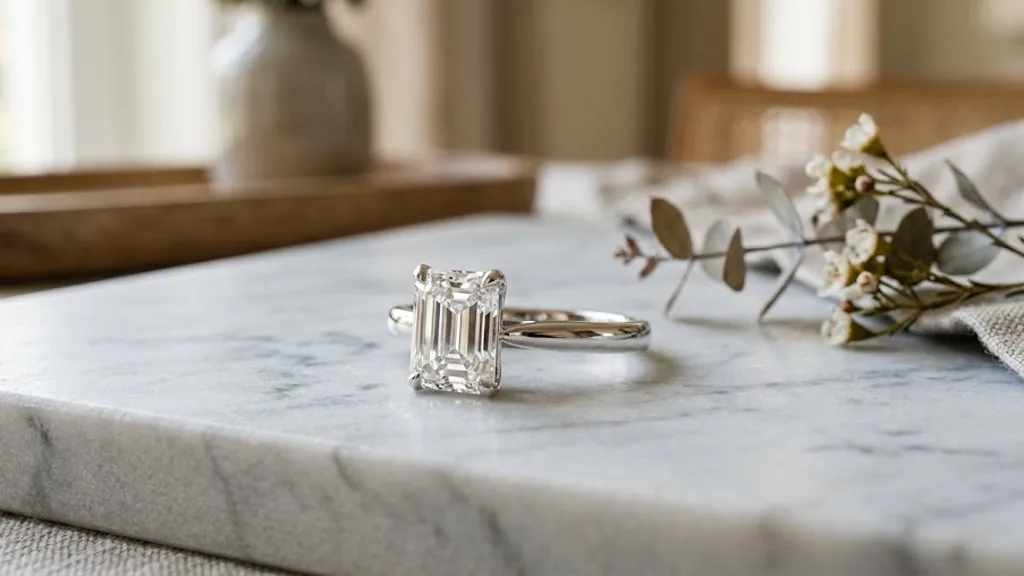
As a real example, our Solitaire Emerald Cut Engagement Ring is £672 as a complete, hand-made, certified ring. Step up to the Hidden Halo Emerald Cut Engagement Ring at £1,016 and the extra is almost entirely setting work — a hidden halo is a ring of tiny diamonds tucked underneath the centre stone, invisible from above, which lifts it and adds sparkle from the side. That is dozens of extra stones, each set by hand.
So when comparing quotes, always ask what the setting costs separately from the stone. Two rings with the same 1 carat emerald cut can differ by hundreds of pounds purely on how they are made.
What drives the price of the stone itself?
Colour
Graded D (completely colourless) through the alphabet as warmth creeps in. Emerald cuts show colour early because you are looking straight through them. For white gold or platinum, aim for D to G. In yellow or rose gold you can go lower, because the metal casts warmth into the stone anyway.
Clarity
This describes tiny natural marks inside the stone, called inclusions. Round diamonds hide them under sparkle. Emerald cuts do not. VS1 or VS2 is the sensible target. Below that, ask to see the clarity plot on the certificate — a small map showing exactly where the marks sit — because position matters more than the grade letter.
Length-to-width ratio
How long the rectangle is compared with how wide. Around 1.40 to 1.50 is the classic emerald cut. Below 1.30 it looks square and stocky. Above 1.60 it looks long and slim. Ratio changes how big the stone looks, so it genuinely affects what you get for your money.
Polish and symmetry
Emerald cuts are not given the overall cut grade that rounds receive, so polish and symmetry are your quality signals. In a step cut, poor symmetry is obvious — the parallel lines stop looking parallel and the flashes look untidy. Insist on Very Good or Excellent for both.
Value two: what is the insurance replacement value?
This is the figure a valuer writes on a certificate for your insurer. It is usually higher than what you paid, sometimes considerably.
That is not a valuer being generous. Replacement value is what it would cost to have an equivalent ring made at full retail, at some unknown point in the future, possibly at a different jeweller, with prices that may have moved. Insurers deliberately work from that worst case.
Two practical points. Insure for replacement value, not what you paid. And get the valuation reviewed every few years, because metal prices in particular do not stand still.
Value three: what would you get if you sold it?
Here is the part the industry is quietest about, so let us be direct.
If you sell a diamond ring, you will get considerably less than you paid. That is true for natural diamonds and lab-grown diamonds alike. The reasons are the same reasons a new car loses money the moment it leaves the forecourt: you paid retail, and a buyer will only pay wholesale, because they need to make a margin on reselling it.
A dealer buying your ring is paying for the stone at trade prices and often valuing the setting as scrap metal by weight. All the hand-making you paid for is simply gone from the calculation.
With lab-grown diamonds there is an additional factor: production costs have fallen year on year, so a new equivalent stone is cheaper today than it was when you bought yours. That compresses second-hand values further.
The honest conclusion is the same one a good jeweller has always given. Buy a ring because you want to wear it every day for the next forty years, not as an investment. Diamonds of every kind are a purchase, not an asset. If you approach it that way, lab-grown makes enormous sense: you get a bigger, better stone for the same money, and you were never going to sell it anyway.
How do you get the most from a 1 carat emerald cut?
- Buy just under the round number. A 0.95 carat stone costs noticeably less than a 1.00 carat one and looks identical.
- Prioritise clarity and symmetry over the last colour grade. In a step cut, a clean, tidy stone reads better than a whiter but messier one.
- Choose a longer ratio. A 1.50 ratio emerald cut spreads further along the finger than a squarer one of the same weight.
- Let the setting do some work. A slim band or a hidden halo makes the centre stone look larger for far less than a bigger diamond would cost.
- Add step-cut stones alongside it. A matching band like the Stackable Emerald Cut Half Eternity Band continues the clean parallel lines and makes the whole hand look more considered.
Frequently asked questions
How big does a 1 carat emerald cut look?
A well-proportioned one measures roughly 7mm long by 5mm wide. Because the top surface is large and open, it generally looks bigger on the finger than a 1 carat round, which is about 6.5mm across.
Is a lab-grown emerald cut worth less than a natural one?
It costs far less to buy, yes. Visually they are identical when cut to the same grades. Resale on both is poor relative to what you paid, so the practical question is which one gets you the ring you actually want.
What clarity do I need for a 1 carat emerald cut?
VS2 as a working minimum, VS1 if you want to stop worrying about it. At 1 carat the stone is small enough that inclusions have less room to show than in a 2 or 3 carat stone, but the step-cut window still hides nothing.
Will my ring be worth more in ten years?
Almost certainly not in resale terms. Gold and platinum prices may rise, which lifts the scrap value of the metal slightly, but the diamond and the craftsmanship will not appreciate. Buy for the wearing, not the reselling.
Should I insure it separately?
Usually yes. Many home insurance policies cap individual items at a low value and may not cover the ring away from home. A named-item policy with an up-to-date valuation is the safer route.
Where can you see emerald cut rings and their prices?
The emerald cut is one of those shapes that people either love instantly or never quite warm to, and the only way to find out which you are is to look at a few. Have a wander through our emerald cut collection to see the shape in different settings, or the wedding ring collection if you are looking for something to sit alongside a ring you already own.
Everything is hand-made to order in solid gold and platinum from our workshop in North Harrow, London, with a free IGI certificate on every centre stone, free insured UK delivery and 30 days to return it. If you want a particular carat weight, ratio or grade, our bespoke service carries no extra design cost — tell us your budget and we will show you honestly what it buys.
More guides on this topic
Ready to find your perfect ring?
Explore our lab-grown diamond collection or book a virtual appointment with our team.