Is Colour or Clarity More Important in an Oval Diamond?
Colour matters more than clarity in an oval diamond. Here are the grades to aim for, and why the shape changes the answer.
Oval diamonds are one of the most requested shapes we cut and set at CarbonstoneUK, and they come with a question we hear almost every week: if the budget only stretches so far, should you spend it on a better colour grade or a better clarity grade?
The short answer for an oval is that colour usually matters more than clarity — but only up to a point, and for reasons that are specific to how an oval is cut. Below, we explain both grading scales in plain words, show you where the sensible cut-off points sit, and tell you exactly where we would put the money.
First, what do “colour” and “clarity” actually mean?
Every certified diamond, lab-grown or mined, is graded on four things — cut, colour, clarity and carat weight. Two of those are the ones people agonise over.
Colour measures how little colour a diamond has. Confusingly, the best grade means no colour at all. The scale runs from D (completely colourless) down to Z (a clearly visible pale yellow or brown tint). It is graded face-down against master stones under controlled lighting, not face-up in daylight, which is why a diamond can look far whiter in real life than its letter suggests.
Clarity measures the tiny natural marks inside and on the surface of a diamond. Those internal marks are called inclusions — think of a minute crystal, a feather-like fracture, or a small cloud. Surface marks are called blemishes. Every diamond, including lab-grown ones, forms with some. The clarity scale runs from Flawless down to Included.
The two scales, explained without the jargon
| Grade | Scale | What it actually means |
|---|---|---|
| D, E, F | Colour | Colourless. Icy white. No tint, even next to a whiter stone. |
| G, H | Colour | Near colourless. Looks white on its own and on the hand. The sweet spot for value. |
| I, J | Colour | Near colourless, faint warmth. Often invisible in yellow or rose gold, more noticeable in platinum. |
| K to Z | Colour | Visible warmth that increases down the scale. A deliberate choice, not a compromise. |
| FL, IF | Clarity | Flawless / Internally Flawless. Nothing visible under 10x magnification. |
| VVS1, VVS2 | Clarity | Very, very slightly included. A trained grader struggles to find anything at 10x. |
| VS1, VS2 | Clarity | Very slightly included. Easy for a grader at 10x, invisible to you. |
| SI1, SI2 | Clarity | Slightly included. Obvious at 10x. SI1 is usually clean to the eye; SI2 is a gamble. |
| I1, I2, I3 | Clarity | Included. Visible without magnification, and often affects sparkle. |
Note the spelling on the certificate itself: a formal IGI report says “Color”, using the American spelling. That is normal and not a sign of anything odd.
Why colour is the bigger worry in an oval
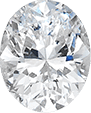
An oval is an elongated brilliant cut. It has the same style of triangular and kite-shaped facets as a round brilliant, just stretched into a long shape. That stretch does two things.
It spreads the stone out. An oval looks bigger than a round of the same carat weight because more of its surface faces upward. Bigger face-up area means more room for any body colour to show, and more room for an inclusion to sit somewhere you can see it.
It concentrates colour at the ends. Light travels further through the long axis of an oval, and any faint warmth tends to gather at the two pointed ends. On a round diamond, tint is spread evenly and is much harder to spot. On an oval, a J colour can show a whisper of warmth at the tips that the same grade in a round would hide completely.
Clarity, meanwhile, gets a bit of help. All those brilliant-cut facets throw light in every direction, and that busy sparkle is very good at camouflaging small inclusions. An SI1 inclusion that would be obvious in a flat, open cut can vanish inside an oval’s flash.
So where should you actually draw the line?
These are the ranges we recommend to customers day to day. Treat them as guidance for a typical engagement-ring size, not as hard rules — every stone is individual and we always check face-up before we set anything.
| What you want | Colour to aim for | Clarity to aim for |
|---|---|---|
| Oval under 1 carat, any metal | G to H | VS2 or SI1 |
| Oval 1 to 2 carats, white gold or platinum | F to G | VS2 |
| Oval 1 to 2 carats, yellow or rose gold | G to I | VS2 or SI1 |
| Oval over 2 carats | E to G | VS1 to VS2 |
| Oval in a halo or hidden halo setting | G to I | VS2 or SI1 |
Two things fall out of that table. First, the colour recommendation tightens as the stone grows, while the clarity recommendation barely moves. That is the whole argument in one line. Second, your metal choice changes the answer. A warm yellow gold setting reflects into the diamond and makes an I colour look perfectly white — so if you have your heart set on yellow gold, you can drop a colour grade and put the saving into size.
Where the money is best spent
If you have a fixed budget, we would order it like this for an oval:
1. Cut quality first. Not a grade on the certificate for most fancy shapes, but the single biggest factor in how a stone looks. A badly proportioned oval shows a dark band across the middle — the bow tie — and no colour or clarity grade will rescue that. Always look at the stone face-up.
2. Colour second. Stay at H or better for a white metal setting. This is where an oval will let you down if you push too far.
3. Clarity third. VS2 is genuinely all most people need. Paying for VVS or Flawless in an oval buys you something only a grader with a loupe will ever see.
4. Carat weight last, using whatever is left. Ovals already wear larger than their weight, so you get a head start here.
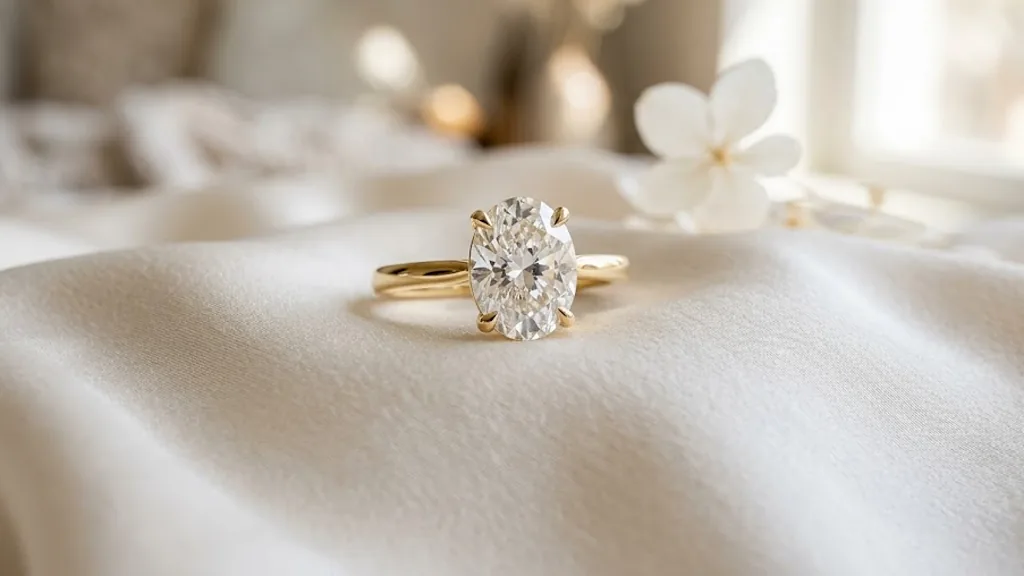
Our Solitaire Oval Cut Engagement Ring is the clearest illustration of this thinking — a plain band puts every bit of attention on the stone, so colour is doing the heavy lifting and there is nowhere for a poor centre stone to hide. Prices start from around £557.
If you would rather relax the colour grade and spend on presence instead, a surrounding frame of small diamonds helps enormously. The Hidden Halo Oval Cut Engagement Ring tucks a ring of tiny stones underneath the centre diamond, which lifts the apparent whiteness from below without changing the look from above. The Three Stone Oval Cut Engagement Ring does something similar by flanking the oval with two more stones, so the eye reads the whole row rather than scrutinising one surface.
You can see everything we currently hold in this shape in our oval diamond collection, or browse the full engagement ring range if you are still deciding on shape.
How this differs from a round diamond
If you are weighing an oval against a classic round brilliant, the balance shifts. A round’s symmetrical facet pattern hides both tint and inclusions more effectively than any other shape, which means you can be a little braver on both grades and still get a stone that looks flawless on the hand. We covered that shape in detail in Is Colour or Clarity More Important in a Round Diamond? — worth a read if you have not settled on a shape yet.
Frequently asked questions
Will anyone notice the difference between a G and an H oval?
Side by side, under bright jeweller’s lighting, a trained eye might. On a hand, in a restaurant, at a wedding — no. The gap between adjacent colour grades is deliberately small. The gap you can see is usually two or three grades, which is why we suggest a range rather than a single letter.
Is SI1 safe in an oval?
Often, yes, and that is one of the advantages of a brilliant-cut shape. But SI1 is a band, not a promise. It depends on where the inclusion sits — one under the table, in the middle of the stone, is far more visible than one tucked near the edge where a claw can cover it. We check every SI stone face-up before it goes into a setting and will tell you honestly if it is not clean to the eye.
Does the same advice apply to pear and marquise diamonds?
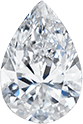
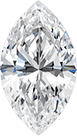
Broadly, yes. Pear and marquise are also elongated brilliants, so they share the oval’s tendency to gather warmth at the points. If anything, be slightly stricter on colour with a marquise, because it is the longest and narrowest of the three.
Do lab-grown diamonds get graded the same way?
Yes. The lab-grown diamonds we use are graded on exactly the same D-to-Z colour scale and the same Flawless-to-Included clarity scale, by the same independent laboratories. Every centre stone we set comes with a free IGI certificate so you can read the grades yourself rather than take our word for them.
What if I want a colour and clarity combination you do not have in stock?
Then we make it. Every piece we sell is hand-made in solid gold or platinum in North Harrow, London, and bespoke work carries no extra design cost. Tell us the shape, the grades and the budget, and we will source and set the stone.
If you are still torn, the honest advice is this: pick the highest colour grade your budget allows, settle at VS2 for clarity, and put every remaining pound into a well-cut stone. That order will serve you better in an oval than any other. Every ring ships with free insured UK delivery and comes with 30 days to change your mind — and if you would like a second opinion before you commit, just ask.
More guides on this topic
Ready to find your perfect ring?
Explore our lab-grown diamond collection or book a virtual appointment with our team.