
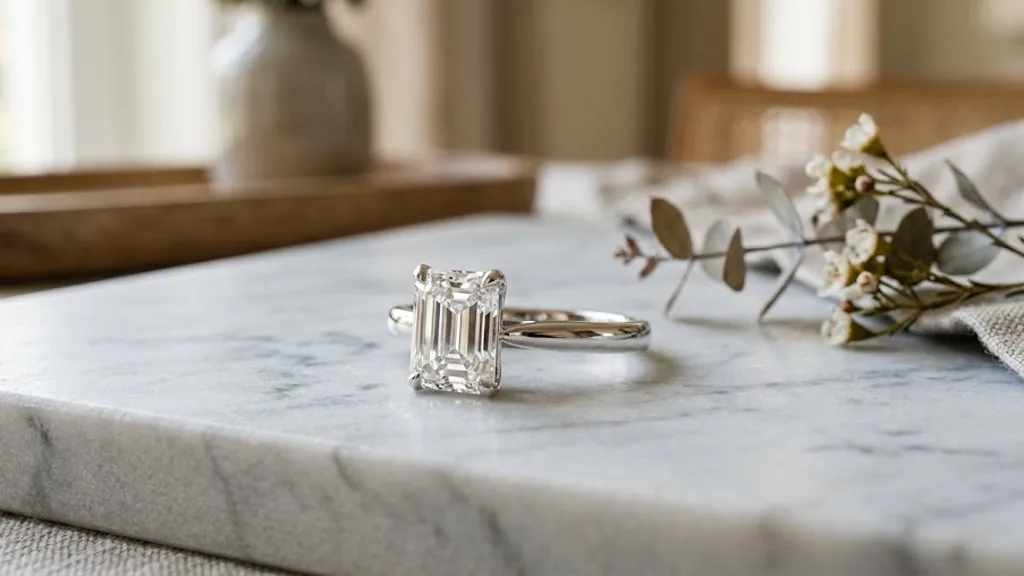
Why Are Emerald Cut Diamonds Cheaper?
Emerald cuts cost less per carat than round diamonds. Here are the four real reasons why, and the one grade you must not economise on.
Shoppers notice it quickly: put an emerald cut and a round diamond side by side at the same carat weight, same colour and same clarity, and the emerald cut is usually the cheaper of the two. It is not a discount, and it is not a sign of lower quality. It comes down to how the shape is cut, how much of the original crystal survives the process, and how many people are queuing up to buy it.
Reason one: less of the rough crystal is wasted
Diamonds arrive at the cutter as rough crystals — irregular lumps that have to be sawn and polished into a finished shape. Every gram removed is gone for good, and the buyer of the finished stone effectively pays for the waste.
A round brilliant is the hungriest shape there is. Turning an angular crystal into a perfect cone with 57 facets throws away a large share of the rough. An emerald cut is a rectangle with straight sides and cropped corners, which sits much more naturally inside the shape of a typical crystal. Less rough is lost, so the finished stone costs less per carat.
The same logic explains why pear, marquise and oval cuts also tend to undercut rounds, though usually by less than emerald cuts do.
Reason two: it is a step cut, not a brilliant cut
This is the part most buyers have never had explained.
A brilliant cut — the round, the oval, the pear — uses lots of small triangular and kite-shaped facets arranged to bounce light around inside the stone and fire it back at your eye. That is what produces the flashing, crushed-ice sparkle.
A step cut — the emerald, the baguette, the Asscher — uses long, straight, parallel facets that run around the stone like steps on a staircase. Instead of scattering light, they reflect it in broad flashes, like light moving across a sheet of glass. Jewellers call the effect the “hall of mirrors”.
Cutting a step cut takes fewer facets and less polishing time than a round brilliant. Less labour means lower cost. It also means the shape is far less forgiving: with those wide open facets you can see straight into the stone, so a poorly chosen emerald cut shows its flaws immediately. The saving is real, but it comes with a condition attached, which we will come back to.
Reason three: demand, plain and simple
Round brilliants dominate engagement ring sales worldwide. When one shape absorbs that much demand, its price per carat holds up. Emerald cuts have a devoted following but a smaller one, and shapes with smaller followings price more keenly. Nothing about the stone itself is inferior — you are simply not bidding against as many people.
Reason four: emerald cuts look bigger for their weight
Strictly this is not a discount, but it means your money buys more visible diamond.
Carat is a measure of weight, not size — one carat is 0.2 grams. Millimetres (mm) measure actual length across the top of the stone, which is what your eye registers. Emerald cuts hold less of their weight in a deep belly beneath the setting and spread more of it across a broad, flat top.
| Carat weight | Emerald cut, typical size | Round brilliant, typical diameter |
|---|---|---|
| 0.50 ct | 6.0 x 4.0mm | 5.0mm |
| 1.00 ct | 7.0 x 5.0mm | 6.5mm |
| 1.50 ct | 7.5 x 5.5mm | 7.4mm |
| 2.00 ct | 8.5 x 6.5mm | 8.1mm |
| 3.00 ct | 9.5 x 7.5mm | 9.3mm |
At every weight the emerald cut is the longer stone. Set with its length running along the finger, it also has a slimming effect that many people prefer. So you pay less per carat and the carats you buy look larger. That combination is why emerald cuts are such good value.
The catch: where you must not economise
Because a step cut is essentially a window into the stone, two grades matter more here than they would in a round.
Clarity. Clarity describes tiny natural marks inside a diamond, called inclusions. A round brilliant’s sparkle hides them beautifully. An emerald cut does not hide anything. It is worth spending more of your budget on clarity with this shape and less on chasing extra weight.
Cut quality and symmetry. Those long parallel facets have to line up. If the steps are uneven, the hall-of-mirrors effect breaks up and the stone looks flat and dull. Emerald cuts do not get a standard cut grade the way rounds do, so read the symmetry and polish grades on the certificate, and look at the actual stone or a video of it.
Colour is more forgiving. In yellow or rose gold, a very slightly warm stone reads as perfectly white against the metal, and you can save real money there.
Does the same apply to lab-grown emerald cuts?
Yes, the cutting and demand logic works the same way, because a lab-grown diamond still arrives as a rough crystal that must be sawn and polished by hand. It is a real diamond, chemically identical to a mined one, simply grown in a controlled environment over weeks instead of forming underground. The shape savings stack on top of the much larger saving you make by choosing lab-grown in the first place.
Everything at CarbonstoneUK is lab-grown, and every centre stone comes with a free IGI certificate so you can check the clarity and symmetry grades that matter most for this shape.
Emerald cut pieces you can see today
Prices are correct at the time of writing:
- Solitaire Emerald Cut Engagement Ring — £672. The shape with nothing else competing for attention, which is exactly how step cuts look best.
- Stackable Emerald Cut Half Eternity Band — £770. A row of small emerald cuts across the front of the band; a very easy way to try the shape before committing to it as a centre stone.
- Stackable Emerald Cut Three Quarter Eternity Band — £1,074. The same idea carried three-quarters of the way round the finger, so it still reads as a full line of diamonds from every normal angle.
Browse the whole emerald cut range, or see how the shape works in a band alongside our other wedding rings.
Frequently asked questions
Is a cheaper emerald cut a lower quality diamond?
No. The price difference comes from cutting yield, labour and demand — not from the stone being inferior. A well-cut, high-clarity emerald cut is a superb diamond that simply happens to cost less per carat than a round.
How much cheaper are they, exactly?
It varies with the market, the grade and the individual stone, so any fixed percentage you read online should be treated with suspicion. The honest answer is that emerald cuts consistently sit below rounds of matching grade, and the way to find out by how much today is to compare two specific certified stones side by side.
Do emerald cuts sparkle less?
They sparkle differently. You get fewer, broader flashes rather than constant glitter. Many people prefer it — it looks calmer and more architectural. If you want maximum fire, a round or an oval will suit you better.
Are emerald cuts more likely to chip?
The cropped corners actually make them fairly robust; a pointed shape like a marquise or pear is more vulnerable. As with any diamond, the setting is what protects it, and a bezel or well-designed claws will look after it for a lifetime.
Which clarity grade should I aim for in an emerald cut?
Aim higher than you would for a round, and always look at the stone or a video rather than buying on the letters alone. We will show you the certificate and images for any stone before you decide.
If you like the look of a step cut but want reassurance before you buy, come and see one. We hand-make everything in solid gold and platinum in North Harrow, London, deliver free and insured across the UK, and give you 30 days to change your mind.
More guides on this topic
Ready to find your perfect ring?
Explore our lab-grown diamond collection or book a virtual appointment with our team.











