What Is the Difference Between Emerald Cut and Princess Cut Diamonds?
Emerald cut is a step cut with mirror-like flashes; princess is a brilliant cut that sparkles. Full comparison of size, clarity, cost and durability.
Emerald cut and princess cut are both angular, both modern-looking, and both frequently confused by first-time buyers. But they are opposites in almost every way that matters — one is built for calm reflections, the other for sparkle.
Here is the plain difference, what each one does well, and how to decide between them.
One honest note before we start: we do not stock princess cut rings. Our shapes are round, pear, emerald, marquise, cushion, oval, baguette, hexagon, heart, radiant, rose cut and asscher. We can make a princess cut as a bespoke commission, and we will tell you that rather than pretend otherwise.
The one-line difference
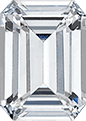
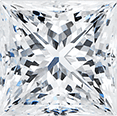
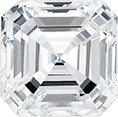
An emerald cut is a rectangle with clipped corners, cut in long steps. A princess cut is a square with sharp corners, cut in tiny triangles.
That is the whole thing. Everything else follows from it.
Step cut versus brilliant cut
This is the concept worth learning, because it explains most diamond shapes.
A step cut has long, flat, parallel facets arranged like the steps of a staircase. Light travels down them and bounces back in broad sheets. The effect is often called a “hall of mirrors” — you see clean flashes of light and dark rather than glitter. Emerald and asscher are step cuts.
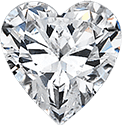
A brilliant cut has many small triangular and kite-shaped facets that scatter light in every direction. The effect is fine, rapid sparkle. Round, princess, cushion, oval, pear and marquise are all brilliant cuts.
So an emerald cut and a princess cut are not two versions of the same idea. They are the two opposite philosophies of diamond cutting.
Side by side
| Emerald cut | Princess cut | |
|---|---|---|
| Outline | Rectangle with the corners cut off | Square with sharp 90-degree corners |
| Faceting | Step cut — long parallel planes | Brilliant cut — many small facets |
| Light effect | Broad flashes, mirror-like | Bright, sharp, angular sparkle |
| Hides inclusions | Poorly — the open table shows everything | Well |
| Hides body colour | Poorly — warmth is visible | Moderately — corners show colour |
| Apparent size per carat | Larger — big flat top, elongated | Smaller — weight sits in the depth |
| Durability | Good — clipped corners are less fragile | Weakest at the four sharp corners |
| Character | Art deco, understated, architectural | Contemporary, geometric, bold |
| In our collection | Yes — around six designs | No — bespoke order only |
Clarity: the biggest practical difference
If you take one thing from this article, take this.
An emerald cut has a large open table — the flat top surface — and long clean facets. You are looking straight into the stone, and there is nowhere for a flaw to hide. A tiny inclusion that would vanish inside a princess cut is plainly visible inside an emerald cut.
In practice that means:
- Emerald cut: aim for VS2 clarity or better to be reliably eye-clean, meaning nothing visible without magnification.
- Princess cut: many SI1 stones are perfectly eye-clean, because the scattered sparkle disguises small marks.
Colour behaves the same way. An emerald cut shows warmth along its length, so G colour or better is the sensible target for a white look. A princess cut shows colour mainly at the corners and is more forgiving overall.
This is why an emerald cut ring can end up costing more than a princess cut ring even though emerald cuts price lower per carat — you buy higher grades to get a stone that looks clean.
Size on the finger
At the same carat weight, an emerald cut looks bigger. It has a large flat top and an elongated outline, so it covers more finger. A princess cut carries more of its weight downward into the depth of the stone, so less of it is visible from above.
As a rough guide at one carat: an emerald cut typically measures somewhere around 7mm long by 5mm wide, while a princess cut measures roughly 5.5mm along each side. Those are working approximations — your stone’s certificate gives the exact figures.
Durability and everyday wear
A princess cut’s four sharp corners are the thinnest points on the stone, and they chip. Any princess ring needs V-shaped prongs — small claws shaped like a V that wrap over each corner — or a bezel, which is a rim of metal around the whole stone. Without that protection it is a matter of when, not if.
An emerald cut has its corners clipped off already, which removes most of that risk. The corners still want covering by prongs, but they are far less delicate. For someone who works with their hands, that is a genuine point in the emerald cut’s favour.
Which should you choose?
Choose an emerald cut if you like clean lines, a quieter kind of glamour, a stone that looks larger for its weight, and a vintage or art deco feel. Be prepared to pay for good clarity.
Choose a princess cut if you want maximum sparkle in a square outline, a modern look, and a shape that is forgiving on clarity and colour. Accept that it needs a protective setting and looks smaller for its weight.
Choose an asscher if you want the emerald cut’s step-cut character in a square outline — it is essentially a square emerald cut, and it is one of the shapes we stock.
Our emerald cut rings
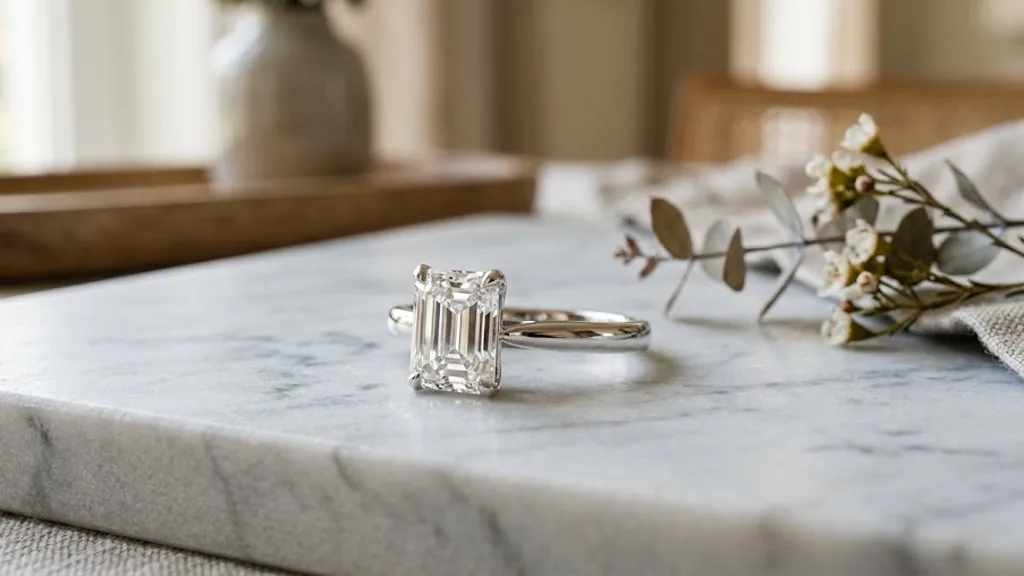
Every ring below is hand-made in solid gold or platinum with lab-grown diamonds. A lab-grown diamond is a real diamond — the same carbon crystal, hardness and optical behaviour as a mined stone, grown in weeks rather than formed underground. Every centre stone comes with a free IGI certificate, which matters more with emerald cuts than any other shape because clarity is doing so much of the work. Prices correct at the time of writing.
| Ring | Style | Price |
|---|---|---|
| Solitaire Emerald Cut Engagement Ring | Single stone, clean lines, nothing competing | £672 |
| Hidden Halo Emerald Cut Engagement Ring | Small stones set beneath the centre, seen from the side | £1,016 |
| Stackable Asscher Cut Wedding Band in Yellow Gold | Square step cuts — the closest square shape we stock | £1,416 |
Browse the whole emerald cut collection, or see the square step cut option in our asscher cut range.
Frequently asked questions
What is the difference between emerald cut and princess cut diamonds?
An emerald cut is a rectangle with clipped corners cut in long parallel steps, producing broad mirror-like flashes. A princess cut is a square with sharp corners cut in many small facets, producing bright sparkle. The emerald cut looks larger per carat and needs higher clarity; the princess cut sparkles more and hides flaws better but is fragile at the corners.
Which is more expensive, emerald cut or princess cut?
Per carat they sit at broadly similar levels, both below round, because both waste less rough crystal than a round does. In finished rings the emerald cut often ends up dearer, because buyers step up to higher clarity and colour grades to get a stone that looks clean.
Which sparkles more?
The princess cut, clearly. It is a brilliant cut designed to scatter light. An emerald cut is not trying to sparkle — it is trying to give you long clean flashes and a view into the stone.
Which looks bigger on the hand?
The emerald cut, at the same carat weight. Its large flat top and elongated shape cover more finger than a princess cut, which hides more of its weight in the depth.
Do you sell princess cut rings?
Not from stock, but we make them bespoke in solid gold and platinum with no extra design cost. You pay for the materials and the making. If you want a princess cut, send us the design and we will price it properly.
Both shapes are excellent; they simply answer different questions. If you want quiet and architectural, go emerald. If you want bright and geometric, go princess. Every order includes free insured UK delivery and 30 days to return, so you can see which one actually suits the hand.
More guides on this topic
Ready to find your perfect ring?
Explore our lab-grown diamond collection or book a virtual appointment with our team.