Do Diamonds Reflect Rainbow Colours? Diamond Fire Explained
Yes, diamonds throw rainbow flashes. What dispersion really is, how cut and lighting change it, and why the fake-diamond myth is wrong.
Yes — diamonds do reflect rainbow colours. Every genuine diamond splits white light into coloured flashes, and it has done so since long before anyone invented a diamond simulant.
The reason this question comes up so often is a piece of advice that circulates endlessly online: “if it flashes rainbows, it’s fake.” That advice is wrong, and it has talked plenty of people out of perfectly good stones. Here is what is actually happening inside a diamond, and how to read it properly.
The proper name for it: dispersion
White light is not one colour. It is every colour of the spectrum travelling together.
When light passes from air into a transparent material, it bends. Crucially, each colour bends by a slightly different amount — violet bends most, red bends least. So the colours that entered as one white beam leave the material spread out as a fan.
That spreading is called dispersion. It is exactly what a glass prism does. Diamond does it too, and the jewellery trade has a nicer word for the result: fire.
How much fire does a diamond have?
Dispersion is a measured optical constant for each material, published in standard gemmological references. It is not a marketing figure. Diamond sits in the middle of the pack:
| Material | Dispersion value | What that means in practice |
|---|---|---|
| Sapphire | 0.018 | Very little coloured flash |
| Diamond | 0.044 | Clear coloured sparks, balanced against strong white brightness |
| Cubic zirconia | 0.060 | More colour than diamond, less overall brightness |
| Moissanite | 0.104 | Roughly two and a half times diamond’s coloured flash |
Read that table again and the popular myth collapses. Moissanite does not show rainbows instead of diamond — it shows more of the same thing diamond already does.
Fire is only one third of sparkle
Jewellers break down what you see into three separate effects. Understanding them makes it far easier to say what you actually like.
- Brilliance — the white light bounced straight back to your eye. This is the bright, clean flash that makes a diamond look luminous.
- Fire — the coloured flashes described above.
- Scintillation — the flickering pattern of light and dark as the stone, the light or your head moves. It is what makes a diamond look alive rather than like a bright piece of glass.
A good diamond gives you all three. A stone that shows colour but no punch of white usually is not a diamond. A stone that shows white but no colour is often a diamond that has been cut badly, or one you are looking at under the wrong light.
The lighting matters more than most people realise
Take the same ring into four rooms and you will see four different stones.
- A single spotlight, a candle or direct sun. These are point sources. The coloured fans stay separate on the way to your eye, so you see maximum rainbow.
- An overcast sky or a big office ceiling panel. These are diffuse sources. Light arrives from every angle at once, the colour fans overlap, and they average back to white. Very little fire.
- Restaurant or evening lighting. Usually a handful of small warm bulbs — the most flattering light there is for fire.
- A phone camera. Cameras average fast-moving flashes and often lose the colour completely, which is why rings look flat in photos.
Jewellery displays use many small bright spotlights because that is the lighting fire needs. Ask to see any ring away from the case before you decide.
Cut controls fire more than anything else
Two diamonds of identical carat weight, colour and clarity can look completely different, because of how they were cut.
Light needs to enter through the top of the stone, bounce off the back facets and leave through the top again. If the stone is cut too deep, light drops out of the bottom and the middle goes dark. Too shallow, and it leaks through the base, leaving a flat, watery look.
Facet size also changes the character of the fire. Larger facets throw fewer, bigger, bolder coloured flashes. Many small facets throw lots of tiny sparks that read almost as glitter. Neither is better — but they look very different on a hand.
Shapes ranked by how much rainbow they throw
Cutting style makes a real difference to fire.
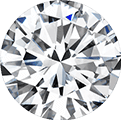
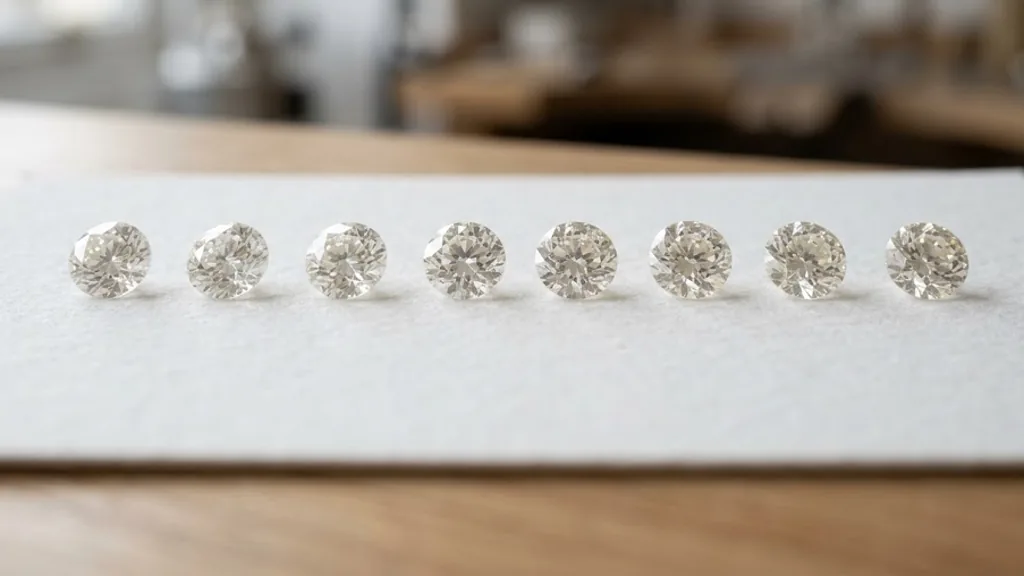
- Round brilliant — the most fire and brilliance of any standard shape, because the facet pattern was mathematically worked out to maximise light return. Our Solitaire Round Cut Engagement Ring in Platinum is the simplest way to see the effect uninterrupted, at £657 correct at the time of writing.
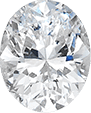
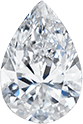
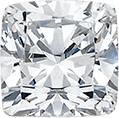
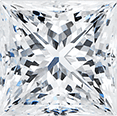
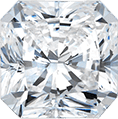
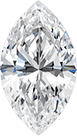
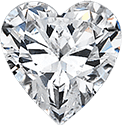
- Pear, oval, marquise, heart, cushion, radiant — all brilliant-style facet patterns, all lively, each with its own personality. Marquise and pear tend to flash in long streaks along the stone.
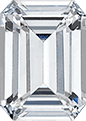
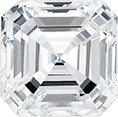
- Emerald, asscher and baguette — step cuts. Long parallel facets act like a hall of mirrors, giving broad slow flashes of white rather than rapid coloured sparks. If sudden rainbows are not your taste, this is the family to look at. A Stackable Baguette Cut Half Eternity Band shows the calmer effect across a whole row, at £672 correct at the time of writing.
- Pavé and vintage settings — tiny accent diamonds add dozens of extra small fire sources around the centre stone. Our Vintage Round Cut Engagement Ring in Yellow Gold is a good example, at £1,051 correct at the time of writing.
You can compare the two families directly by browsing round against emerald, or look through all of our engagement rings.
Do lab-grown diamonds throw rainbows too?
Yes, identically. A lab-grown diamond has the same carbon crystal structure as a mined one, which means the same refractive index and the same dispersion value of 0.044. The physics does not know or care where the crystal formed.
So a lab-grown diamond gives exactly the same balance of white brilliance and coloured fire as a mined stone of the same cut. There is no visual tell, which is why identification is done by laboratory equipment reading growth features, not by looking at sparkle. Every centre stone we set comes with a free IGI certificate stating what it is.
Why your diamond has stopped showing colour
This is the most common worry we hear, and the cause is almost never the stone.
Fire needs light to get in. A film of hand cream, soap residue, sun cream and skin oil on the underside of the stone blocks the entry and exit path. The diamond has not changed; it has been coated.
Warm water, a drop of washing-up liquid and a soft baby toothbrush around the back of the setting, once a fortnight, brings it straight back. Rinse thoroughly and pat dry with a lint-free cloth. Avoid bleach and avoid chlorinated pool water, which attacks the alloys in gold rather than the diamond itself.
Can you spot a fake by the rainbows alone?
Honestly, no — not reliably, and not from across a counter.
Someone who looks at stones every day can often tell a large moissanite from a diamond by the sheer intensity of colour flash. But small stones, low light and unfamiliar cutting styles defeat even experienced eyes. Photographs and videos are worse still.
What actually identifies a stone is an electronic tester that reads both thermal and electrical conductivity, and a report from a recognised laboratory such as IGI or GIA. If a seller cannot produce a certificate for a centre stone, that tells you far more than the sparkle does.
Frequently asked questions
Do real diamonds sparkle rainbow or white?
Both, at the same time. White brilliance dominates, with coloured fire flashing through it. If you only see one of the two, look at the stone under a different light before drawing any conclusion.
Why does my diamond look more colourful than my friend’s?
Usually cut and shape. A round brilliant throws more fire than an emerald cut, a shallow stone behaves differently from a deep one, and pavé accent stones multiply the number of flash points. Body colour grade and clarity grade have very little to do with it.
Does a diamond glow in the dark?
No. It has no light of its own and can only return light that reaches it. Some diamonds glow blue under ultraviolet light — a separate property called fluorescence — but that needs a UV source, not darkness.
Is more fire always better?
No, it is a matter of taste. Plenty of people find heavy rainbow flashing looks artificial and prefer the quieter, glassy character of a step cut. Look at both before you decide which you actually like.
Will the fire fade over the years?
Not in the stone. Diamond is the hardest material there is and does not wear smooth or go cloudy in normal wear. What does wear is the metal — claws thin out over decades — so have the setting checked every couple of years.
Seeing it for yourself
Fire is one of the few things about a diamond that you genuinely have to see in person and in motion. No photograph does it justice, and no rule of thumb from social media will do the job for you.
All of our centre stones are lab-grown, IGI certified and hand-set in solid gold or platinum here in North Harrow, London. If you would like to compare a brilliant cut against a step cut before you commit, do get in touch — and if you have a design in mind that we do not stock, we create bespoke pieces at no extra design cost.
Ready to find your perfect ring?
Explore our lab-grown diamond collection or book a virtual appointment with our team.