What Do P1, P2 and P3 Mean on a Diamond Certificate?
P1, P2 and P3 are Pique clarity grades from older European reports, roughly I1 to I3. They are the lowest tier, and IGI does not use them on ours.
P1, P2 and P3 on a diamond certificate are Piqué clarity grades, an older European way of naming the lowest clarity band. Piqué is French, said pee-kay, and it means the inclusions inside the stone are visible without magnification. P1 shows the fewest of the three and P3 the most. They line up roughly with I1, I2 and I3.
What does a Pique grade actually mean on a report?
A Piqué grade on a report means the stone has inclusions you can see with your own eyes, with no loupe and no magnification. Piqué is the French word for pricked or spotted, and the trade shortened it to P. P1 is the cleanest of the three, P2 has more or larger inclusions, and P3 is the bottom, where the marks are obvious at arm’s length.
A loupe, for anyone meeting the word for the first time, is the small ten-times magnifier a jeweller holds to one eye. Grades above the Piqué band need one to see anything at all; a P grade does not. At the other end of the scale, the highest diamond clarity grades explained sets out Flawless, Internally Flawless and VVS1.
How do P1, P2 and P3 line up against I1, I2 and I3?
P1, P2 and P3 line up against I1, I2 and I3 as the same bottom band of the clarity scale, described in two different vocabularies. P1 sits roughly where I1 does, P2 near I2, and P3 near I3. Treat that as a rough guide and nothing more. No laboratory publishes an official conversion between the two, and two reports on one stone can disagree by a grade.
That approximation is the honest position, and it is worth saying plainly because a lot of jewellery listings state the conversion as though it were fixed. The table below sets the two vocabularies side by side with the plain meaning of each row, and it is a guide rather than an official mapping.
| Piqué grade | Closest familiar code | What you would see |
|---|---|---|
| P1 | Roughly I1 | Inclusions visible face-up if you look |
| P2 | Roughly I2 | Dark or white marks obvious at once |
| P3 | Roughly I3 | Heavy marks across the whole top facet |
| No P grade | SI1 and above | Usually clean to the naked eye |
Why does our certificate not show a P grade?
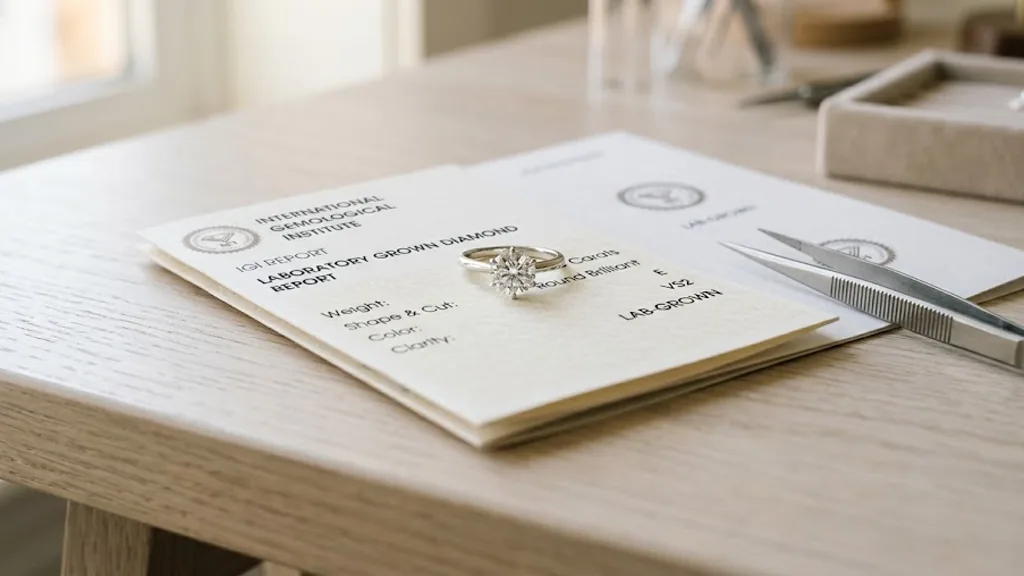
Our certificate never shows a P grade, because every centre stone we set is graded by IGI, and IGI uses the FL to I3 scale rather than the Piqué vocabulary. We also do not buy stones at that end of the scale in the first place. The lowest clarity we will put in a ring is one that stays clean to the naked eye once it is set.
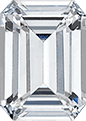
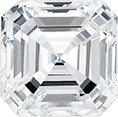
An emerald cut is the shape that punishes a low clarity grade hardest, because its long flat facets act like a window straight into the middle of the stone. Our solitaire emerald cut engagement ring is £672, correct at the time of writing, and the stone in it is picked to be clean face-up for exactly that reason.
Does GIA still grade lab-grown on the same scale?
GIA stopped grading lab-grown diamonds on the D to Z colour scale and the IF to I3 clarity scale on 1 October 2025. A lab-grown stone submitted to GIA now receives an overall assessment of Premium or Standard instead of letter and code grades. IGI still uses the familiar 4Cs scales, which is why our certificates are IGI. Neither laboratory puts a Piqué grade on our stones.
That change matters when you compare two certificates side by side, because a GIA report on a lab-grown stone and an IGI report on the same stone now say different kinds of thing. Certification is also one of the fixed costs that keeps a lab-grown price where it is, which why lab-grown diamonds still cost money sets out in full.
Where will you actually meet a P1 or P2 stone?
You will meet a P1 or P2 stone most often in second-hand jewellery, in older European reports, and in very cheap new rings sold on carat weight alone. An inherited ring with a continental paper is the common case we see across the bench. The second case is a large stone priced far below everything near it, where the clarity grade is the reason and the listing does not lead with it.
Clarity is also the grade people most expect to change how a stone sparkles, and it does not work that way. whether clarity changes how a diamond sparkles explains what actually creates brilliance. What a P grade does change is how the stone reads face-up in ordinary daylight, which is the thing you notice every day rather than once.
Which clarity grade should you buy instead of a P?
Buy a clarity grade that is eye-clean rather than one that is high on paper. SI1 and SI2 are where most sensible money goes, because a well-placed SI1 inclusion is invisible without a loupe and costs far less than a VS or VVS stone of the same size. Position matters more than the letter: a mark under a claw is hidden, and the same mark under the top facet is not.
Shape changes that advice more than most people expect. A round brilliant hides an inclusion better than a flat step cut does, while a hexagon, as what a hexagon cut diamond is explains, shows a wide open face that hides nothing. Our halo round cut engagement ring is £707, correct at the time of writing.
Every centre stone we set is lab-grown, IGI certificated at no extra cost, and chosen to be clean to the naked eye in the finished ring. You can see the grades we work with across the whole engagement ring collection, and we will read any certificate you send us, whether the ring came from us or not.
Frequently asked questions
Is P1 clarity good enough for a ring?
No, not for a centre stone we would sell. A P1 diamond has inclusions visible without magnification, so the stone reads grey or spotted in daylight rather than bright. It is a real diamond and it will not fall apart, but you can buy an eye-clean SI1 for the same money by dropping a little carat weight.
Which labs still issue Pique grades?
We will not name a laboratory here, because we cannot verify which ones still issue Piqué grades today. What we can say is where you meet them: older European reports, some non-IGI paperwork, and second-hand valuations. If a report in front of you carries a P grade, ask the issuing laboratory directly what it means on their scale.
Can you see a P2 inclusion without a loupe?
Yes. A P2 grade means the inclusions are visible to the naked eye, which is the whole point of the Piqué band. In practice you see a dark crystal, a white cloud or a feather sitting in the stone when you hold it at reading distance. A loupe only tells you what shape the mark is.
What is the lowest clarity a diamond can be given?
I3 is the lowest clarity grade on the scale IGI uses, and P3 is its counterpart in the older Piqué vocabulary. Below that a stone is usually sold as industrial material rather than as a gem. Neither grade means the diamond is fake; it means the inside of the crystal is heavily marked.
Does a P grade make the diamond weaker?
Yes, sometimes, and it depends on where the inclusion sits rather than on the letter. A large feather reaching the girdle, or a crystal breaking the surface, can give a knock somewhere to travel, which is a real concern at the bench on any low clarity stone. A cloud in the middle changes how the stone looks, not how it holds together.
How do you check a clarity grade yourself?
Hold the stone at arm’s length in daylight, away from a shop spotlight, and look straight down through the top. Anything you can see at that distance is what a Piqué grade describes. Then read the plotted diagram on the certificate, which maps each inclusion, and match the marks on the paper to the stone in front of you.
More guides on this topic
Ready to find your perfect ring?
Explore our lab-grown diamond collection or book a virtual appointment with our team.