
How Were Diamonds Cut in the Past? Rose Cuts, French Cuts and Old Stones
How diamonds were cut before machines, what a French cut diamond is, and whether rose cut diamonds are actually valuable.
Diamond is the hardest natural material there is. Which raises an obvious problem: for most of human history, how on earth did anyone cut one?
The answer is the reason antique diamonds look the way they do. Every soft, glowing, slightly irregular old stone you have admired in a museum case or an inherited ring is the product of the tools available at the time. Understanding those tools explains the cuts — the rose cut, the French cut, the old mine cut — far better than any list of facet counts.
The one trick that makes it possible
Only a diamond can cut a diamond. That single fact governs the whole story.
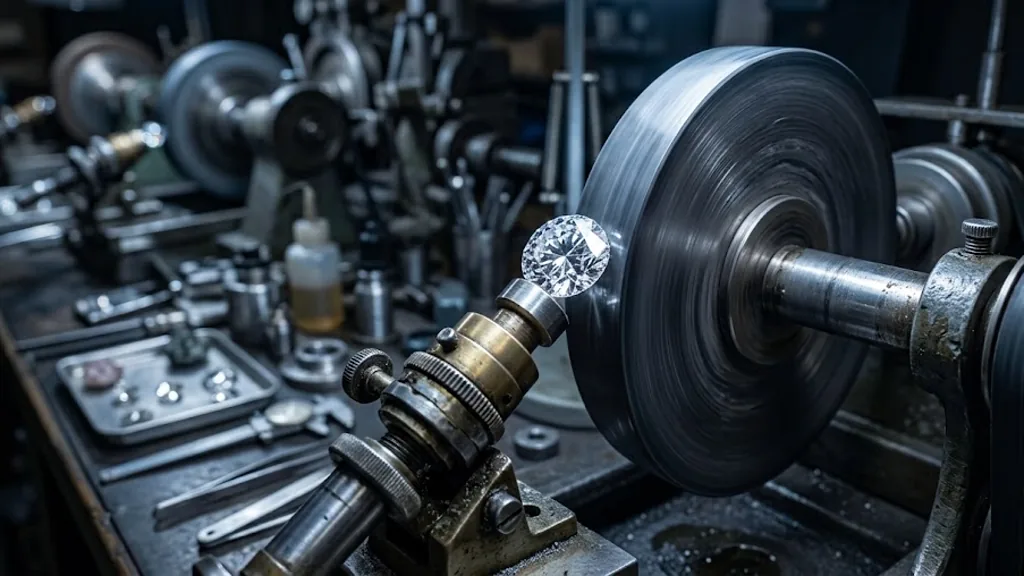
Cutters use diamond powder — ground-up fragments of other diamonds — embedded in a spinning iron wheel called a scaif. The stone is held against the wheel and material is worn away, very slowly. The technique is centuries old and, in principle, is still what happens today.
There is a second trick. Diamond is not equally hard in every direction. It has a grain, like wood, and a cutter who reads that grain correctly can split a crystal cleanly along it with a controlled tap. Read it wrongly and the stone shatters. For hundreds of years this was done by eye, by hand, and by nerve.
A rough timeline of diamond cutting
| Period | Cut | What made it possible |
|---|---|---|
| Before the 14th century | None — natural crystals, polished | Diamonds were worn as found, valued for hardness and mystery rather than sparkle |
| 14th century | Point cut | Polishing the eight natural faces of the octahedral crystal |
| 15th century | Table cut | Grinding one point flat to create a window into the stone |
| 16th century | Rose cut and French cut | Better wheels and steadier holding tools allowed deliberate faceting patterns |
| 17th–18th century | Old mine cut | Cutters began chasing brightness rather than saving weight |
| Late 19th century | Old European cut | The bruting machine, which could round a stone mechanically, plus powered wheels |
| 1919 onwards | Modern round brilliant | Marcel Tolkowsky’s mathematical study of how light travels through a diamond |
| Today | All modern cuts | Computer scanning of the rough, laser sawing, automated polishing |
You will often read that a Bruges cutter named Ludwig van Berquem invented symmetrical faceting in 1476. It is a good story, repeated everywhere, and historians treat it with a good deal of scepticism. Take it as tradition rather than record.
Cutting for candlelight
This is the part that makes antique cuts click into place. Until the late nineteenth century, jewellery was seen at night by candle and oil lamp — a small number of warm, flickering, moving light sources.
Modern brilliant cuts are designed for many small facets returning many small flashes, which works magnificently under electric light and daylight. Under a candle it just looks busy and grey.
So old cuts have fewer, bigger facets. They catch a flame and return it as a slow, broad, warm flash. Seen in a modern room they can look sleepy. Seen by candlelight, as they were meant to be, they come alive in a way modern stones do not. Antique cuts are not worse. They were optimised for a different light.
What is a French cut diamond?
The French cut is a square or rectangular stone with a distinctive cross on top. It is one of the oldest deliberate faceting patterns still in use, dating to around the sixteenth century, and it enjoyed a big revival in the Art Deco period of the 1920s and 1930s.
The pattern works like this. The table — the flat top facet — is set as a square rotated forty-five degrees to the outline of the stone, so its corners point at the middle of each side. Four large triangular facets fill the gaps. Looked at from above, the facet edges form a clear X or cross.
Its characteristics:
- Very few facets. Typically well under twenty, against fifty-seven or fifty-eight on a modern round brilliant.
- Broad, mirror-like flashes rather than pinpoint sparkle — closer in feel to a step cut than to a brilliant.
- A shallow profile, which makes it excellent for sitting flush in a setting.
- Perfectly square corners, which is why Art Deco jewellers used it for calibré work — rows of small stones cut to fit tightly together with almost no metal showing between them.
You will still see French cut stones in genuine antique Art Deco pieces and in modern jewellery made in that style. It is a beautiful, quiet cut. We should say plainly that we do not stock French cut diamonds, and we do not stock old European or princess cuts either. If that geometric Deco look is what you are after, the closest thing in our collection is the baguette — another straight-edged step cut used in rows. The Pave Baguette Cut Wedding Band at £690 gives you that same clean, linear architecture, price correct at the time of writing.
Are rose cut diamonds valuable?
The rose cut is the great survivor of the antique cuts, and the question of its value has a genuinely two-sided answer.
A rose cut has a completely flat bottom and a domed top covered in triangular facets rising to a point — like an opening rosebud, which is where the name comes from. Facet counts vary widely, from as few as three to around twenty-four. There is no pointed pavilion underneath at all.
On price per carat, a rose cut is usually less expensive than a brilliant cut of the same weight. Two reasons, both straightforward. Its flat back means the stone is shallow, so the same weight spreads much wider — you get more visible diamond for your money. And it returns less light than a brilliant, producing a soft, watery glow rather than flash, so demand for it is smaller.
On value in the broader sense, it holds its own. Genuine antique rose cuts from the Georgian and Victorian periods are collected and can command a real premium, because they cannot be made again. And modern rose cuts sell steadily to people who simply prefer the look — quieter, more organic, less obviously showy.
So: less expensive to buy per carat, harder to value in a straight comparison, and not a stone anyone should buy as an investment. Bought because you love the glow, it is superb value.
We hold two rose cut designs. The Stackable Rose Cut Wedding Band in Sterling Silver is £489 and shows the soft glow at its most wearable, while the Bezel Rose Cut Eternity Band in Sterling Silver is £1,611 and rims each stone in metal for an unmistakably antique feel. For an engagement ring in the same spirit, the Vintage Pear Rose Cut Engagement Ring is £1,237. All prices correct at the time of writing.
The other antique cuts worth knowing
- Table cut. The simplest of all: a natural crystal with one point ground flat. Common in Renaissance jewellery. Almost no sparkle — it reads as a dark, glassy square.
- Old mine cut. A softly squarish cushion outline with a high crown, a small table and a large open culet, which appears as a little circle when you look down through the stone. Cut by hand and by eye, so no two are identical.
- Old European cut. The round successor to the old mine cut, made possible once machines could grind a stone truly round. High crown, small table, open culet, and a distinctive chunky sparkle.
- Single cut. A simple eight-facet-crown, eight-facet-pavilion stone that was the direct ancestor of the brilliant, and is still used today for very small accent diamonds. We have written about it separately in our guide to single cut diamonds.
Frequently asked questions
How were diamonds cut before machines?
By hand, on a wheel dressed with diamond powder, with the cutter judging every angle by eye. Larger crystals were split along the grain with a blade and a tap before shaping. It was slow, and mistakes destroyed the stone.
Why do antique diamonds look duller than modern ones?
They were cut for candlelight, with fewer and larger facets to catch a flame. Under electric light that reads as soft rather than brilliant. In the light they were designed for, they look wonderful.
Is a French cut the same as a princess cut?
No. Both are square, but a French cut is a shallow, few-faceted antique pattern with a cross-shaped facet arrangement on top. A princess cut is a modern, deep, many-faceted brilliant. They look nothing alike in person.
Can you get antique cuts in lab-grown diamond?
Yes. Cutters work lab-grown stones exactly as they work mined ones, so rose cuts and other antique styles are entirely possible — and we hold two rose cut designs. Anything we do not stock can be made bespoke at no extra design cost.
Are old cuts worth more than modern cuts?
Genuine antique stones carry a collector’s premium because their supply is fixed. Modern stones cut in an antique style do not carry that premium; you buy them for the look. Either way, buy for the pleasure of wearing it.
Old character, made today
The appeal of an antique cut is that it looks handled, historic and a little imperfect — a diamond with a face rather than a formula. If that is the direction you are drawn in, start with the rose cut pieces above, or browse the wedding ring collection and the engagement ring collection. Everything is hand-made in solid metal, IGI certified on the centre stone, delivered free and insured within the UK.
Ready to find your perfect ring?
Explore our lab-grown diamond collection or book a virtual appointment with our team.











