What Are Single Cut Diamonds?
A single cut diamond has 17 or 18 facets instead of 57. Why fewer facets is deliberate, where you find them, and whether it matters.
A single cut diamond is a round diamond with just 17 or 18 facets, instead of the 57 or 58 on a modern round brilliant. That is the whole definition. Everything interesting about it follows from that one number.
You will meet the term in three places: in vintage jewellery, in watch dials and bezels, and in descriptions of the tiny accent stones that surround a centre diamond. It is not a lesser quality of diamond — it is a different faceting pattern, chosen deliberately.
What the facets actually are
A single cut is about as simple as a faceted round stone gets:
- One flat table on top
- Eight facets around the crown, the upper section
- Eight facets around the pavilion, the lower section
- Sometimes a tiny flat culet at the very bottom, which is what makes the count 18 rather than 17
It is also called an eight cut, for the obvious reason. Compare that with a full brilliant, which packs star facets, upper girdle facets and lower girdle facets into the same outline to reach 57 or 58.
| Cut | Facets | Where you see it |
|---|---|---|
| Single cut (eight cut) | 17 or 18 | Melee under about 1.3 mm, watch dials, vintage jewellery |
| Swiss cut | About 33 | An intermediate step, used on small stones |
| Full round brilliant | 57 or 58 | Centre stones and most modern accent diamonds |
Why cut fewer facets on purpose?
Because on a very small stone, more facets stop helping and start hurting.
Picture a diamond a millimetre across — smaller than the head of a pin. Squeeze fifty-seven facets onto it and each one is microscopic. Individually they are too small for your eye to resolve as separate flashes, so instead of sparkle you see a slightly greyish, gritty shimmer. The trade sometimes calls it a salt-and-pepper look, and it is not a compliment.
Cut the same stone with seventeen facets and each one is proportionally much larger. Each returns a flash your eye can actually register. A row of them reads as clean and bright rather than fuzzy.
There are two practical reasons as well. Cutting sixteen facets takes far less labour than cutting fifty-six, which matters enormously when a jeweller needs a few hundred of them. And on a very small crystal, a simpler pattern saves more of the original weight.
Where single cuts come from
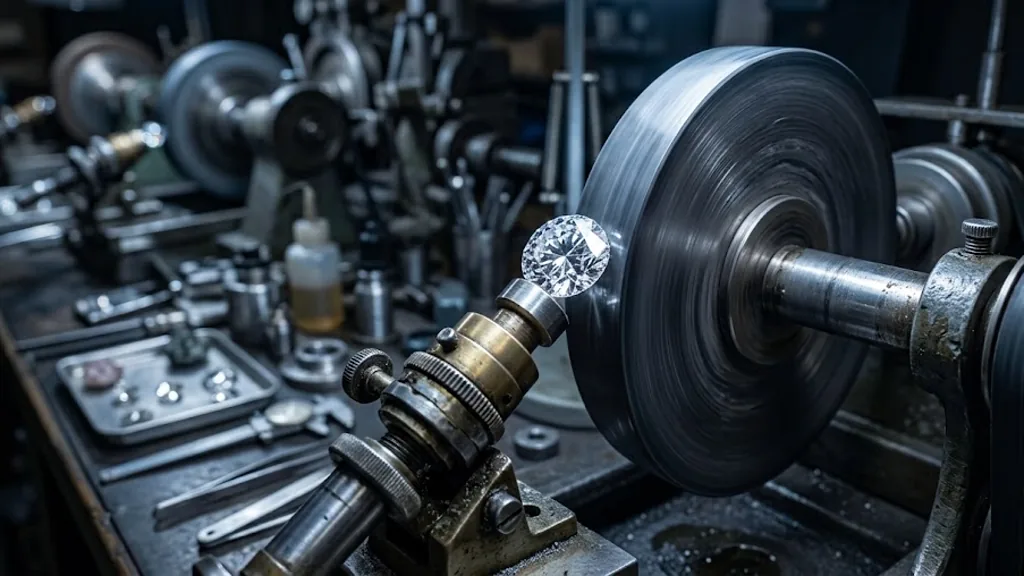
Historically, the single cut was a stage on the way to the brilliant rather than a destination. Cutters would rough a stone to eight crown and eight pavilion facets, then keep going, adding facets until they reached a full brilliant. Stop halfway and you have a single cut.
Because of that, single cuts turn up constantly in jewellery from the 1920s through the 1940s, especially in Art Deco pieces where rows of small stones line a band or frame a centre diamond. If you own an inherited piece from that era and the small stones look calm and mirror-like rather than fiery, they are very likely single cuts. It is a genuine dating clue. Our guide to how diamonds were cut in the past puts that period in context.
Single cuts in watchmaking
Watch bezels and dials are the one place single cuts remain absolutely standard, and there is a good engineering reason.
A watch bezel needs stones set flush in a shallow channel, all identical, all sitting at exactly the same height. Single cuts are shallower than full brilliants and far easier to match precisely to one another. They also produce a steadier, cleaner glint under a watch crystal, where the fizzy scatter of a full brilliant would fight with the dial.
Are single cut diamonds worth less?
Per stone they cost very little, simply because they are very small. Per carat the picture is more mixed and depends heavily on size and quality, and anyone quoting a firm figure without seeing the parcel is guessing.
What matters more to a buyer is this: the quality of a piece of jewellery is not decided by whether its accent stones are single cut or full cut. It is decided by how well those stones are matched to one another for colour and size, how neatly they are set, and how securely the metal holds them. A row of well-matched single cuts, evenly set, looks far better than a row of mismatched full cuts.
The one place it does matter is a centre stone. If you are buying a diamond large enough to be the star of the ring, you want a full brilliant. At that size, all fifty-seven facets earn their place.
How this affects a ring you are actually buying
Modern cutting has moved on. Automated equipment can now cut full brilliants at sizes that would once have been impossible, so a great deal of today’s melee is fully cut even at very small diameters. Single cuts persist where they still make sense: watches, very fine pavé work, and jewellery made deliberately in an antique style.
To be straightforward about our own range: we do not sell loose single cut diamonds, and we do not describe any design in our collection as single cut. What we do use is small, well-matched accent diamonds in our pavé and eternity designs, set by hand.
You can see the effect in the Vintage Round Cut Engagement Ring in Yellow Gold at £1,051, where small stones run along the shoulders, and in the Stackable Round Cut Full Eternity Band at £707, where they run the whole way round. The Stackable Round Cut Three Quarter Eternity Band at £762 is the same idea over three quarters of the band, which keeps the underside comfortable for daily wear. All prices correct at the time of writing.
Round is our largest range, with twenty designs — you can see them all in the round cut collection, and the small-stone designs sit mostly in the wedding ring collection.
Frequently asked questions
Is a single cut diamond a real diamond?
Completely. It is the same material as any other diamond, mined or lab-grown, simply polished with fewer facets. The word describes the faceting pattern, not the quality or the authenticity of the stone.
How can I tell a single cut from a full cut?
Under a ten-times loupe, look at the crown. A single cut shows eight clean, kite-shaped facets around a table and nothing else. A full brilliant shows a busier pattern with small triangular star facets between the larger ones.
Do single cut diamonds sparkle?
Yes, but differently. They give fewer, broader, calmer flashes rather than the fine fizz of a brilliant. At the tiny sizes they are used at, many people find that cleaner and brighter than a full cut of the same size.
Are single cut diamonds certified?
Almost never individually. They are far too small for that to be practical, so they are bought and sold in graded parcels by size and quality. Certification applies to centre stones — every centre stone we set comes with a free IGI certificate.
Should I avoid jewellery with single cut accent stones?
No. Judge accent stones on how well they are matched and set, not on their facet count. In vintage and antique-style pieces single cuts are exactly right, and swapping them for full cuts would spoil the look.
Worth knowing, rarely worth worrying about
Single cuts are one of those pieces of jewellery vocabulary that sound like a warning and turn out to be a technical detail. Now you can spot them in a vintage ring or on a watch bezel and know why they are there.
If you would like the wider picture, our guide to the types of diamond cuts covers the whole family. And if you are looking for something with fine hand-set detail, everything in the collection is made in solid gold or platinum, with free insured UK delivery and 30 days to return it.
Ready to find your perfect ring?
Explore our lab-grown diamond collection or book a virtual appointment with our team.