How to Wear a Pear Shaped Wedding Ring
Which way the point should face, how to stop a pear ring spinning, and the chevron and curved bands that sit flush against it.
A pear shaped diamond is the only popular ring shape with a right way up and a wrong way up. That single fact causes more questions than any other bridal shape we sell — which way should the point face, what band goes with it, and why does it keep spinning?
Here is a straightforward guide to wearing a pear shaped ring well, day to day.
First, what a pear shape actually is
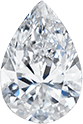
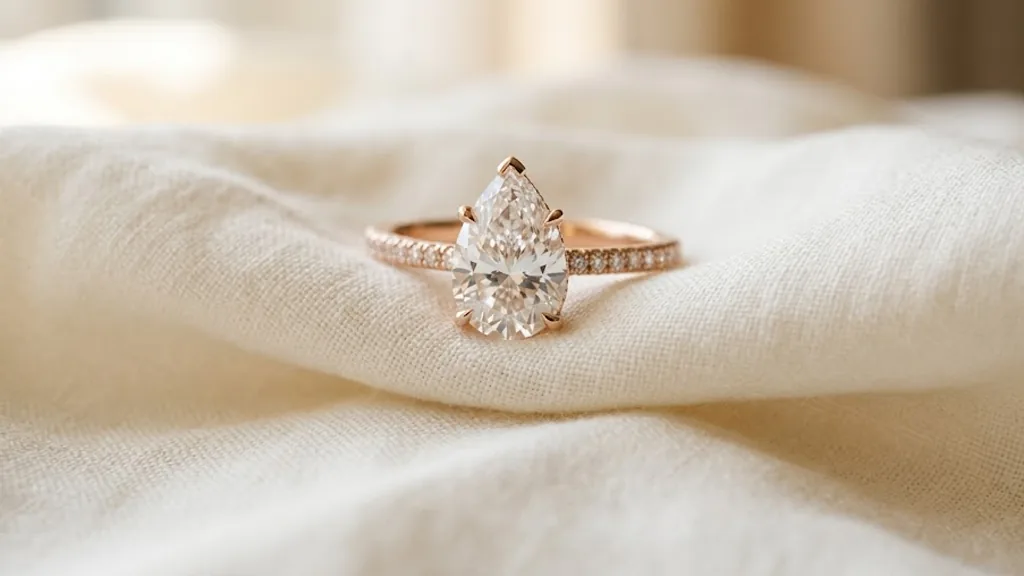
A pear cut (sometimes called a teardrop) is round at one end and comes to a single point at the other. That point is called the tip, and the wide curved end is the belly. Because the shape is longer than it is wide, it makes a finger look longer — which is a large part of why people love it.
The tip is also the most delicate part of any diamond shape. It is a thin point of stone, and if it is not properly protected by the setting, it is the part that can chip. Good pear rings always have a V-shaped claw (a small metal cap) covering the tip. Check for it before you buy anything pear shaped, ours included.
Which way should the point face?
The traditional answer, and by far the most common: the point faces towards your fingernail, with the wide belly of the stone sitting nearest your hand.
There are two good reasons for it.
It flatters the hand. A point aiming up the finger draws the eye along the finger and makes it look longer and slimmer. Point the other way and the effect reverses slightly.
It leaves room for the wedding band. The band sits at the base of your finger. If the pear’s belly is at the base, the band has a wide, gently curved shape to nest against — much easier to fit than a sharp point.
That said, some people genuinely prefer the point facing down towards the wrist. It is a real style choice, not a mistake, and it is more common on right-hand and cocktail rings than on engagement rings. Wear it whichever way you like the look of — just be aware that if you point it towards your wrist, your wedding band has to sit against the tip, which needs a more carefully shaped band.
Stopping a pear ring from spinning
This is the real complaint. A pear ring that rotates leaves the point sitting sideways across your finger, and it looks wrong immediately.
Spinning happens for one of three reasons.
| Cause | What it feels like | Fix |
|---|---|---|
| The ring is slightly too big | Slides freely, spins with any hand movement | Resize down half a size, or fit sizing beads inside the band |
| The stone is top-heavy | Fits fine but rolls to one side, especially in cold weather | Sizing bars or a slightly wider band to add balance underneath |
| Your finger is narrow at the base and wide at the knuckle | Has to be loose to get over the knuckle, then rattles | Sizing beads, a ring guard, or a snug wedding band worn beneath to hold it steady |
That last one is worth noting, because it is a genuine benefit of wearing a wedding band under your pear engagement ring: a well-fitted band acts as a stop, holding the engagement ring upright. Many people find their pear only settles down once the band is on. If you are not sure your ring is the right size to begin with, our guide on how a wedding ring should fit explains what a correct fit feels like.
Choosing a wedding band for a pear engagement ring
A straight, flat band will almost always leave a visible gap under a pear, because the stone’s tip or belly sits lower than the band. You have four sensible options.
1. A chevron or V-shaped band. This is the classic partner for a pear. The band dips into a V that cradles the point of the stone, so the two rings sit tight against each other with no gap. Our Chevron Pear Cut Wedding Band in Rose Gold is made exactly for this, and its own pear-cut stones echo the shape of the engagement ring.
2. A curved band. A gentler, softer curve rather than a sharp V. It suits a pear worn belly-down and is more forgiving if you ever change your engagement ring.
3. A matched bridal set. The simplest route, and the one we recommend most often. The band is designed around that exact engagement ring, so it nests perfectly first time. Both our Curved Pear Cut Bridal Set and our Tiara Pear Cut Bridal Set in Platinum come as a pair, so there is nothing to match up later.
4. Wear them on separate hands. Not a failure, just a decision. Plenty of people with a low-set pear do exactly this and never think about it again.
Which way round do the two rings go?
The tradition is the same for a pear as for any other shape: the wedding band goes on first, closest to your hand, and the engagement ring sits above it towards your fingertip. The band ends up nearest the heart, which is where the custom comes from.
With a pear, there is a practical bonus to following it. The band underneath supports the engagement ring and reduces the spinning we talked about above. We cover the full tradition, the wedding-day swap and when to ignore it in our guide to which way round you wear wedding and engagement rings.
Everyday wear: protecting the point
A pear needs a little more care than a round brilliant, purely because of that tip. None of this is difficult.
- Take it off before the gym. Gripping a bar is how points get knocked and shanks get bent.
- Take it off for rough work. Gardening, DIY, moving furniture, anything with gloves. A knock straight onto the tip is the one thing that can chip it.
- Check the V-claw once a year. That small metal cap over the point is what protects the whole stone. If it lifts or wears thin, get it retipped. It is a quick, inexpensive job compared with a chipped diamond.
- Watch for snagging. If your ring catches on jumpers, a claw has probably lifted. Treat that as a warning, not a nuisance.
- Clean it gently. Warm water, a drop of mild washing-up liquid, a soft toothbrush, then rinse and pat dry with a lint-free cloth. Nothing stronger. See what to clean a wedding ring with for the full method and what to avoid.
Does the pear suit your hand?
Honestly, the pear suits most hands, which is why it has stayed popular for so long. A few observations from fitting them:
Shorter fingers: a pear is one of the best shapes you can choose. The long line lengthens the finger.
Long, slim fingers: also excellent, though a wider, rounder pear (a shorter, fatter outline) balances a very long finger better than a narrow one.
Wider fingers: go for a slightly larger stone and a narrow band. A tiny stone on a wide finger reads as smaller than it is.
Active hands: ask for a lower setting. A pear set low and bezel-edged is far more practical than one perched high on tall claws.
Frequently asked questions
Which way does a pear shaped ring point?
Traditionally the point faces your fingernail, with the wide end towards your hand. It flatters the finger and leaves the band a smoother shape to sit against. Pointing it towards the wrist is a style choice, not an error.
Do I need a special wedding band for a pear engagement ring?
Usually, yes — a chevron or curved band, or a matched bridal set. A straight band will normally leave a small gap. That gap does no harm, but most people dislike the look.
Are pear shaped diamonds more fragile?
The stone itself is as hard as any diamond. The tip is the vulnerable part because it is a fine point, so it must be protected by a V-shaped claw. With that in place and sensible everyday care, a pear lasts a lifetime.
Why does my pear ring keep turning?
Usually the ring is a fraction too large, or the setting is top-heavy. Sizing beads, a small resize, or simply wearing a snug wedding band underneath will normally settle it.
Can I wear a pear shaped ring as a wedding band on its own?
Yes. A band set with a row of small pear-cut stones, like our 7 Stone Pear Cut Wedding Band, works beautifully worn alone or stacked with plain bands.
If you are still choosing
Pear is our second-largest shape range, so there is plenty to compare — you can see everything pear shaped in one place under pear cut rings, or browse all engagement rings if you are still weighing shapes against each other.
Every CarbonstoneUK pear is a lab-grown diamond, hand-made into solid gold or platinum in North Harrow, London, and supplied with a free IGI certificate on the centre stone. Delivery within the UK is free and insured, you have 30 days to return anything, and if you want a band shaped to your existing pear ring we will design it at no extra design cost.
Ready to find your perfect ring?
Explore our lab-grown diamond collection or book a virtual appointment with our team.