How Many Carats Is a 7mm Princess Cut Diamond?
A 7mm princess cut is about 2 carats. Full mm-to-carat chart, why carat is not size, and the square shapes we do stock.
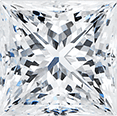
A 7 mm square princess cut diamond weighs roughly 2 carats. That is the answer most people are looking for, and it is close enough for planning a ring.
But the word “roughly” is doing real work in that sentence, and understanding why will save you money. Two stones that both measure 7 mm across can differ in weight by a surprising amount — and the one that weighs less is often the better buy.
Princess cut millimetres to carats
These are the standard trade approximations for a square princess cut with typical proportions. Treat them as a guide, not a specification.
| Face-up size | Approximate carat weight |
|---|---|
| 4.0 mm | 0.35 ct |
| 4.5 mm | 0.50 ct |
| 5.0 mm | 0.70 ct |
| 5.5 mm | 1.00 ct |
| 6.0 mm | 1.25 ct |
| 6.5 mm | 1.50 ct |
| 7.0 mm | 2.00 ct |
| 7.5 mm | 2.50 ct |
| 8.0 mm | 3.00 ct |
Notice how quickly the weight climbs. Going from 5.5 mm to 7 mm — a difference of a millimetre and a half, which is barely visible on a hand — doubles the carat weight and roughly doubles the price.
Why carat is not the same as size
This is the single most useful thing to understand before you spend anything.
A carat is a unit of weight, not of size. One carat is 0.2 grams. What you actually see on a hand is the face-up area — the top surface of the stone.
Two princess cuts can both weigh 2 carats and look noticeably different, because weight can be hidden underneath. A stone cut deep carries more of its weight below the setting where nobody sees it. A shallower stone of the same weight spreads wider and looks bigger.
So when you are comparing stones, ask for the actual millimetre measurements from the certificate, not just the carat weight. The measurements tell you what you will see. The carat weight tells you what you are paying for.
What 2 carats looks like in other shapes
Princess cuts are square and compact, which means they look smaller than their carat weight suggests compared with elongated shapes. Here are approximate face-up dimensions for 2 carat stones in different cuts.
| Shape | Approximate size at 2 carats | How it reads on the hand |
|---|---|---|
| Princess | 7.0 × 7.0 mm | Compact and square. Efficient use of weight, but visually contained. |
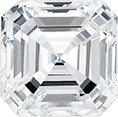
| Asscher | 7.0 × 7.0 mm | Square with cut corners. Step-cut facets give a hall-of-mirrors depth rather than sparkle. |
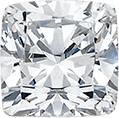
| Cushion | 7.5 × 7.5 mm | Square with rounded corners. Softer, more antique. |
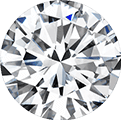
| Round | 8.1 mm diameter | The most sparkle per carat, and the most expensive per carat. |
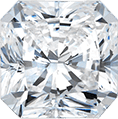
| Radiant | 7.5 × 6.0 mm | Cut corners with brilliant faceting. Lively, and slightly elongated. |
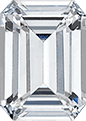
| Emerald | 8.5 × 6.5 mm | Long and rectangular. Looks considerably larger than a princess of the same weight. |
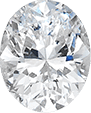
| Oval | 10.5 × 7.0 mm | Elongates the finger. Excellent value for apparent size. |
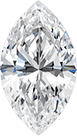
| Marquise | 13.0 × 6.5 mm | The largest apparent size for the weight of any common shape. |
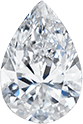
| Pear | 11.0 × 7.0 mm | Long, with one point. Reads large and distinctive. |
If your goal is “the biggest-looking stone for the money”, a princess cut is not the shape to choose. Marquise, oval, pear and emerald all cover more finger per carat.
We do not stock princess cuts — and that is a straight answer
CarbonstoneUK does not currently sell princess cut rings. We are not going to send you to a product page for something we do not make.
What we can do is make one bespoke. We design bespoke at no extra design cost, so a princess cut lab-grown diamond in a setting of your choice is a normal order rather than an unusual one. Tell us the carat weight or the millimetre size you want and we will quote for it.
The square-ish shapes we do stock
If what you like about a princess is the geometry rather than the name, several stocked shapes give you the same clean lines. Prices correct at the time of writing.
- Emerald cut — rectangular, step-cut, and the shape that gets the most size out of its weight. The Solitaire Emerald Cut Engagement Ring (£672) is the simplest version. Browse all our emerald cut rings.
- Cushion cut — square with softened corners, warmer and less severe than a princess. The Bezel Cushion Cut Engagement Ring in Platinum (£904) holds the stone in a rim of metal, which protects the corners.
- Radiant cut — cut corners with the brilliant faceting that gives a princess its sparkle. The 5 Stone Radiant Cut Engagement Ring in Yellow Gold (£917) is our five-stone version.
- Hexagon cut — geometric and modern, if you want angles without the traditional look. See the Solitaire Hexagon Cut Engagement Ring (£1,078).
Everything is visible in the engagement ring collection, and every centre stone comes with a free IGI certificate.
How to check the size on a certificate
Every centre stone we sell comes with a free IGI certificate, and any reputable diamond should come with one from IGI or GIA. It is a short document, and three lines on it answer the size question properly.
- Measurements. Given in millimetres, usually as length × width × depth. For a square princess you want the first two numbers to be close to equal — a ratio between about 1.00 and 1.05 looks square to the eye. Above about 1.10 it starts to read as a rectangle.
- Depth percentage. The depth of the stone as a percentage of its width. A high depth percentage means weight is hidden below the setting, so the stone looks smaller than its carat weight suggests.
- Table percentage. The width of the flat top facet relative to the whole stone. It affects how the light behaves rather than the apparent size, but it is worth glancing at.
If a seller will not give you the millimetre measurements, that on its own tells you something. Carat weight alone is not enough information to compare two stones fairly.
One practical warning about princess cuts
Princess cuts have four sharp, unprotected corners, and a corner is the most vulnerable part of any diamond. Diamond is the hardest material there is, but hardness is not the same as toughness — a sharp knock on a corner can chip it.
If you do commission a princess cut, insist on a setting that covers the corners: V-shaped claws, or a bezel. This is the most common cause of damage to princess cut rings, and it is entirely preventable at the design stage.
Frequently asked questions
How many carats is a 7 mm princess cut diamond?
Approximately 2 carats for a stone with typical proportions. A deeper-cut stone of the same width will weigh more; a shallower one will weigh less.
Is a 7 mm princess cut big?
Yes, by normal standards. It covers roughly the same width as an 8 mm round, and at 2 carats it is well above the size most people picture for an engagement ring. On a slim finger it will be very noticeable.
How many carats is a 6 mm princess cut?
Around 1.25 carats. A 5.5 mm princess is about 1 carat, which is the size most size charts are built around.
Do princess cuts look smaller than other shapes?
For the same carat weight, generally yes. Square shapes concentrate the weight into a compact face. Marquise, oval, pear and emerald cuts all spread wider and look larger.
Are lab-grown princess cut diamonds cheaper?
Substantially, yes — a lab-grown diamond costs a good deal less than a mined one of the same size and quality, which is why a 2 carat stone is a realistic conversation rather than a fantasy for most budgets. Any market range you see quoted should always state whether it refers to lab-grown or natural; the two are not comparable.
Can you make me a princess cut ring?
Yes, bespoke, at no extra design cost. Tell us the size you want in millimetres or carats and the setting style, and we will quote.
If you would like help deciding between a princess and one of the shapes we hold in stock, get in touch — we are in North Harrow and happy to talk it through before you commit to anything.
More guides on this topic
Ready to find your perfect ring?
Explore our lab-grown diamond collection or book a virtual appointment with our team.