What Does Diamond Clarity I3 Mean? The Bottom of the Scale, Explained
I3 is the lowest diamond clarity grade: visible inclusions, less sparkle, and sometimes a durability risk. What to buy instead.
I3 is the lowest clarity grade a diamond can be given. It stands for Included, third grade, and it means the stone contains inclusions that are obvious without any magnification at all — visible to an ordinary person, at arm’s length, in normal light.
This is the one part of the clarity scale where the grade genuinely changes how a diamond looks and, sometimes, how safely it can be worn. It deserves a straight explanation rather than a sales pitch, so here is one.
Where I3 sits on the scale
Clarity runs across eleven grades, from Flawless at the top to I3 at the bottom. The bottom three form the “Included” band.
| Grade | Full name | What you see |
|---|---|---|
| SI2 | Slightly Included 2 | Easily seen at 10x. Sometimes visible without a lens. |
| I1 | Included 1 | Obvious at 10x and often visible to the naked eye. |
| I2 | Included 2 | Clearly visible without a lens. Sparkle starts to suffer. |
| I3 | Included 3 | Heavy, obvious inclusions. Noticeably reduced brilliance, and possible durability concerns. |
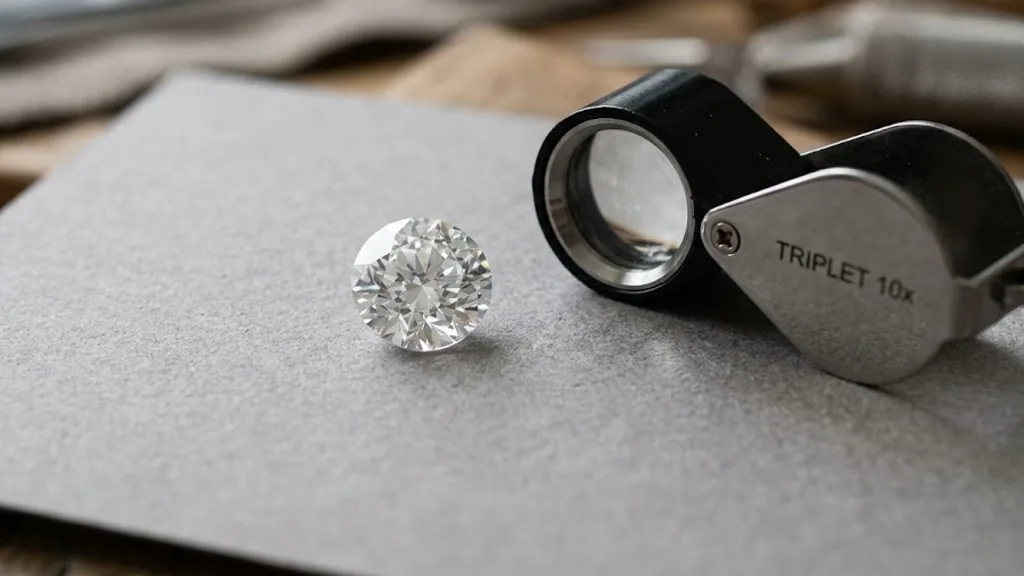
Every grade above I1 is judged at 10x magnification — through a jeweller’s loupe. The I band is different. These are the grades where the inclusions have grown large enough, dark enough or numerous enough that the lens stops being necessary.
What an I3 diamond actually looks like
It varies more than any other grade, because I3 is a catch-all for “worse than I2” with no floor beneath it. But the common features are consistent:
- Visible dark specks or lines. Black carbon inclusions and dark crystals read as full stops or commas inside the stone. Once you have seen one, it is difficult to stop seeing it.
- A dull or hazy look. Dense clouds of microscopic inclusions scatter light before it can bounce back out. The stone looks slightly milky rather than bright, even when perfectly clean.
- Reduced sparkle. Light entering a heavily included diamond gets absorbed and deflected instead of returning to your eye. This is the real loss at I3, and it is the reason cut alone cannot rescue the stone.
- Large feathers. Internal fractures, sometimes big enough to catch the light as a distinct plane inside the diamond.
The durability question
This is the part that separates I3 from a merely disappointing purchase.
Diamond is the hardest natural material, but hardness is resistance to scratching, not resistance to breaking. A diamond with a large feather reaching the surface — especially near the girdle, the thin edge where the top and bottom meet, or at a pointed tip on a pear or marquise — has a genuine weak point.
Most I3 diamonds will not break. But the risk is real rather than theoretical, and it rises with a sharp knock against a door frame, a worktop or a car door. For a ring worn every day for decades, that matters more than it would for a pendant worn occasionally.
A good jeweller will look at where the feathers sit and tell you honestly whether a particular stone needs a protective setting — a bezel, which wraps metal all the way round the edge, is the usual answer.
Is an I3 diamond ever worth buying?
We will be straight with you: we do not stock I-grade centre stones, and we would not recommend one for an engagement ring. That is not us steering you towards something dearer — it is that at the prices lab-grown diamonds now reach, the compromise no longer buys you anything.
There is a narrow set of cases where an I-grade stone can make sense:
- Very small accent stones. Below about 0.05 carat, in pavé or a halo, clarity is effectively invisible because there is so little stone to look through. Nobody is inspecting a 1mm accent diamond.
- You want maximum carat weight for a fixed sum and genuinely do not mind visible inclusions. That is a legitimate personal choice, made with open eyes.
- A stone with a striking, characterful inclusion that you actively like. Salt-and-pepper diamonds are a whole style built on this, and they are deliberate rather than a compromise.
What does not hold up is buying I3 as a shortcut to a bigger-looking ring. There are better ways to get visual size, and we would rather point you at those.
Better ways to get a big look on a small budget
If size is the goal, four things work harder than dropping clarity to the bottom of the scale.
Choose an elongated shape. Oval, pear and marquise cuts spread their weight across a longer surface, so they cover more of the finger than a round of the same carat weight. A Solitaire Marquise Cut Engagement Ring at £538 or a Solitaire Oval Cut Engagement Ring at £557 — both prices correct at the time of writing — read considerably larger than their weight suggests.
Use a halo or a cluster. A ring of tiny diamonds around the centre stone makes the whole thing read as one much bigger diamond. The accent stones are small enough that their own clarity is irrelevant.
Spread the weight across several stones. Three-stone and five-stone designs give a wide, generous look without a single expensive centre.
Buy lab-grown. This is the big one. A lab-grown diamond is the same material as a mined one, graded on the same scale by the same laboratories, and it costs a fraction of the price. That difference is what makes an eye-clean stone affordable in the first place. Our Minimalist Round Cut Engagement Ring starts at £587 and our Stackable Pear Cut Engagement Ring at £503, both correct at the time of writing, with a free IGI certificate on the centre stone.
What to buy instead of I3
The trade’s guideline — a rule of thumb rather than a measured figure — is to buy the lowest clarity grade that is still eye-clean, meaning nothing visible looking straight at the stone from about 30 centimetres away in ordinary light.
For a round brilliant, that is usually SI1 and sometimes SI2. For ovals, pears and marquises, VS2 to SI1. For emerald and asscher cuts, where long open facets hide nothing, VS1 to VS2.
Those grades cost meaningfully less than the top of the scale while looking identical on a hand. That is where a sensible budget goes — not to the bottom of the scale, and not to the top.
Frequently asked questions
Is an I3 diamond a real diamond?
Yes. I3 is a genuine diamond with a low clarity grade. It is not a simulant such as cubic zirconia or moissanite. The grade describes how included it is, not whether it is authentic.
Will an I3 diamond still sparkle?
Less than a cleaner stone. Heavy inclusions absorb and scatter light instead of returning it, so the diamond looks duller and sometimes hazy. Excellent cutting helps, but it cannot fully compensate.
Can an I3 diamond break?
It is more vulnerable than a higher-clarity stone, particularly if it contains large feathers reaching the surface. Most will not break, but the risk is real enough that a protective bezel setting is worth considering.
What is the difference between I1, I2 and I3?
Severity, on the same theme. I1 has obvious inclusions that are often visible without a lens. I2 has clearly visible inclusions that begin to dull the stone. I3 has heavy inclusions that noticeably reduce brilliance and may affect durability.
Do you sell I3 diamonds?
No. Every centre stone we set is chosen to be eye-clean, and comes with a free IGI certificate so you can see the grade for yourself. If you want a particular grade in a design we do not list, we make bespoke at no extra design cost.
The short version
I3 is the bottom of the clarity scale: visible inclusions, reduced sparkle, and sometimes a durability question. It is not fake and it is not worthless, but it is the one grade where the certificate letter describes something you will genuinely notice.
If your budget is tight, elongated shapes, halos, multi-stone designs and lab-grown diamonds all get you further than dropping clarity this low. There is more on choosing sensibly in what clarity and colour to choose for a diamond ring, and the whole scale is explained in how to read diamond clarity grades on a certificate.
Otherwise, have a look through our engagement ring collection or the pear cut designs. Everything is hand-made in solid gold or platinum in North Harrow, with free insured UK delivery and 30 days to change your mind.
More guides on this topic
Ready to find your perfect ring?
Explore our lab-grown diamond collection or book a virtual appointment with our team.