What Is the Average Wedding Ring Size?
The average wedding ring size in the UK, a full UK to US size chart, and why an average is a risky basis for buying a ring.
There is no official statistic for the average wedding ring size in the UK. No body collects it, and the figures you find quoted online are almost always one retailer’s own sales data, which reflects what that shop stocks rather than what British fingers actually measure.
What does exist is a working rule of thumb used across the trade. It is useful for stocking a shop and for making an educated guess. It is not useful as a basis for buying a specific ring for a specific person, and this guide explains why.
The trade rule of thumb
Most jewellers work on roughly this:
- Women: UK size L to N covers the biggest share of orders, with M often described as the middle of the range.
- Men: UK size T to V covers the biggest share, with U often treated as the middle.
Treat that as a rule of thumb in the trade, not a measured figure. Real orders spread far wider than those bands in both directions, and plenty of people sit several sizes outside them with perfectly ordinary hands.
The UK ring size chart
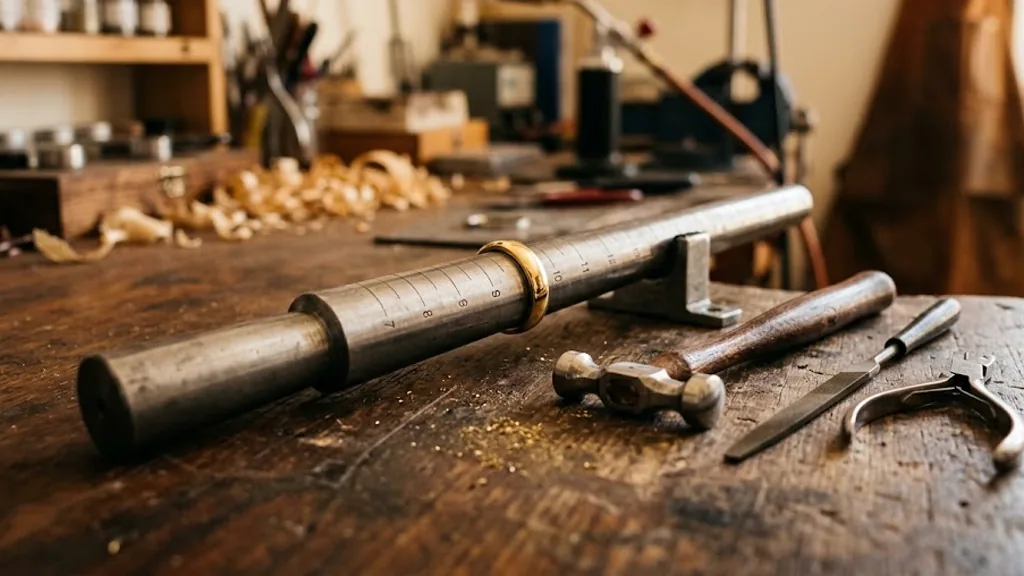
UK sizes run through the alphabet, with half sizes in between. Each full letter is roughly 0.4mm of internal diameter. Here are the sizes most wedding rings fall into:
| UK size | Inside diameter | Inside circumference | US size |
|---|---|---|---|
| H | 15.3mm | 48.0mm | 3¾ |
| J | 16.1mm | 50.6mm | 4¾ |
| K | 16.5mm | 51.9mm | 5¼ |
| L | 16.9mm | 53.1mm | 5¾ |
| M | 17.3mm | 54.4mm | 6¼ |
| N | 17.7mm | 55.7mm | 6½ |
| O | 18.1mm | 57.0mm | 7 |
| P | 18.5mm | 58.3mm | 7½ |
| R | 19.4mm | 60.8mm | 8½ |
| T | 20.2mm | 63.4mm | 9½ |
| U | 20.6mm | 64.6mm | 10 |
| V | 21.0mm | 65.9mm | 10½ |
| X | 21.8mm | 68.5mm | 11½ |
| Z | 22.6mm | 71.0mm | 12½ |
European sizes are different again: they use the inside circumference in millimetres directly. A UK M is a European 54, a UK U is a European 65. If you are buying from abroad, always convert using the diameter or circumference rather than trusting a letter-to-number chart, because different countries round differently.
Why the average is a poor guide
Three reasons, and each of them catches people out.
The spread is enormous
Finger size is driven by build, height, age, occupation and genetics. Two people of the same dress size can be four ring sizes apart. Buying “the average” is a coin toss, not an estimate.
Knuckles do not follow fingers
Plenty of people need a ring that passes a large knuckle and then sits loosely at the base. Their “size” is really two different numbers. No average accounts for this, and it is one of the most common fitting problems we see. If it applies to you, our guide on making a wedding ring tighter covers the fixes.
Band width changes the size you need
This surprises almost everyone. A wide band covers more of the finger, so it feels tighter at the same nominal size. As a general guide, if you are going above about 5mm wide, expect to need roughly half a size larger than your usual measurement. Someone who is a comfortable T in a 3mm band may well need a U in a 6mm one.
What changes your ring size
- Temperature. Cold hands are smaller. Measuring on a winter morning gives a false reading.
- Time of day. Fingers are usually at their largest in the evening.
- Salt, alcohol and exercise cause short-term swelling.
- Weight change, pregnancy and some medications cause lasting change.
- Age. Knuckles tend to enlarge over decades, which is why many older people wear rings that spin.
Measure in the middle of the day, at normal room temperature, and take readings on more than one day before committing. The full method is in our guide to finding your wedding ring size, and there is a specific one for sizing a man’s wedding ring.
If you genuinely have to guess
Sometimes there is no way round it — a surprise proposal, or a ring being bought as a gift. In that case:
- Borrow an existing ring worn on the same finger and measure its internal diameter. This beats every other method.
- If you cannot, use the middle of the rule-of-thumb range: M for a woman, U for a man.
- Choose a design that can be resized. This matters more than the guess itself.
- Buy from somewhere with a real returns policy.
That third point deserves emphasis. A plain band or a half eternity can be adjusted; a full eternity band with stones all the way round usually cannot, and neither can titanium, tungsten or zirconium. Guessing a size on a ring that cannot be altered is how people end up with an expensive object in a drawer.
Designs with plain metal at the base give you the most room to manoeuvre — something like the Tiara Round Cut Wedding Band (£707, correct at the time of writing) or the Stackable Emerald Cut Half Eternity Band (£770). For an engagement ring, a simple setting such as the Solitaire Round Cut Engagement Ring (£657) is among the easiest of all to adjust later.
Should the wedding band be the same size as the engagement ring?
Usually, but not always. Two things can push them apart.
The first is width, as above. If the engagement ring is a slim 2mm shank and the wedding band is 4mm, the band may need to be a fraction larger to feel the same.
The second is stacking. Two rings worn together on one finger press against each other and can feel tighter than either does alone. If you are adding a band to a ring you already wear, try them on together before you commit to a size — a half size of difference is easy to feel and impossible to guess.
There is one more practical point that catches people out at the wedding itself. If the wedding band is ordered months ahead and the wedding falls in high summer, fingers may be a touch larger on the day than they were at the fitting. It is worth a check a few weeks before, while there is still time to adjust.
Sizes to be cautious about
A few situations deserve extra care rather than an average:
- Very small sizes (below about H). Slim fingers usually mean slim bands. A wide band on a very small size can look and feel overwhelming.
- Very large sizes (above about Z). Not every design is made beyond Z without altering the proportions, and the price rises because more metal is used. Ask before assuming a design is available.
- Arthritic or enlarged knuckles. Standard sizing does not solve this. A hinged shank or a sizing insert usually does.
Frequently asked questions
What is the most common wedding ring size for a woman in the UK?
Trade experience points to L, M and N as the sizes ordered most often, with M frequently treated as the default guess. There is no official survey behind that, so treat it as a starting point rather than a fact about any individual.
What is the most common men’s wedding ring size in the UK?
T, U and V, with U as the usual default. Again, this is workshop experience rather than published data.
What is the average ring size in US sizing?
Converting the same rule of thumb, that is roughly a US 6 for women and a US 10 for men. The conversion table above lets you check any specific size properly.
Should a wedding ring be slightly loose or slightly tight?
Slightly snug. It should need a small amount of effort over the knuckle and should not spin freely at the base. If you can shake it off, it is too big — and a ring that is a fraction tight in the morning is usually correct by the afternoon.
Can any ring be resized if I guess wrong?
No. Plain bands and half or three-quarter eternity bands usually can. Full eternity bands, tension settings, and rings in titanium, tungsten, ceramic or zirconium usually cannot. Check before you buy, not after.
Getting it right first time
The average is interesting; your actual measurement is what matters. If you are anywhere near a jeweller, thirty seconds with a set of ring sizers will settle it for good.
When you are ready, our wedding rings and engagement rings are hand-made to order in solid gold and platinum, with free insured UK delivery, 30-day returns, and a free IGI certificate on every centre stone.
More guides on this topic
Ready to find your perfect ring?
Explore our lab-grown diamond collection or book a virtual appointment with our team.