Can You Upgrade or Sell Your Diamond Engagement Ring?
What your engagement ring is really worth, why valuations mislead, and four ways to upgrade it without losing money on resale.
Two questions arrive at our counter constantly, and they turn out to be the same question wearing different clothes. “Can I upgrade my engagement ring?” and “How much can I get for it?” both come down to one thing: what is this ring actually worth to somebody other than you?
The answer is not the number on your insurance certificate, and it is usually not what you paid. This guide gives you the honest version, then shows you the routes that get you the most value — several of which do not involve selling at all.
The uncomfortable truth about resale value
An engagement ring is not an investment, and anyone who sold you one as an investment was not being straight with you.
When you buy a ring, the price includes the stone, the metal, the labour of a goldsmith, the retailer’s overheads and VAT. When you sell it, a buyer pays only for what they can resell — essentially the stone and the scrap value of the metal, at trade prices, minus the margin they need to make. Everything else evaporates the moment the ring leaves the shop.
So expect to be offered considerably less than you paid. We are deliberately not printing a percentage, because a single figure would be dishonest — the gap depends on the stone, the shape, the certificate, where you sell and what gold is doing that week. Any website quoting you one precise “you’ll get X%” number is guessing.
This is true of natural diamonds and it is true of lab-grown diamonds. It is also true of a car, a sofa and a wedding dress. It is not a scandal, it is just what happens when something moves from retail to second-hand.
Your valuation is not your resale price
This trips people up more than anything else.
| Type of figure | What it actually means |
|---|---|
| Insurance valuation | What it would cost to replace the ring new, at retail, today. Deliberately generous. |
| Retail price | What you paid, including making, overheads and VAT. |
| Trade or resale offer | What a dealer will pay knowing they must resell it at a profit. The lowest of the three. |
| Scrap value | Metal weight only, stones ignored. The floor beneath everything. |
If your insurance document says a number and a dealer offers you far less, nobody is cheating you. They are answering different questions.
What actually raises what you’ll be offered
- An independent certificate. A stone with IGI or GIA paperwork sells for more than an identical stone without, because the buyer does not have to take a risk on the grades. This is why we include a free IGI certificate on every centre stone we set.
- Size. Larger stones hold proportionally more of their value than small ones, which are cheap and plentiful in the trade.
- A popular shape. Round brilliants are the easiest to move on. Very unusual shapes have a smaller pool of buyers.
- Condition. A clean ring with no chips and unworn claws is worth more than a battered one. A professional clean before a valuation is worth the money.
- The original box and receipt. Small thing, real effect on a private sale.
The four ways to sell, ranked honestly
Private sale gets you the most money and takes the most work. You are selling at something nearer retail because there is no middleman, but you will deal with time-wasters, and you must handle payment safely.
Specialist diamond buyer or auction house is the sensible middle ground for a substantial stone. Auction takes weeks and charges commission, but reaches real buyers. Get more than one offer — they vary widely.
Your original jeweller is worth asking first, particularly if you want a trade-in rather than cash. Many will offer better value in credit than in money.
Pawnbrokers and gold-for-cash outlets are the fastest and pay the least, often little more than scrap. Fine in an emergency, poor value otherwise.
Can you upgrade your engagement ring?
Yes — and for most people this is a far better outcome than selling, because upgrading keeps the value inside the jewellery instead of losing it at the door.
There are four genuine routes.
1. Reset the same stone in a new setting
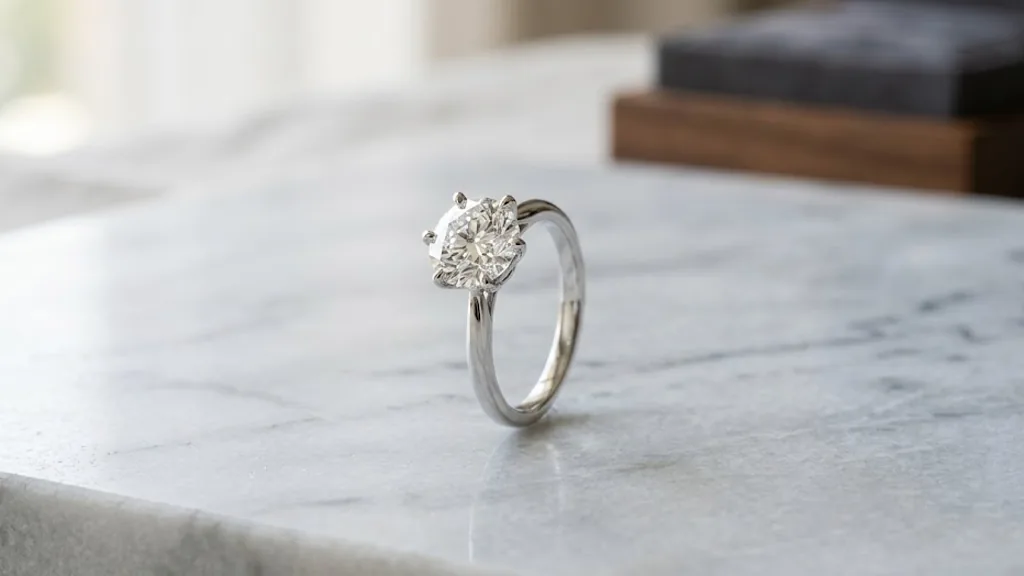
The cheapest transformation there is. Your diamond is unchanged; the ring around it is new. A stone that has sat in a plain solitaire for ten years looks completely different in a halo, a hidden halo or a modern twisted band. You pay for the new setting and the goldsmith’s time only.
Adding a surround is the most dramatic version of this — we have written separately on whether you can add a halo to an existing ring.
2. Trade up the centre stone
Keep the design, increase the stone. Worth knowing before you start: because carat weight rises much faster than visible width, going from 1ct to 1.5ct adds under a millimetre of spread. Read our guide to choosing a carat size before you commit, so you upgrade to something you will actually see.
3. Add rather than replace
Often the happiest answer. Rather than changing the ring that was proposed with, add a diamond band alongside it. A stackable round cut three quarter eternity band sits against an existing engagement ring and changes the whole look of the hand for a fraction of what a new ring costs. Price correct at the time of writing.
4. Repurpose the original entirely
If the ring carries difficult memories, or the style is simply finished for you, the stones can be lifted and set into something else — a pendant, earrings, or a right-hand ring. Nothing is wasted and nothing needs to be sold.
If you are upgrading for an anniversary
The most common upgrade we see is not a bigger diamond at all. It is a halo added around a modest original stone, or a matching band commissioned for a milestone year. A halo round cut engagement ring shows the effect a surround has on apparent size — it can lift a stone a full size class in appearance without touching the centre diamond.
We design bespoke pieces at no extra design cost, in solid gold or platinum, so a reset or a matched band is a conversation rather than a compromise.
Frequently asked questions
How much can I get for my diamond engagement ring?
Meaningfully less than you paid, and much less than your insurance valuation. The only way to find your number is to get two or three written offers from independent buyers and compare them. Never accept the first.
Do lab-grown diamonds have any resale value?
Some, but low, and we would rather say that plainly than dress it up. Lab-grown diamonds are bought for what they are — a real diamond at a far more sensible price — not as a store of value. If resale matters more to you than size and quality today, that is a genuine reason to weigh natural stones instead.
Will my jeweller buy the ring back?
Ask, but do not assume. Buy-back is not standard practice in the UK trade. Trade-in against a new purchase is much more commonly offered than cash.
Is it worth getting a valuation before selling?
For insurance, yes. As a guide to selling price, no — an insurance valuation will give you an unrealistically high expectation and make every genuine offer feel insulting.
Can any ring be resized or reset?
Most can, but not all. Full eternity bands and some tension or channel settings are difficult or impossible to alter. Have a jeweller look at the actual ring before you plan around it.
Should I sell an inherited engagement ring or reset it?
Reset it, in almost every case. Inherited stones rarely fetch what they mean, and a modern setting around an old stone keeps the history while making it wearable.
Thinking about the next ring?
Whether you are upgrading, resetting or starting again, it helps to see what is possible. Browse the engagement ring collection for settings, or the wedding and eternity bands if adding alongside appeals more than replacing. Free insured UK delivery and 30-day returns on everything.
More guides on this topic
Ready to find your perfect ring?
Explore our lab-grown diamond collection or book a virtual appointment with our team.