
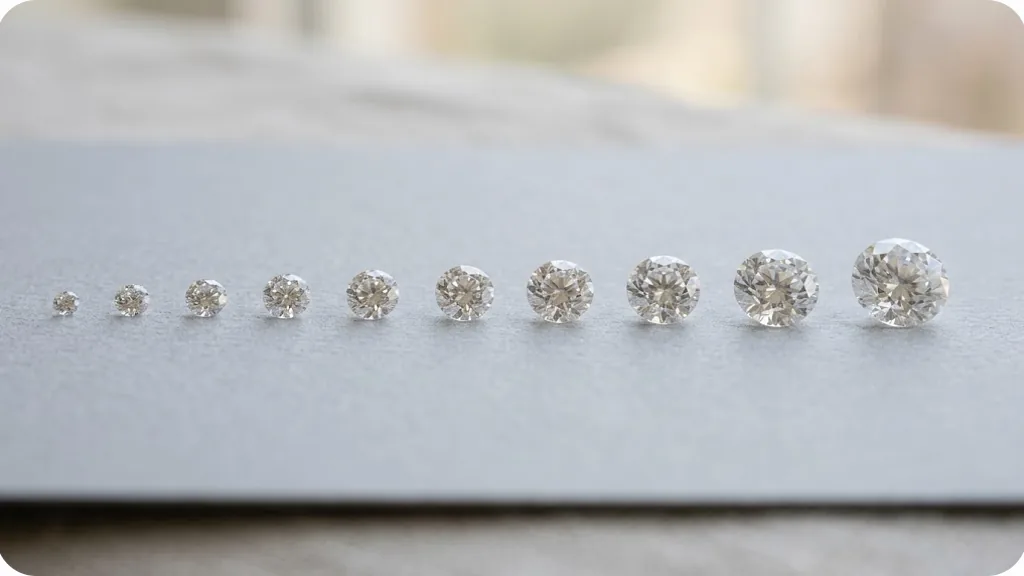
What Carat Size Diamond Should You Choose for an Engagement Ring?
Good, standard, normal or large? What each carat weight looks like in millimetres, and how to pick the right size for your budget.
This is the question we are asked more than any other, and it arrives in about eight different disguises. What is a good carat? What is standard? What is normal? What counts as big? How many carats should I actually buy?
They all have the same honest answer, so this guide gives it once, properly, and then deals with each version of the question in turn. By the end you should be able to walk into any jeweller’s and say a number with confidence.
First, carat is weight — not size
A carat is a unit of weight. One carat is 0.2 grams, and it is divided into 100 “points”, so a 0.50ct stone is often called a fifty-pointer.
This matters because two diamonds of identical carat weight can look noticeably different in size on the hand. A stone cut deep hides weight underneath, where nobody sees it. A stone cut well spreads that weight across the top. What your friends actually see is the millimetre measurement across the top of the stone, not the number on the certificate.
So the useful skill is not memorising carat weights. It is knowing roughly what each weight looks like in millimetres.
What each carat weight actually looks like
These are approximate top-diameter measurements for a well-proportioned round brilliant diamond. Treat them as a guide, not a specification — real stones vary by a few tenths of a millimetre either way.
| Carat weight | Approx. diameter (round) | How it reads on the hand |
|---|---|---|
| 0.25ct | 4.1 mm | Delicate. Clearly a diamond, quietly worn. |
| 0.50ct | 5.2 mm | Comfortably visible. A common first choice. |
| 0.75ct | 5.8 mm | Noticeable without being a talking point. |
| 1.00ct | 6.5 mm | The classic. Reads as a “proper” diamond to most people. |
| 1.50ct | 7.4 mm | Generous. Gets noticed across a table. |
| 2.00ct | 8.1 mm | Large by any normal standard. |
| 3.00ct | 9.3 mm | A statement stone. |
Notice how slowly the millimetres climb. Doubling the weight from 1ct to 2ct does not double the width — it adds about a quarter. Diamonds are three-dimensional, so weight rises much faster than visible spread. This single fact should change how you budget.
What is a good diamond carat for an engagement ring?
A good carat weight is the largest stone you can buy without compromising the cut, and without spending money you would rather keep.
If we had to give one range, most first engagement rings sit somewhere between 0.50ct and 1.50ct. That is a trade rule of thumb from what we see across the counter, not a measured national figure, and we are not going to pretend otherwise. We have seen very happy 0.30ct buyers and very happy 2ct buyers.
What makes a carat weight “good” is what surrounds it:
- Cut quality first. A well-cut 0.90ct stone outshines a badly cut 1.20ct stone, and often looks the same size or bigger.
- Colour and clarity that hold up in daylight. You do not need flawless. You need a stone with no visible inclusions to the naked eye and no obvious warmth if it is set in white metal.
- Proportion to the hand. A 1ct stone on a size J finger looks considerably bigger than the same stone on a size R.
What is the standard size diamond for an engagement ring?
There is no official standard, and anyone quoting you a precise national average carat weight is almost certainly repeating a figure with no reliable source behind it. We will not invent one.
What is true is that 1.00ct is the reference point everybody has in their head. It is the weight jewellers quote, the weight advertising uses, and the weight most people picture when they hear “diamond ring”. If you want a diamond that looks unmistakably like the mental image, 1ct is where that lives.
Just be aware that 1.00ct carries a price jump. Stones priced per carat step up sharply at round numbers, so a 0.95ct diamond can cost meaningfully less than a 1.00ct of otherwise identical quality while being about a tenth of a millimetre narrower. Nobody will ever see that difference. Buyers who know this trick — often called buying “shy” of a milestone weight — get more ring for the money.
What is a decent size diamond? What is normal?
These two phrasings usually mean the same thing: will people think it’s too small?
Practically speaking, anything from 0.50ct upwards reads clearly as a diamond engagement ring to an ordinary observer at conversational distance. Below about 0.30ct in a plain solitaire, the stone starts to read as delicate rather than as a centrepiece — which is a perfectly valid choice, and a beautiful one on a small hand, but it is a different look.
If your worry is that a modest stone will look modest, the setting solves it far more cheaply than extra carat weight does. See the section below on making a diamond look bigger.
What is considered a large diamond engagement ring?
In everyday British terms:
| Weight | How it is generally described |
|---|---|
| Under 0.50ct | Petite / delicate |
| 0.50ct – 0.99ct | Classic, everyday |
| 1.00ct – 1.49ct | Substantial |
| 1.50ct – 2.49ct | Large |
| 2.50ct and above | Statement — noticed immediately |
These are descriptive conventions in the trade, not defined categories. There is no point at which a diamond officially becomes “large”.
How many carats should you actually buy?
Work in this order, and the number decides itself.
- Set the total budget first — the whole ring, not the stone. Ignore old “months of salary” advertising slogans entirely.
- Choose the shape. Elongated shapes look larger per carat (more on this below).
- Choose the setting. Halo and hidden-halo designs add visible width for far less than extra carat weight costs.
- Fix cut quality as non-negotiable, then let carat weight take whatever is left.
That last step is the one people get backwards. If you start from a carat number and then squeeze the quality to reach it, you end up with a big, dull stone. Start from the light and let the size follow.
Getting a bigger look without a bigger stone
Three genuinely effective tricks, in order of how much size they add per pound spent:
Choose an elongated shape. Oval, marquise and pear diamonds spread their weight along the finger, so they cover more surface than a round of the same weight. A solitaire oval cut engagement ring looks larger on the hand than an equivalent round, and a marquise looks larger still.
Add a halo. A halo is a ring of small diamonds set around the centre stone. It grows the outline dramatically. A halo round cut engagement ring can read a full size class above its actual centre weight.
Keep the band slim. A narrow shank makes the stone look proportionally bigger. This is why a minimalist round cut engagement ring often photographs larger than you expect. Prices correct at the time of writing.
Frequently asked questions
What size diamond engagement ring should I buy?
The one that fits your budget after cut quality is protected. If you want a single starting number to react to, begin at 1.00ct, then move up or down once you have seen a shape and setting you love. Most people adjust downward slightly and spend the difference on a better cut.
Is a 0.5 carat diamond too small?
No. At roughly 5.2mm across it is plainly visible and sits beautifully on most hands, particularly in a halo or a three-stone design. “Too small” is a comparison problem, not a stone problem.
Does carat weight affect how sparkly a diamond is?
Not directly. Sparkle comes from cut proportions and polish. A larger stone simply gives you more surface area for that sparkle to happen on, which is why a big badly cut diamond can look flat and disappointing.
Do lab-grown diamonds let me go bigger?
Yes, and that is the main practical reason people choose them. A lab-grown diamond is chemically and optically the same material as a mined one, so the size step you gain is real, not a compromise. Every centre stone we set is lab-grown and comes with a free IGI certificate.
Can I upgrade the carat weight later?
Often, yes. Many couples start with a smaller centre stone and reset it for a milestone anniversary. Talk to us before you buy if that is your plan, because some settings are far easier to work with later than others.
What if I cannot find the exact carat weight I want?
We design bespoke pieces at no extra design cost, in solid gold or platinum, so a specific weight and shape combination can be made rather than compromised on.
Have a look for yourself
Numbers on a page only take you so far — seeing shapes next to each other is what makes the decision click. Browse the full engagement ring collection, or narrow it to oval cut rings if you want maximum visible spread for the weight. Free insured UK delivery and 30 days to return anything that is not right.
Ready to find your perfect ring?
Explore our lab-grown diamond collection or book a virtual appointment with our team.











