Is a Lab-Grown Diamond a Moissanite?
No. One is carbon, the other silicon carbide. The real differences in fire, hardness, grading and price, explained plainly.
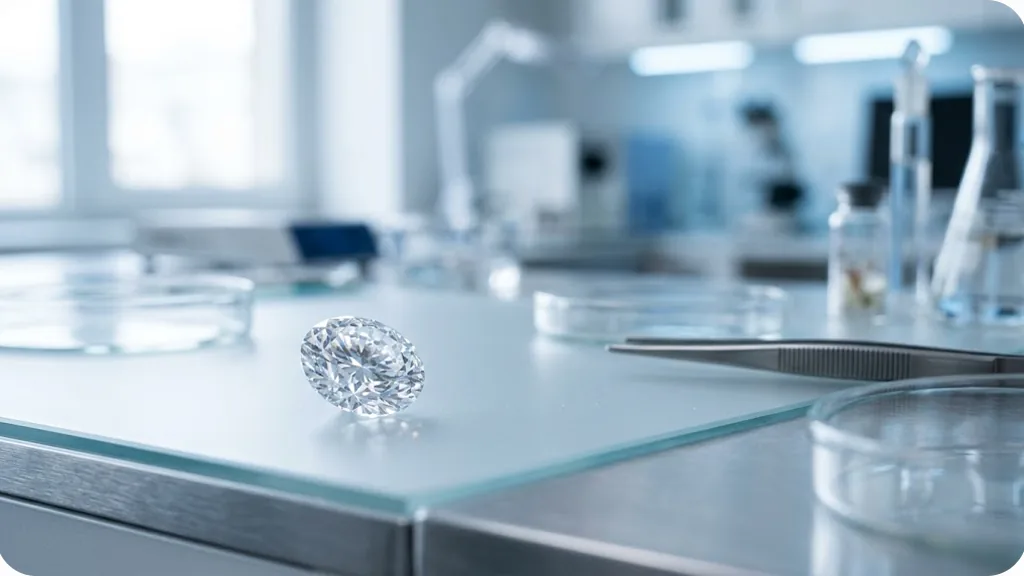
Short answer: no. A lab-grown diamond and a moissanite are two completely different stones, made of different materials, with different physical properties and very different prices.
The confusion is understandable. Both are grown in laboratories rather than mined. Both are sold as affordable alternatives to natural diamonds. Both sparkle brilliantly. But one is diamond and the other is not, and that distinction matters — both for how the stone looks and for what you are entitled to call it.
What each one actually is
Lab-grown diamond
Pure carbon, crystallised in the diamond lattice. Chemically, physically and optically identical to a mined diamond. It is graded on the same four Cs by the same laboratories, tests as diamond on a jeweller’s tester, and is legally described as a diamond — with the word “laboratory-grown” attached.
Moissanite
Silicon carbide — a compound of silicon and carbon. A completely different material. It was first identified in a meteorite crater by the French chemist Henri Moissan in 1893, which is where the name comes from. Natural moissanite is vanishingly rare, so every moissanite you can buy is laboratory-grown.
Moissanite is a beautiful gemstone in its own right. It is not diamond, and it is not a “fake diamond” either — it is its own thing, and the honest sellers describe it that way.
The properties compared
| Lab-grown diamond | Moissanite | |
|---|---|---|
| Chemical composition | Carbon (C) | Silicon carbide (SiC) |
| Hardness (Mohs) | 10 | About 9.25 |
| Refractive index | About 2.42 | About 2.65 |
| Dispersion (fire) | About 0.044 | About 0.104 |
| Double refractive? | No | Yes |
| Graded on the four Cs? | Yes, by IGI, GIA and others | No — sold by colour range and size |
| Sold by | Carat weight | Usually millimetre size |
| Reads as diamond on a tester? | Yes | No — flagged as moissanite |
| Price | Higher | Lower |
What those numbers mean when you look at the stone
Three of those rows change the appearance in ways you can genuinely see.
Fire
Dispersion is the property that splits white light into rainbow colours. Moissanite’s dispersion is roughly two and a half times that of diamond. In small stones and soft lighting this reads as extra life. In larger stones under bright light it produces a strong rainbow flash that some people love and others describe as looking artificial — the “disco ball” effect you will see mentioned in forums.
It is a matter of taste, not quality. But it is the single most reliable way to tell the two apart across a room.
Double refraction
Moissanite splits light into two rays as it passes through the stone. Look through the top facet at an angle under magnification and you can see facet edges appearing doubled, like a slight print misregistration. Diamond is singly refractive and never does this. This is the classic gemmologist’s check.
Hardness
Moissanite at about 9.25 is genuinely hard and perfectly suitable for daily wear. Diamond at 10 is harder still. The Mohs scale is not linear, so the real-world gap is wider than the numbers suggest — diamond is considerably harder than anything below it. Over decades of daily wear, a diamond’s facet edges stay crisper. Both will resist ordinary scratching.
Colour and clarity
Modern moissanite is usually described as colourless or near-colourless, but many stones show a faint greenish, greyish or yellowish cast in certain lighting, particularly in larger sizes and in daylight. It is not a defect; it is characteristic of the material.
Moissanite is not graded on the diamond clarity scale by an independent laboratory. Sellers describe it in their own terms. A lab-grown diamond, by contrast, arrives with a formal report — every centre stone we sell comes with a free IGI certificate stating cut, colour, clarity and carat weight, plus a laser-inscribed report number on the girdle you can verify online.
That verifiability is the practical difference. With a lab-grown diamond you can check the seller’s claims against an independent record. With moissanite you are relying on the seller’s own description.
Price and value
Moissanite is significantly cheaper than lab-grown diamond, which is in turn significantly cheaper than natural diamond. We are deliberately not quoting percentages, because the gaps shift constantly.
Neither holds meaningful resale value — and nor, in truth, does most natural diamond jewellery once you account for the difference between retail and trade prices. Buy either one to wear, not as an investment.
The question worth asking is not “which is cheaper” but “what do I want for this budget”. Moissanite buys you more size for less money. Lab-grown diamond buys you a certificated diamond, with the grading, the inscription and the word itself. For an engagement ring, many people find the second matters more than they expected.
Will they be confused with each other?
Not by a jeweller. Older thermal-only testers could be fooled by moissanite, which is where much of the internet folklore comes from, but modern combination testers add an electrical conductivity check that separates the two instantly and reliably.
So a lab-grown diamond reads diamond, and a moissanite reads moissanite. There is no ambiguity with current equipment. We cover the testing question in full in do lab-grown diamonds test as real diamonds.
A note on what we stock
CarbonstoneUK sells lab-grown diamonds only. We do not stock moissanite, cubic zirconia or any other simulant, so there is no product link we can honestly point you to for one.
If you want to see what a lab-grown diamond looks like in a setting, the Solitaire Oval Cut Engagement Ring at £557 and the Solitaire Round Cut Engagement Ring at £657 (both correct at the time of writing) are our clearest examples — a single certificated centre stone with nothing to distract from it.
Frequently asked questions
Is moissanite a fake diamond?
No, and it should not be sold as one. It is a genuine gemstone made of silicon carbide. It is a diamond alternative, not a diamond imitation in the way glass or cubic zirconia is.
Can a normal person tell moissanite from a diamond?
Side by side in bright light, often yes — the extra rainbow fire is noticeable. On its own, on a hand, usually not. Under a loupe, the doubled facet edges give it away immediately.
Does moissanite get cloudy?
No, and neither does diamond. Both myths come from the same source: a film of soap, hand cream and skin oil on the underside of the stone. Warm water, washing-up liquid and a soft brush restores both.
Which is better for an engagement ring?
If certification, the word “diamond”, and maximum hardness matter to you, choose a lab-grown diamond. If maximum size for minimum spend is the priority and you like a fiery look, moissanite is a reasonable choice. Both wear well.
Do you sell moissanite?
No. We work with lab-grown diamonds exclusively. If you want a design we make but with a different stone, ask about bespoke — we charge no extra design cost — but we will always be straight with you about what we can and cannot supply.
Have a browse
Every ring we make is hand-made in solid gold or platinum in North Harrow, London, set with an untreated lab-grown diamond and a free IGI certificate, delivered insured and free within the UK with 30 days to return it.
Browse the engagement rings or the oval cut selection, and read lab-grown versus natural diamonds if you are still weighing up which stone to buy.
Ready to find your perfect ring?
Explore our lab-grown diamond collection or book a virtual appointment with our team.