Are Lab-Grown Diamonds Better for the Environment?
An honest look at whether lab-grown diamonds are greener: what mining involves, what growing costs in energy, and which claims to trust.
Lab-grown diamonds are usually sold as the greener choice, and we sell lab-grown diamonds, so you should read what follows with that in mind. The honest position is more complicated than the marketing on either side, and you are better served by understanding the actual trade-offs than by being handed a number.
What is a lab-grown diamond?
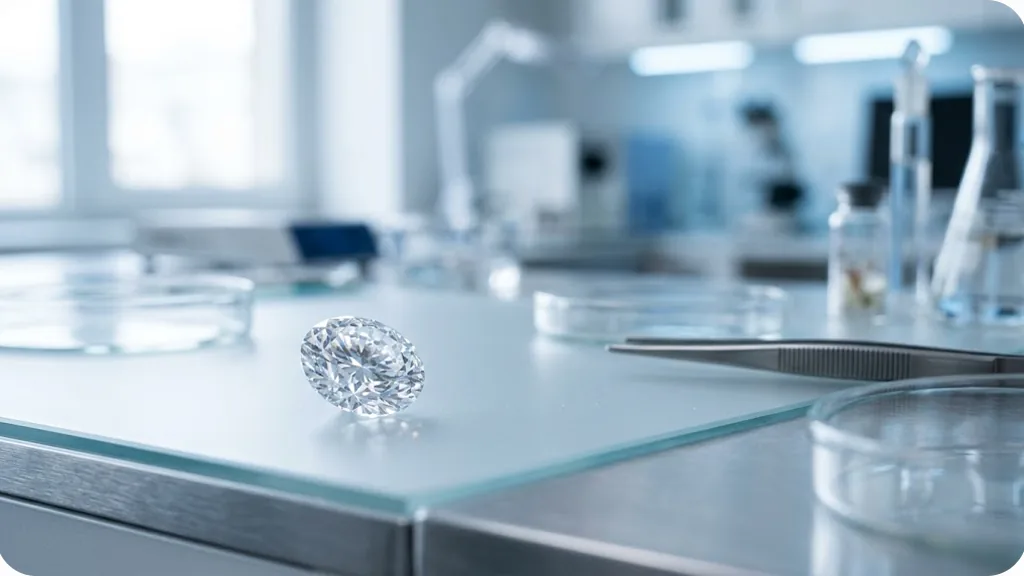
A lab-grown diamond is a diamond. Same carbon atoms arranged in the same crystal structure, same hardness, same optical behaviour. It is not a simulant like cubic zirconia or moissanite, both of which are different materials that only resemble diamond.
The difference is where it formed. A mined diamond formed deep in the earth over a very long period. A lab-grown diamond is formed in a reactor over a matter of weeks, either by HPHT — high pressure, high temperature, which imitates the conditions underground — or by CVD, chemical vapour deposition, where carbon is deposited onto a seed crystal from a heated gas.
A standard gemmological test cannot tell them apart, which is why laboratories use specialist equipment and why every lab-grown stone of any size is laser-inscribed and certificated. We cover the technical detail in our guides to how lab-grown diamonds are made and how they differ from natural diamonds.
Are lab-grown diamonds better for the environment?
You will find confident figures on both sides of this. Mining bodies publish research showing lab-grown production is energy-intensive; lab-grown producers publish research showing mining moves vastly more earth. Both sets of figures were commissioned by interested parties, and the methodologies differ enough that they are not really comparable.
We are not going to quote you a percentage. Any single number in this space should be treated with suspicion, including numbers that would flatter us.
What can be said without inventing anything:
What mining involves
Diamond mining is a large-scale earth-moving operation. Open-pit mines are among the biggest holes humans dig, and recovering gem-quality rough means processing an enormous volume of rock relative to the diamonds obtained. It changes landscapes permanently, uses a great deal of water, and produces tailings that have to be managed.
It also, in many places, provides substantial employment and public revenue. Some producing countries depend on it heavily. A shift away from mined diamonds is not costless for those economies, and pretending otherwise is not honest.
What growing involves
Growing a diamond takes sustained heat and pressure, or sustained plasma, for weeks. That means significant electricity consumption. The environmental footprint therefore depends almost entirely on where the electricity comes from.
A stone grown on a grid running largely on coal has a very different profile from one grown on hydroelectric or solar power. This is the crux of the whole question, and it is why blanket claims about lab-grown diamonds being clean are not reliable. It depends on the facility.
Growing does not move earth, does not create tailings, and does not permanently alter a landscape. Those are real differences, not marketing.
What else do people mean when they ask if lab-grown is better?
Environmental impact is often not what people actually mean when they ask if lab-grown is “better”. They usually mean a bundle of concerns.
| Concern | Mined | Lab-grown |
|---|---|---|
| Land disturbance | Substantial and permanent | Industrial facility only |
| Energy use | Machinery and processing | High, and grid-dependent |
| Traceability | Improving, but supply chains are long | Origin known by definition |
| Labour conditions | Varies enormously by operation | Factory conditions; varies by country |
| Local economies | Significant employment in producing nations | Employment concentrated elsewhere |
Traceability is the strongest honest claim for lab-grown. A stone that was grown in a known reactor at a known facility has a shorter, clearer chain than one that passed through several countries between the ground and the ring.
How can you check an eco-friendly diamond claim?
If a seller tells you their diamonds are sustainable, these are fair questions:
- Which facility grew the stone, and in which country?
- What powers that facility?
- Is the claim independently verified, or self-reported?
- Is “carbon neutral” being achieved through reduction or through purchased offsets?
Vague words — eco, green, conscious, responsible — are not regulated terms in jewellery. A claim that cannot be answered with a specific facility and a specific power source is a slogan.
Why do we sell lab-grown diamonds?
We work exclusively in lab-grown diamonds. Our honest reasons, in order: they cost substantially less than mined stones of equivalent size and grade, so customers get a bigger or better stone for their money; their origin is known; and they avoid large-scale extraction. We think that combination is a good deal for our customers.
We are not going to tell you the carbon figure is zero, because it is not, and we are not going to hand you a comparison chart we did not produce. If environmental impact is your primary reason for buying, the greenest diamond ring is one that already exists — a second-hand or inherited stone reset into a new design. We do that work as a bespoke commission at no extra design cost, and we would rather say so than pretend a new stone is the only option.
What comes with one of our rings?
Every centre stone comes with a free IGI certificate, so you know exactly what you have bought. Rings are hand-made in solid gold, platinum or sterling silver in our North Harrow workshop, with free insured UK delivery and 30 days to return.
If you want to see what the price difference actually buys, a solitaire round cut engagement ring at £657 or a solitaire oval cut engagement ring at £557 — both correct at the time of writing — give a reasonable idea of where lab-grown stones land compared with mined equivalents.
What does certification actually tell you?
A laboratory report is the only part of this conversation that is not subject to interpretation, so it is worth understanding what you are getting.
An IGI or GIA report on a lab-grown diamond states the growth method where determinable, the carat weight, the cut, colour and clarity grades, the measurements, and the laser inscription on the girdle that ties the stone to the paperwork. It states plainly that the stone is laboratory-grown.
What it does not tell you is where the stone was grown or what powered the facility. No mainstream gemmological report covers that. If a seller makes an environmental claim, the report will not substantiate it — you have to ask them directly.
We include a free IGI certificate on centre stones as standard. Small stones set in bands are graded as a matched parcel rather than individually, which is normal practice throughout the trade.
What about the metal in the rest of the ring?
The diamond is only part of what you are buying, and the metal is easy to overlook.
Gold and platinum are also mined, and gold mining carries its own well-documented environmental and human costs. Recycled precious metal is widely available and is a genuine reduction in impact rather than a marketing line, because the metal is infinitely reworkable without loss of quality.
If this matters to you, ask your jeweller about metal sourcing as well as stone origin. It is a fair question and a good jeweller will answer it plainly rather than reaching for a slogan.
Frequently asked questions
Are lab-grown diamonds real diamonds?
Yes. Same material, same hardness, same optical properties. They are not simulants.
Are lab-grown diamonds better for the environment?
They avoid large-scale mining, but growing uses significant energy and the footprint depends heavily on the electricity source. Be sceptical of any single figure quoted by either side.
Do lab-grown diamonds hold their value?
Diamonds in general are poor investments, mined or grown. Buy a ring because you want to wear it, not as an asset. Our note on whether lab-grown diamonds are getting cheaper looks at the price trend.
Can a jeweller tell if a diamond is lab-grown?
Not with standard tools. It takes specialist laboratory equipment, which is why certification and laser inscription matter.
What is the most environmentally sound diamond ring?
One that already exists. Resetting an inherited or second-hand stone into a new design uses no newly produced diamond at all.
If you would like to see the range, our engagement rings and wedding bands are all set with lab-grown stones, and our guide to the price difference between lab-grown and natural covers the cost side in detail.
Ready to find your perfect ring?
Explore our lab-grown diamond collection or book a virtual appointment with our team.