
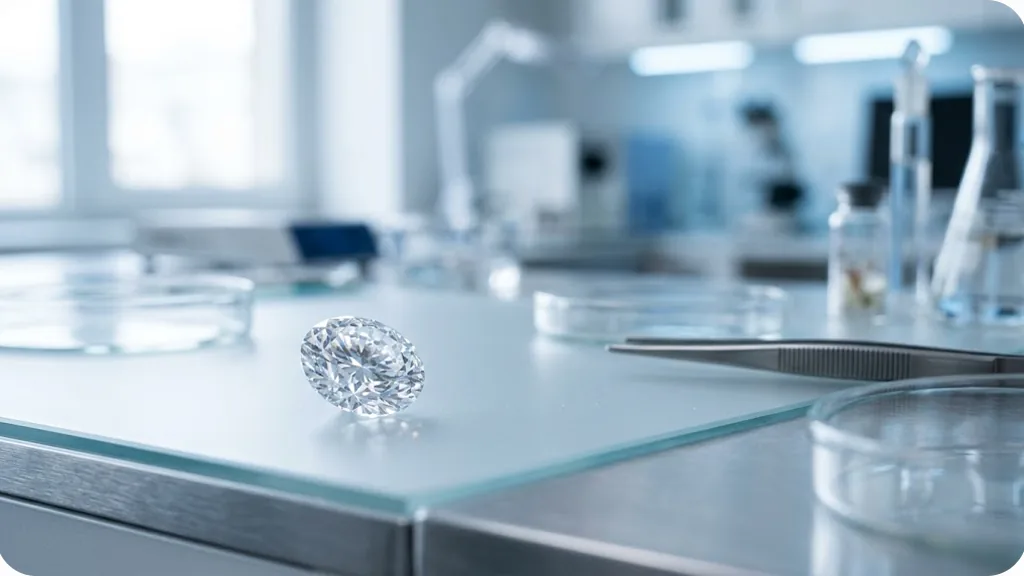
Do Lab-Grown Diamonds Test as Real Diamonds?
Yes, and here is why. How diamond testers work, what they can and cannot detect, and how laboratories confirm a stone's origin.
Two versions of the same worry come up again and again: “will a lab-created diamond test positive?” and “does a lab diamond test as a real diamond?” Both are usually asked by someone about to hand their ring across a jeweller’s counter, quietly dreading a beep that says “fake”.
The answer is reassuring. Yes. A lab-grown diamond tests as a diamond, because it is one. A standard diamond tester will read it as diamond every time. Below is how those testers actually work, what they can and cannot tell you, and how a laboratory distinguishes lab-grown from mined when it needs to.
Why it passes: it is the same material
A lab-grown diamond is pure carbon arranged in the diamond lattice — the same material, structure and properties as a mined diamond. Same hardness of 10 on the Mohs scale. Same refractive index. Same density. Same thermal and electrical behaviour.
A diamond tester does not know or care where carbon was assembled. It measures physical properties. Identical properties give an identical reading.
This is also the legal position. In the UK and internationally, lab-grown diamonds are classed as diamonds and must be described as “laboratory-grown”, “lab-created” or “synthetic” — not as imitations. An imitation is something like cubic zirconia, which is a different material altogether.
How the common testers work
Thermal conductivity testers
The classic pen-style tester most high street jewellers keep behind the counter. Diamond conducts heat better than almost anything else. The probe applies a tiny amount of heat and measures how fast it is drawn away. Diamond drains it instantly; glass, cubic zirconia and white sapphire do not.
A lab-grown diamond conducts heat exactly as a mined diamond does. It reads DIAMOND. There is no separate reading for lab-grown, because the machine has no way of producing one.
Combination diamond and moissanite testers
Thermal testers had one famous weakness: moissanite conducts heat nearly as well as diamond and used to fool them. Modern testers therefore add a second check based on electrical conductivity, which separates the two cleanly.
A lab-grown diamond passes both stages. It reads as diamond, not as moissanite. If you are worried about the moissanite question specifically, we cover it in is a lab-grown diamond a moissanite.
Home tests you may have read about
The fog test, the water test, the newspaper test and the scratch test are all unreliable and some are damaging. None of them can tell a lab-grown diamond from a mined one, because there is no property to separate them on. Skip them.
| Test | What a lab-grown diamond does | Useful? |
|---|---|---|
| Thermal probe tester | Reads DIAMOND | Yes, for diamond vs simulant |
| Diamond/moissanite combo tester | Reads DIAMOND | Yes, for diamond vs moissanite |
| Fog / breath test | Same as any diamond | No |
| Loupe examination | Real inclusions, sharp facets | Confirms diamond, not origin |
| Laboratory screening | Identified as laboratory-grown | Yes — the only reliable method |
So how does anyone tell lab-grown from mined?
Not with a counter tester. Distinguishing origin needs specialist equipment, and it works by looking for traces of how the crystal grew rather than what it is made of.
- Growth pattern imaging. Instruments such as the DiamondView expose the stone to deep ultraviolet light and photograph how it glows. Natural diamonds show irregular, geological growth patterns. CVD-grown stones show flat layered banding; HPHT-grown stones show a distinctive cross-shaped or sectored pattern.
- Photoluminescence spectroscopy. Cooled to very low temperatures and hit with a laser, diamonds emit a spectrum that carries a signature of their growth environment.
- Ultraviolet transparency. Most lab-grown diamonds are what gemmologists call type IIa — chemically very pure, with almost no nitrogen. Only a small minority of natural diamonds are type IIa, so this makes a useful first screen.
- Inclusion type. Metallic flux inclusions point to HPHT growth. No natural diamond contains them.
All of this happens in a laboratory, which is why origin is stated on a grading report rather than tested for in a shop.
The laser inscription: the easy answer
There is a much simpler route, and it is the one to use in practice.
Certificated diamonds are laser-inscribed on the girdle — the thin outer rim — with their report number, in characters far too small to see unaided. Lab-grown stones are additionally inscribed with wording such as “LAB GROWN”, “LG” or the growth method.
Any jeweller with a microscope can read it in under a minute. You can then type the report number into the laboratory’s free online report-check tool and see the original grading data straight from the source. That is proof of both quality and origin, and it takes about thirty seconds.
Every centre stone we sell comes with a free IGI certificate for exactly this reason. Whether you choose the Solitaire Round Cut Engagement Ring at £657 or the Hidden Halo Oval Cut Engagement Ring at £1,021 (prices correct at the time of writing), the paperwork travels with the stone.
What this means for you in real life
Insurance. Insurers value a lab-grown diamond as a lab-grown diamond, using the certificate. The stone testing as diamond is not in question; what they need is the grading report and a valuation.
Repairs and resizing. Any jeweller can work on it. There are no special precautions, unlike treated or filled stones. It takes heat, ultrasonic cleaning and repolishing exactly as a mined diamond does.
Valuation and resale. A valuer will identify it correctly from the certificate and inscription, and price it as lab-grown. Be realistic here: lab-grown diamonds sell for a fraction of their retail price second-hand, as most jewellery does. Buy one to wear, not as an investment.
Honesty. There is no need to hide anything, and no benefit in it. A lab-grown diamond is a real diamond with a documented origin. Selling it as mined would be fraud; describing it accurately costs you nothing, because the stone is genuinely beautiful on its own terms.
Frequently asked questions
Will a lab-created diamond test positive on a jeweller’s tester?
Yes. It reads as diamond. A counter tester identifies material, not origin, and lab-grown diamonds are the same material.
Can a jeweller tell my ring is lab-grown just by looking?
An experienced gemmologist may suspect it from the inclusion types under magnification — metallic flux, or very high clarity with no nitrogen-related features. Confirming it needs laboratory equipment or the girdle inscription.
Do lab diamonds show up differently under UV light?
Sometimes. Many lab-grown stones fluoresce differently from mined ones, and some CVD stones show a distinctive afterglow. But natural diamonds vary hugely in fluorescence too, so an ordinary UV torch proves nothing.
Is it dishonest to give a lab-grown engagement ring?
Only if you conceal it. Most people we speak to are delighted — a certificated, untreated, larger, brighter stone for the same budget is an easy story to tell. It is a real diamond and the certificate says so.
What if my stone has no certificate?
Then origin cannot be confirmed without laboratory screening. That is a good reason to buy certificated in the first place, and to insist on it from any seller.
See the certificates for yourself
Every ring we make is set with an untreated lab-grown diamond, certificated free by IGI, hand-made into solid gold or platinum in North Harrow, London. Free insured UK delivery, 30-day returns, and bespoke design at no extra design cost.
Browse the engagement rings or the wedding rings. To understand where these stones come from, read how lab-grown diamonds are made.
Ready to find your perfect ring?
Explore our lab-grown diamond collection or book a virtual appointment with our team.











