Are Promise Rings Bad Luck? The Myths, Answered Plainly
No superstition attaches to promise rings, including losing one. The real risks are sizing, damage and being misread as a proposal.
No. There is no tradition, no established superstition and no evidence of any kind that a promise ring brings bad luck. If you have read otherwise, you have read something written to fill a page.
The same goes for losing one. Losing a promise ring is upsetting and expensive; it is not an omen, and it says nothing about the relationship. Below we take each version of this worry in turn — the ring itself, losing it, taking it off, and the broader question of whether promise rings are a bad idea at all — and answer them plainly.
Where the “bad luck” idea comes from
Jewellery attracts superstition because it is worn on the body and given at emotional moments. Some old ring superstitions do exist in folklore — beliefs about opals, about pearls at weddings, about dropping a wedding ring during the ceremony. None of them attaches to promise rings, which are far too recent as a named custom to have collected any folklore at all.
What has happened instead is more mundane. Search engines reward pages that answer questions, so somebody wrote “are promise rings bad luck”, somebody else copied it, and the question now looks established because it appears so often. The question is manufactured. The answer is still no.
Is losing a promise ring bad luck?
It is not. It is a practical problem, and worth treating as one.
Most rings are lost in four ways: they slip off cold hands, they are taken off at a sink or gym and forgotten, they come off with gloves, or they go missing at the beach. Fingers also shrink in cold weather and swell in heat, which is why a ring that fits perfectly in July can slide off in January.
What actually helps:
- Get the size right. A ring should need a small amount of effort to come over the knuckle. If it spins loosely, it will eventually leave.
- Have one place it goes. A dish by the sink, a pouch in a bag. Not a pocket, not a windowsill.
- Check the settings. Stones loosen over time. A jeweller can tighten claws in minutes; replacing a lost diamond costs considerably more.
- Consider insurance. Many home contents policies cover jewellery up to a limit, and single items above that usually need naming.
If it is already gone, replacing it is not a betrayal of the original. Plenty of couples replace a lost ring and treat the replacement as the same promise, which is exactly right — the promise was never in the metal.
Is it bad luck to take a promise ring off?
No, and taking it off at the right moments is how rings survive. Remove it for heavy lifting, for the gym, for gardening, for swimming in the sea, and before any cleaning product with bleach in it. Chlorine and other harsh chemicals attack the alloys in gold over time, and impact damage bends bands and knocks stones loose.
A ring taken off sensibly and worn for forty years is a much better tribute to a promise than one worn constantly and ruined in five.
Are promise rings a bad idea?
This is the more serious question hiding under the superstition one, and it deserves a real answer rather than reassurance.
A promise ring is a good idea when it means something specific that both people understand. It is a bad idea in one situation: when it is used to buy time or to quiet a conversation that needs having. If one person wants an engagement and the other gives a promise ring instead of an answer, the ring becomes a substitute for honesty, and that ends badly regardless of how nice the ring is.
| Reason for giving it | Is it a good idea? |
|---|---|
| Marking a serious commitment before either of you is ready to marry | Yes |
| Something to wear while apart for study, work or service | Yes |
| A gift on an anniversary that is not about the future at all | Yes |
| Because they asked about engagement and you want to delay the discussion | No — have the conversation first |
| To reassure someone after you have hurt them | No — a ring does not repair trust |
The one real risk, and how to avoid it
The genuine hazard is not luck; it is being misunderstood. Give someone a classic solitaire, on the left ring finger, in a restaurant, and it will be read as a proposal no matter what you say afterwards. That produces an awkward evening and, occasionally, a very public misunderstanding.
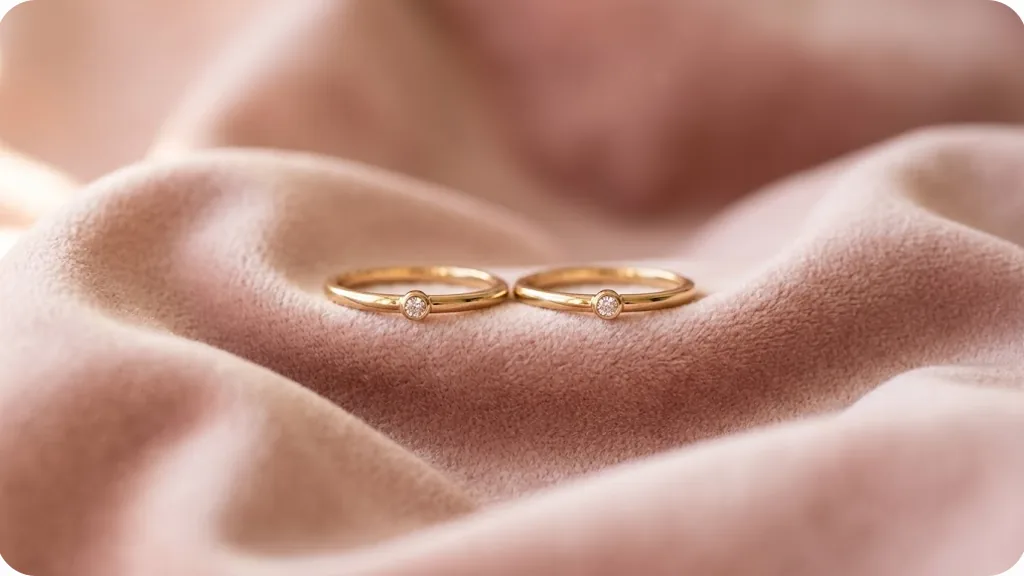
Avoiding it is easy. Choose a design that does not look bridal, and say clearly what the ring is for when you give it. Stacking bands, two-stone designs and slim eternity-style rings all read as jewellery rather than as an engagement. A stackable pear cut ring at £503 or a baguette cut half eternity band at £672 (both correct at the time of writing) sit firmly on the right side of that line, and both stack neatly beside an engagement ring later if one comes.
The superstitions that do exist, and why they do not apply
For completeness, here are the ring beliefs that genuinely circulate in Britain, so you can see how little any of them touches a promise ring.
- Opals are unlucky unless they are your birthstone. This is usually traced to a nineteenth-century novel rather than to any older folklore. Opal is a poor choice for daily wear anyway, because it is soft and can crack — a practical reason that has nothing to do with luck.
- Pearls mean tears. An old wedding superstition. Pearls are also soft and dislike perfume and sweat, which is the real argument against them in a ring.
- Dropping the ring during a wedding ceremony is a bad sign. Purely folklore, and one that best men have been ignoring for a very long time.
Notice the pattern. Where a superstition exists, there is usually a sensible practical concern buried underneath it about a stone that does not survive being worn. Promise rings have no equivalent, because the category is barely a few decades old.
A better thing to worry about: how it is made
If you want something to be genuinely cautious about when buying a promise ring, it is quality rather than fortune. Three things are worth checking on any ring you are considering.
Is it solid metal or plated? Gold-plated rings look right on day one and wear through to the base metal underneath. A small solid gold ring will outlast a large plated one many times over.
Is the stone certified? A certificate from an independent laboratory means the colour and clarity grades were assessed by someone with no interest in the sale. Our centre stones come with a free IGI certificate.
Can it be repaired? Gold, silver and platinum can be resized, reshaped and reset. Tungsten and some titanium rings cannot be worked on at all, which means any change of finger size ends the ring’s life.
What to do if the relationship ends
There is no rule and no superstition here either. In practice, people either return the ring, keep it and wear it on another finger, or put it away. A promise ring is a gift rather than a conditional loan, so there is rarely any expectation that it goes back, unlike the more contested question of engagement rings.
If you keep it and want to move on from it, a jeweller can reset the stone into something else entirely. That is a common request and a genuinely good use of a piece you no longer want to wear as it is.
Frequently asked questions
Is it bad luck to buy your own promise ring?
No. Buying a ring for yourself is increasingly ordinary and carries no superstition at all.
Is it bad luck if the ring does not fit?
No, it is a sizing problem. Almost all gold, silver and platinum rings can be resized; titanium and tungsten generally cannot.
Does it matter which finger it goes on?
Only for how it is read by other people, not for luck. Our guide on which hand and finger a promise ring goes on covers the usual conventions.
Is a second-hand or inherited promise ring unlucky?
No. Reusing a family ring is a lovely thing to do, and any competent jeweller can resize or reset it.
What if the ring is damaged rather than lost?
Most damage is repairable. Bent bands can be reshaped, worn claws rebuilt, and stones reset. Ask before assuming a piece is finished.
If you want to look at designs that clearly read as a promise rather than a proposal, browse our band and eternity ring collection or the smaller pieces in the engagement ring collection. Everything is hand-made, comes with free insured UK delivery, and can be returned within 30 days.
Ready to find your perfect ring?
Explore our lab-grown diamond collection or book a virtual appointment with our team.