Where Did Promise Rings Come From? An Honest History
Posy rings, gimmel rings and the Claddagh are the real ancestors of the promise ring. What is documented, what is invented, and what it means today.
The promise ring, as a named thing you can buy in a jeweller’s window, is recent. The idea behind it — a ring given as a pledge before a marriage is agreed — is very old indeed. Both statements are true, and confusing them is why so much written about promise ring history is nonsense.
This is an honest account of where the custom comes from, what is documented and what is guesswork, and why the ring you might buy today has almost nothing to do with the ones in museums.
Rings as promises: the long version
Rings have carried the meaning of a binding word for a very long time. In Roman practice, a ring could be given at a betrothal — a formal agreement to marry, made well before the wedding. Later, in the medieval and early modern periods, European courts produced a series of ring types that were explicitly about pledges rather than weddings.
Two are worth knowing about because they are the genuine ancestors of the modern idea.
Posy rings were plain bands, popular in Britain from roughly the fifteenth to the eighteenth centuries, engraved with a short line of verse or a private message. The inscription was usually inside the band, where only the wearer would read it. They were given between lovers, between friends and between family members, and the point was the words rather than any stone.
Gimmel and fede rings took the pledge further. A gimmel is a ring made of two or three interlocking hoops that separate and rejoin; a fede shows two clasped hands. Both were used in courtship across Europe, sometimes with each party wearing half until the marriage, at which point the halves were reunited on one finger.
None of these was called a promise ring. They were betrothal rings, love rings or friendship rings, and the vocabulary shifted from place to place and century to century.
The Claddagh, and a note about tidy stories
The Irish Claddagh — hands, heart and crown — is often listed in promise ring histories, and it is a genuine and much-loved tradition of the ring-as-pledge. It is also the point where the internet tends to lose its footing, attaching very precise dates and biographies to a design whose early history is not as firmly documented as the confident retellings suggest.
That is the honest position on most old jewellery: the objects survive, the customs around them are partly reconstructed, and anyone quoting exact years and origin stories with total certainty is telling a story rather than a history.
Where the modern promise ring actually comes from
The specific product — marketed under that name, aimed mainly at young couples, positioned as a step before engagement — belongs to the late twentieth and early twenty-first centuries. It grew out of a few real social changes:
- People began marrying later, leaving a longer stretch of serious commitment with no ring to mark it
- Long-distance relationships became far more common through study and work
- A generation of couples wanted a way to say “this is serious” without the weight, cost or family expectation attached to an engagement
In other words, the modern promise ring filled a gap that had opened up in how relationships actually run. That is a far more interesting origin than a borrowed medieval legend.
A rough timeline
| Period | What existed | What it meant |
|---|---|---|
| Roman era | Betrothal rings | A formal agreement to marry |
| 15th–18th century Britain | Posy rings | A private inscribed message between two people |
| 16th–17th century Europe | Gimmel and fede rings | Two halves joined at marriage; clasped hands as faith |
| 17th century onwards, Ireland | Claddagh rings | Love, loyalty and friendship, worn to signal status |
| Victorian Britain | Acrostic and regard rings | Gemstone initials spelling a hidden word |
| Late 20th century onwards | The promise ring by name | A pre-engagement pledge, defined by the giver |
Victorian Britain and the language of stones
The nineteenth century deserves its own mention, because it produced the most charming version of the pledge ring ever made. Victorian jewellers built rings where the first letters of the gemstones spelled a word. A ring set with ruby, emerald, garnet, amethyst, ruby and diamond spelled REGARD. Another arrangement spelled DEAREST.
These were given between courting couples and between friends, and they are the clearest evidence of what the tradition has always valued: a message hidden in plain sight, readable by the two people who knew what it said. They were also, by modern standards, small and inexpensive pieces. The value was in the idea.
Why the modern version looks the way it does
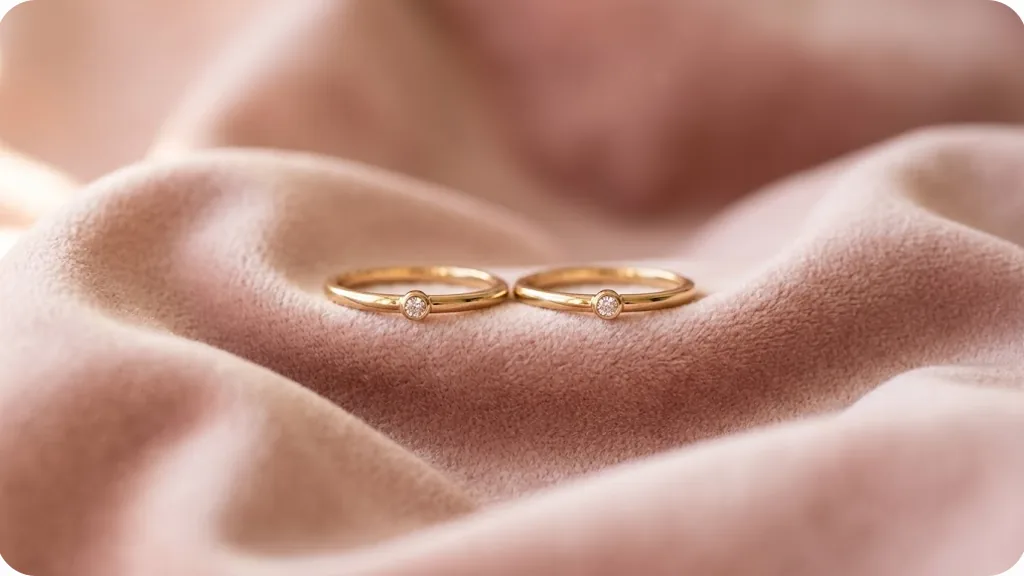
Two things shaped the promise ring you can buy today. The first is the twentieth-century rise of the diamond engagement ring as the standard, which created a very clear visual language: a single large stone means engaged. Anything given before that point therefore had to look different, which is why promise rings settled on slim bands, small stones and stacking designs.
The second is cost. A ring given at twenty-two, often by someone still studying, sits in a different price bracket from one given at thirty with a salary behind it. That pushed the category towards silver and 9ct gold, and more recently towards lab-grown diamonds, which let a modest budget buy a real certified stone rather than a very small one.
It is worth being clear that this is a commercial history as much as a romantic one. That does not make the custom hollow. Wedding rings have a commercial history too.
What survived, and what it means for choosing one
Look at that list and one thread runs through all of it: the meaning was private, and it was carried by a detail rather than by size. An inscription inside a band. Two hoops that fit together. A hidden arrangement of stones. Nobody across four centuries was trying to make the biggest possible ring.
That is genuinely useful when you are choosing. The historically faithful promise ring is a modest one with something personal built into it. Three ways to do that today:
Engrave it. The direct descendant of the posy ring. A date, a phrase, a set of initials, inside the band where only the wearer sees it. A plain, well-made band like the minimalist round cut wedding band at £687 (correct at the time of writing) leaves plenty of room for it.
Use two stones. The gimmel idea, updated. A toi et moi pear cut ring in white gold at £685 puts two stones side by side, which says the same thing the interlocking hoops did.
Choose a stackable band. The modern equivalent of a ring designed to join another later. A stackable pear cut ring at £503 sits happily beside an engagement ring if one follows.
Frequently asked questions
Are promise rings a real tradition or a modern invention?
Both. The custom of giving a ring as a pledge before marriage is centuries old. The name “promise ring” and the product sold under it are modern.
Did promise rings come from any one country?
No. Pledge rings appear across Roman, British, Irish and wider European traditions, and the modern version grew up mainly in English-speaking countries.
Is a Claddagh ring a promise ring?
It can be used as one, and often is. It carries its own separate meaning as well, including the way it is worn to show whether someone is attached.
Were old promise rings set with diamonds?
Rarely. Most of the historical pledge rings were plain metal, engraved, or set with small coloured stones. Diamonds in ordinary rings are a much later development.
Can you make something in an older style?
Yes. We hand-make in solid gold and platinum in North Harrow, London, and design bespoke pieces at no extra design cost, including engraved and two-part designs.
If you want to see how these older ideas look in modern rings, our engagement ring collection covers the stone-set designs and the band collection covers the plainer, engravable ones. Free insured UK delivery and 30-day returns on everything.
Ready to find your perfect ring?
Explore our lab-grown diamond collection or book a virtual appointment with our team.