
Full, Half or Three-Quarter Eternity Ring: What the Difference Means
Half, three-quarter and full eternity rings compared: stone coverage, cost, comfort, resizing and which suits everyday wear.
Half eternity, three-quarter eternity, full eternity. Three names for what looks, in photographs, like the same ring. The difference is simply how far round the band the diamonds go — but that one decision affects price, comfort, durability and whether the ring can ever be resized. Here is what each one actually means.
The plain definitions
A half eternity ring has diamonds across roughly the front half of the band. The back half, the part that sits against your palm, is plain metal.
A three-quarter eternity ring has diamonds around about 75% of the band, leaving a shorter plain section underneath.
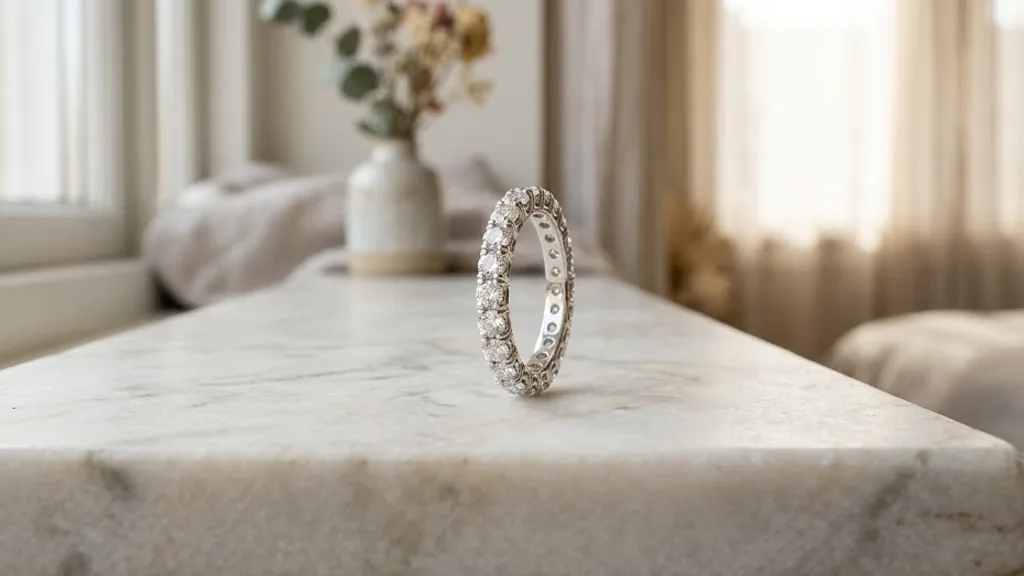
A full eternity ring has diamonds all the way round, 360 degrees, with no plain metal at all.
That is the entire distinction. Everything else in this article follows from it.
What “half” really means in practice
Half eternity does not always mean exactly 50%. Different workshops set anywhere from about 40% to 60% and call it half. What matters is that the stones cover the part of the finger you and other people see, and the plain metal sits where nobody looks.
That plain section is doing several jobs at once. It is more comfortable against the palm. It gives a jeweller somewhere to cut if the ring ever needs resizing. It stops stones being crushed against a neighbouring ring in a stack. And it costs less, because fewer diamonds are involved.
Our stackable emerald cut half eternity band is a straightforward example, and the baguette cut half eternity band in sterling silver shows the same format with step-cut stones.
Side by side
| Half eternity | Three-quarter | Full eternity | |
|---|---|---|---|
| Stone coverage | ~50% | ~75% | 100% |
| Cost for the same stone quality | Lowest | Middle | Highest |
| Sparkle when hand turns | Front only | Nearly all angles | Every angle |
| Comfort against palm | Best | Good | Stones underneath |
| Resizing | Usually possible, within limits | Sometimes, within tighter limits | Almost never |
| Spins on the finger | Shows plain metal at front | Barely noticeable | Never a problem |
The spinning problem
Here is the one genuine drawback of a half eternity ring, and it is rarely mentioned when you are buying.
Rings rotate on the finger during the day. When a half eternity ring rotates, the plain metal comes round to the front and the diamonds disappear underneath. You end up nudging it back into place without thinking about it.
How much this bothers people varies enormously. Some never notice. Others find it maddening. It is worse when the ring is slightly loose, and worse again when the band is very thin.
A three-quarter eternity ring largely solves it. With stones covering three-quarters of the band, even a fair amount of rotation still leaves diamonds facing outwards. That is the main reason three-quarter exists as a category at all — it is the answer to a practical annoyance rather than a design idea.
Why full eternity rings cannot usually be resized
Resizing a ring means cutting the band, adding or removing metal, and soldering it back together. On a plain band this is routine. On a stone-set band it is only possible where there is plain metal to cut.
A full eternity ring has no plain metal. Cutting it means cutting through a setting, which means removing stones, rebuilding that section and resetting them. At that point you are not resizing the ring, you are partly remaking it. Most jewellers will decline, and where it is possible it is expensive.
Fingers change size over a lifetime — with heat, cold, salt, exercise, pregnancy, weight, and simple ageing. A full eternity ring bought at 30 may not fit comfortably at 50. That is not a reason to avoid one, but it is a reason to know before you buy. We cover the detail in our guide to whether eternity rings can be resized.
Durability and repairs
A half eternity ring is easier to live with in one more way: repairs. If a stone is lost or a claw wears through, a jeweller works on a defined stretch of the band. On a full eternity ring, work on one section often means supporting the whole ring, and the labour rises accordingly.
Setting style matters more than coverage here. Bezel-set stones, wrapped in a rim of metal, are the most secure of all. Channel settings come next. Fine pavé with tiny claws is the most beautiful and the most demanding of care. Our bezel rose cut eternity band in sterling silver is about as low-maintenance as a diamond-set band gets.
Which should you buy?
Choose half eternity if the ring will be worn every day, if you want the option to resize later, if it will sit in a stack of three or more rings, or if budget matters and you would rather spend on stone quality than stone quantity.
Choose three-quarter if you want a full-eternity look without giving up all resizing flexibility, or if the spinning issue would bother you. It is the quiet favourite among people who have owned a half eternity before.
Choose full eternity if you want the maximum statement, if the ring will be worn occasionally rather than constantly, or if you are confident about the finger size and happy to treat it as a fixed object.
A note on price
Coverage is one of the main things you pay for, because you are literally buying more diamonds. Across our own bands, prices run from around £489 for a simple stackable band to £2,450 for a full eternity, correct at the time of writing. Metal choice and total carat weight drive the rest.
Every diamond we set is lab-grown, with a free IGI certificate on centre stones, hand-made in solid gold, platinum or sterling silver, with free insured UK delivery and 30-day returns. If you want a coverage or width we do not stock, we design bespoke at no extra design cost.
How coverage affects the price
The stones are the variable. Metal cost changes very little between a half and a full eternity ring of the same width, because the band itself is the same object. What changes is the number of diamonds and the hours of setting work.
That means the price difference is not linear with sparkle. Going from half to full roughly doubles the stone count, but only about half of those extra stones are ever visible on the hand. If budget is finite, the better spend is usually a half eternity in a higher-quality matched row than a full eternity in a lower one.
There is one situation where full eternity genuinely earns its cost: when the ring is worn alone, on a hand where it turns freely, and where the wearer notices the underside. If the ring lives in a stack pressed between two other rings, most of the extra stones are permanently hidden.
Getting the size right first time
Because a full eternity ring cannot usually be resized, sizing matters more here than on any other ring you will buy.
Measure at the end of the day, when fingers are at their largest, and never when you are cold or have just exercised. Measure the same finger on the correct hand — most people’s dominant hand is very slightly larger. If you fall between two sizes, go up rather than down; a ring that will not pass the knuckle is useless, while a marginally loose one can be corrected with a small sizing bead inside the band.
If there is any doubt at all, buy a half eternity. It is the format that forgives a mistake.
Frequently asked questions
Is a half eternity ring worth less than a full one?
It contains fewer diamonds, so yes, it costs less. Whether it is worth less to you depends on whether you would rather have more stones or a ring that can be resized.
Can a half eternity ring be used as a wedding ring?
Yes, and it is a common choice. It sits flush against most engagement rings and gives more presence than a plain band.
Does a three-quarter eternity ring resize?
Sometimes, by a small amount, if the plain section is long enough for the jeweller to work with. Do not assume it. Ask before buying if resizing matters to you.
Which way round should a half eternity ring be worn?
Stones facing outwards, plain metal against the palm. If it keeps rotating, the ring is probably slightly loose, or a wider band would sit more stably.
Do the hidden stones on a full eternity ring get damaged?
Diamonds themselves are extremely hard. What suffers is the metal around them and, occasionally, a claw. Bezel or channel settings reduce the risk considerably.
Browse our wedding and eternity bands to compare formats in person, or filter by baguette cut stones if you like the step-cut look. If you are still working out what the ring means and when to give it, start with our guide to what an eternity ring is.
Ready to find your perfect ring?
Explore our lab-grown diamond collection or book a virtual appointment with our team.











