Do Wedding Rings Have to Be Diamonds?
Wedding rings do not need diamonds. Plain bands, shaped bands, coloured stones and alternative metals compared honestly for daily wear.
No. A wedding ring does not have to contain a single diamond, and for most of the history of the custom it did not. Plain metal bands are the traditional form. Diamonds on wedding rings are a comparatively recent addition, driven partly by taste and partly by advertising. Here is what your actual options are, what each one costs to live with, and how to choose.
The short history, honestly told
Rings have been exchanged at marriage in various cultures for a very long time, and they were almost always plain — gold, silver, iron, or whatever the household could manage. The point was the circle and the metal, not the stones.
Two things changed in the twentieth century. Men began wearing wedding rings in large numbers, which happened in Britain and America around the 1940s. And the diamond became the default gemstone for bridal jewellery, helped enormously by a sustained advertising campaign that most people have now heard about.
So when someone says a diamond wedding ring is traditional, they mean traditional within living memory. The plain band has a far longer claim.
What you can have instead
A plain metal band
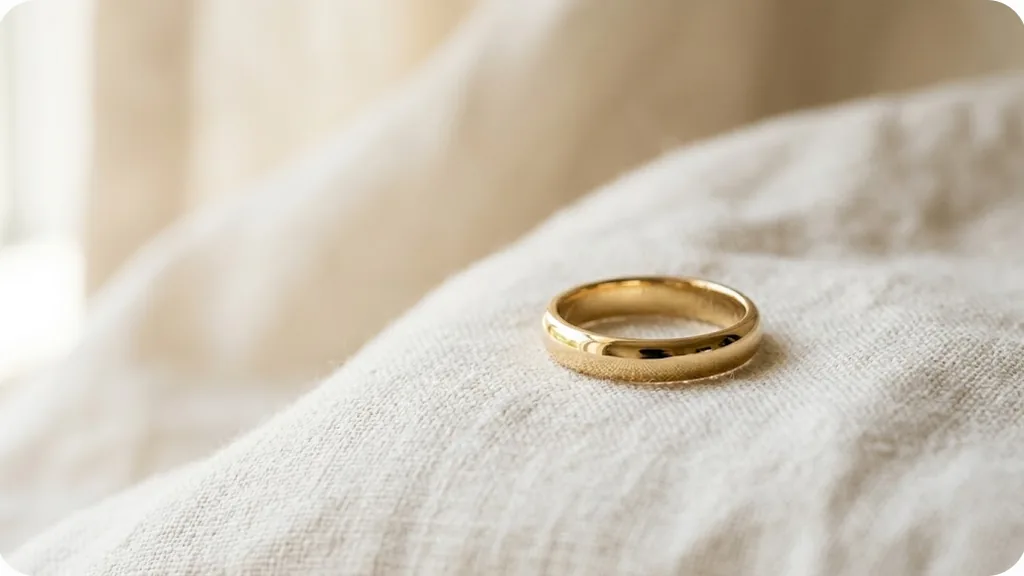
The most durable option, by a distance. Nothing to catch, nothing to loosen, nothing to replace. It can be resized easily throughout your life, engraved inside without difficulty, and re-polished to look new after decades.
It is also the cheapest, because you are paying for metal and workmanship rather than stones. If you want a ring that will still be on your finger in fifty years with minimal fuss, this is it.
A band with texture or shape rather than stones
This is the option people forget. A band does not have to be a smooth hoop. It can be hammered, brushed, twisted, milgrained along the edges, or shaped in a wave or chevron.
Our ocean wave round cut wedding band in yellow gold shows how much character a shaped band carries, and a chevron round cut wedding band in rose gold has a strong outline that reads clearly across a room.
A coloured gemstone
Sapphire is the most practical alternative. On the Mohs scale of mineral hardness, sapphire sits at 9, against 10 for diamond and around 7 to 7.5 for quartz-family stones. That makes it genuinely suitable for daily wear. Ruby is the same mineral in red and equally hard.
Emerald, by contrast, is softer and typically included, meaning it contains internal fractures. It is beautiful and it chips. Opal, pearl, moonstone and turquoise are softer still and are poor choices for a ring worn every day.
We should be straight with you here: we work in lab-grown diamonds only. We do not stock sapphire, ruby or any coloured stone. If you want a coloured centre stone, we are not the right shop for a ready-made piece, though we can discuss a bespoke commission.
Black or dark rings
Black ceramic, black zirconium and black-plated metals are popular for men’s bands. They look striking. Be aware that black plating wears through on the edges and needs redoing, whereas solid black ceramic keeps its colour but cannot be resized and can crack under a hard knock. We do not stock black wedding rings — our note on what black wedding rings are explains the materials in full.
Alternative metals
Titanium, tungsten carbide, cobalt and zirconium are all used for men’s wedding bands. They are hard, light and inexpensive. The trade-off is that most of them cannot be resized or repaired — if the fit changes, you replace the ring rather than alter it. Precious metals can be worked on for a lifetime.
Comparing the realistic options
| Option | Hardness / durability | Resizable | Notes |
|---|---|---|---|
| Plain gold or platinum band | Excellent | Yes | Lowest maintenance of anything |
| Diamond-set band | Very good; settings need checks | Half eternity usually; full eternity rarely | Most sparkle, most upkeep |
| Sapphire or ruby | Very good (Mohs 9) | Depends on setting | Not stocked by us |
| Emerald | Poor for daily wear | Depends | Chips and fractures |
| Titanium / tungsten | Very hard, can shatter | No | Cheap; replace rather than repair |
| Black ceramic | Hard but brittle | No | Colour is permanent; ring is not |
Why people still choose diamonds
Two reasons, and both are legitimate.
The first is hardness. Diamond is the hardest natural material known, which is why it survives being knocked against door frames and kitchen worktops for decades without scratching. For a ring worn every single day, that matters.
The second is that it catches light in a way nothing else does, and a wedding ring is worn where light hits it constantly.
If you want stones without a large one, a set band gives you sparkle at a fraction of the cost of a solitaire, because many small diamonds cost far less than one big one of the same total weight. Our pavé baguette cut wedding band at £690 and twisted round cut half eternity band at £657 — both correct at the time of writing — show what that looks like in practice.
Lab-grown or natural
If you do want diamonds, this is the choice that affects the price most. A lab-grown diamond is the same material as a mined one: same carbon structure, same hardness, same optical behaviour. It is grown in a controlled environment over weeks rather than formed underground over a very long time.
They cost substantially less for equivalent size and grade. That is the whole reason we work in them. Our comparison of lab-grown and natural diamonds covers the technical detail without the sales talk.
Does the wedding ring have to match the engagement ring?
No, and worrying about it stops people buying rings they would enjoy. Two things do help, though.
Fit. If the engagement ring has a raised centre stone, a straight band may leave a gap. A curved or shaped band solves it — our curved round cut wedding band in yellow gold is designed for exactly this.
Metal. Either match exactly or contrast obviously. A near-match reads as a mistake; a deliberate mix of rose gold and white gold reads as a decision.
Beyond that, mixing a diamond engagement ring with a plain wedding band is completely standard and always has been.
What we make
Everything we sell is set with lab-grown diamonds, with a free IGI certificate on centre stones. Rings are hand-made in solid gold, platinum or sterling silver at our workshop in North Harrow, with free insured UK delivery and 30 days to return.
We do not stock coloured gemstones, black rings, or alternative metals like titanium. If you want any of those, we will tell you so rather than talk you into something else. What we can do is design bespoke at no extra design cost — including a completely plain band in the exact width and profile you want.
What to ask before you buy any wedding ring
Whatever material you settle on, four questions separate a ring that lasts from one that disappoints.
Is the metal solid or plated? Plating wears through on the edges within a few years and needs redoing. Solid metal does not.
Can it be resized? Gold, platinum and silver can be worked on for a lifetime. Titanium, tungsten and ceramic generally cannot, and full eternity rings usually cannot either.
How deep is the band, not just how wide? A wide but very thin band looks substantial and wears through faster than a narrow, deeper one.
What certification comes with any stones? Anything of meaningful size should have an independent laboratory report. Our centre stones come with a free IGI certificate.
Frequently asked questions
Is a plain wedding band old-fashioned?
No. It is the original form and remains the most common wedding ring worldwide. It is also the most practical for anyone whose hands work hard.
Can a wedding ring have a coloured stone?
Yes. Sapphire and ruby are hard enough for daily wear. Emerald, opal and pearl are not. We work in lab-grown diamonds only, so a coloured stone would be a bespoke conversation.
Does the engagement ring have to be a diamond?
No, and we have written about that separately in our guide to whether your engagement ring has to be a diamond.
Are diamond wedding bands harder to look after?
Slightly. Settings should be checked once a year and the ring cleaned more often, because dirt collects around stones. A plain band needs almost nothing.
Which is cheaper, a plain band or a diamond one?
A plain band, essentially always, because you are paying for metal and time rather than stones. The gap narrows if the plain band is very wide and heavy.
Have a look at our wedding ring collection to compare plain, shaped and stone-set bands side by side, or browse the bridal sets if you want the engagement ring and band designed to fit together from the start.
More guides on this topic
Ready to find your perfect ring?
Explore our lab-grown diamond collection or book a virtual appointment with our team.