
Should You Buy a Lab-Grown Diamond?
A straight assessment: the real reasons to buy one, the resale drawback nobody mentions, and who should choose a mined stone instead.
For most people buying an engagement or wedding ring in the UK today, yes — a lab-grown diamond is the sensible choice. It is a real diamond, it is graded by the same laboratories on the same scales, and it costs considerably less than a mined stone of the same specification. That last point is not a small saving; it is the difference between the ring you wanted and the ring you settled for.
But it is not the right answer for everyone, and anyone telling you it is has stopped being useful. Here is a straight assessment of who should buy one, who probably should not, and the questions worth asking yourself before you decide.
What you are actually buying
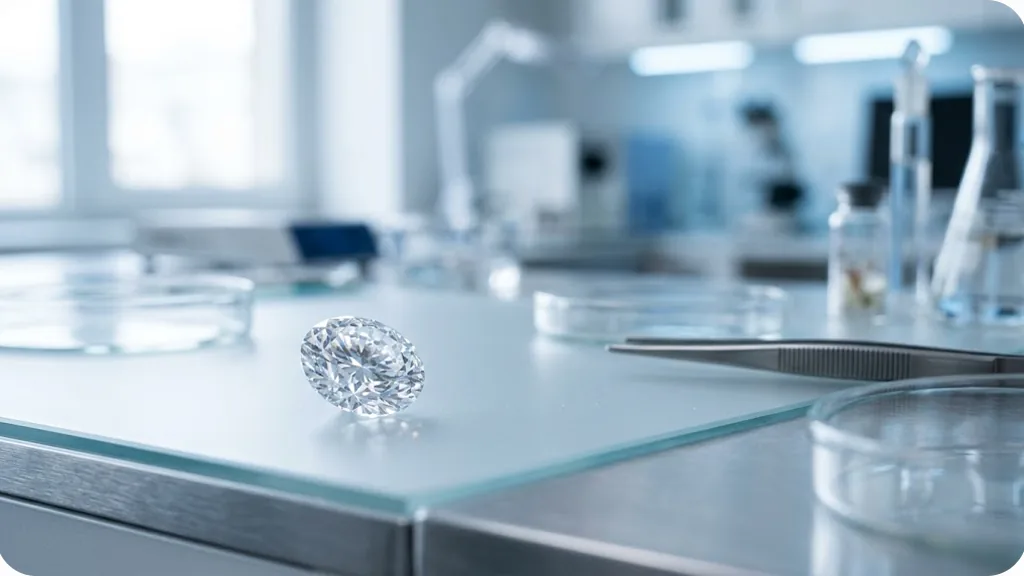
A lab-grown diamond is diamond. Pure carbon in the diamond crystal structure, grown in a chamber over a few weeks rather than in the earth over an immense period. Same hardness, same brilliance, same behaviour under a diamond tester, graded on the same four Cs by the same laboratories.
There are two growing methods — CVD, which builds the crystal in layers from a carbon-rich gas, and HPHT, which recreates the earth’s pressure and heat. We explain both in our guide to how lab-grown diamonds are made.
What it is not is a simulant. Cubic zirconia and moissanite are different materials that resemble diamond. A lab-grown diamond is not a resemblance — it is the material itself, made somewhere new.
Reasons to buy one
The price. This is the honest headline. Laboratory-grown stones sell for a fraction of the mined equivalent, and that gap has widened as growing capacity has increased. The same budget buys a considerably larger or better-graded stone. Treat any specific figure you read as guidance rather than a fixed rule — prices move, and mined and laboratory-grown stones move differently.
The origin is documented. You know where the stone came from and how it was made. That certainty appeals to a lot of buyers, and it is not something the mined supply chain can offer in the same way.
Quality is achievable at the top end. Because growth conditions are controlled, high colour and clarity grades are more readily available than they are in mined rough, and at prices that make them realistic to buy rather than aspirational.
Nobody can tell. Not by eye, not with a loupe, not with a standard tester. Separating laboratory-grown from mined takes specialist laboratory equipment reading the crystal’s growth structure.
Reasons you might not
Resale. This is the genuine drawback and it deserves stating plainly. Diamonds of any origin lose value the moment they leave a shop, but laboratory-grown stones have a weaker second-hand market than mined ones. If you are thinking of a ring as a store of value, that is not what either kind really is, but it is more true of laboratory-grown. Buy one to wear, not to sell.
Prices are falling. Good news when you buy, less good if you expect your stone to hold its price. Growing capacity has increased steadily and prices have followed.
It matters to the person wearing it. Some people want a stone that formed in the earth, and that is a completely legitimate preference. No amount of chemistry changes how someone feels about it. If your partner would rather have a smaller mined stone, buy the smaller mined stone — you are buying a feeling as much as a mineral.
Family expectation. Occasionally there is a family tradition or an heirloom setting involved. Worth thinking about before, rather than after.
Mined or laboratory-grown, side by side
| Lab-grown | Mined | |
|---|---|---|
| Material | Diamond | Diamond |
| Hardness | 10 on the Mohs scale | 10 on the Mohs scale |
| Graded by IGI or GIA | Yes, same scales | Yes |
| Price for the same specification | Considerably lower | Considerably higher |
| Origin certainty | Fully documented | Varies by supply chain |
| Second-hand market | Weaker | Established but still well below retail |
| Visible difference | None to the eye or a loupe | None to the eye or a loupe |
How many people are actually buying them?
A lot, and the share has grown quickly — but we are not going to give you a percentage, because the honest position is that the reliable figures vary depending on who is counting, what they are counting (units, weight or value) and which market they are looking at. Numbers quoted confidently online are often lifted from a single report and repeated without context.
What can be said without inventing anything: laboratory-grown diamonds have moved from a curiosity to a mainstream option for engagement rings in the UK within a short space of time, most high street and online jewellers now stock them, and prices have fallen as supply has grown. If you would like a fuller look at the numbers question, we have written about what percent of diamonds are lab-grown separately.
How to buy one properly
Three rules cover almost everything.
Insist on certification. An IGI or GIA report on the centre stone, with the report number laser-inscribed on the girdle. That is your proof of what you own.
Put the money into cut. Cut is what makes a diamond look alive, and it is the grade where paying more always shows. Colour and clarity can both be relaxed a step or two with no visible loss, especially in warm metal.
Check the setting, not just the stone. A beautiful diamond in a poorly made setting is a repair waiting to happen. Ask what the ring is made of, how the stones are held, and what happens if something needs attention later.
What we do
Everything we make uses lab-grown diamonds, set by hand in solid gold and platinum in North Harrow, London. Every centre stone comes with a free IGI certificate at no extra cost, delivery within the UK is free and insured, and you have 30 days to return a ring if it is not right.
A good place to start is the solitaire round cut engagement ring in white gold at £563 at the time of writing — the classic shape and setting, and the clearest demonstration of what a well cut stone does. If you want more presence for the money, the halo round cut engagement ring is £707, and for a modern, elongated look the solitaire oval cut engagement ring is £557, both correct at the time of writing.
Browse the full engagement ring collection, or the bridal sets if you would like the wedding band designed alongside. If nothing is quite right, bespoke design costs nothing extra.
Two ways to spend the same budget
The clearest way to think about the decision is to stop comparing stone against stone and start comparing ring against ring. The same money buys two quite different outcomes.
With a mined diamond, the stone takes the great majority of the budget. What is left has to cover the setting, which often means a lighter mount and smaller accent stones than you would have liked.
With a laboratory-grown diamond, the stone costs far less for the same grades, which leaves room for a heavier, better made setting, a matching wedding band, or simply a larger centre stone. That is a real, visible difference rather than a theoretical one.
Neither is the right answer for everyone. But it is the honest way to frame the choice, and it is more useful than arguing about which stone is more “real” — they are both diamond.
Questions worth asking any seller
- Is the centre stone certified, and by whom? IGI and GIA are the names to look for.
- Is the report number inscribed on the stone? It should be, and you should be able to see it.
- What is the ring made of? Solid gold or platinum, not plated or filled.
- Who made it, and where? A seller who cannot answer this is a reseller, which is fine, but worth knowing.
- What happens if it needs resizing or repair? Ask before you buy, not after.
- What is the returns period? Thirty days is a reasonable minimum for something bought unseen.
A seller who answers all six clearly and in writing is a seller worth buying from. One who deflects on any of them is telling you something useful.
Common questions
Are lab-grown diamonds real diamonds?
Yes. Chemically, physically and optically identical to mined diamonds, and graded by the same laboratories on the same scales. The only difference is where they grew.
Will a lab-grown diamond last a lifetime?
Yes. It sits at 10 on the Mohs hardness scale, the same as any diamond, and it will not cloud, fade or wear. Setting and everyday care matter far more to the life of a ring than the origin of the stone.
Do lab-grown diamonds hold their value?
Not well, and neither do mined diamonds relative to what you paid at retail. Buy a ring because you want to wear it. If you need something that holds value, that is a different conversation and a different purchase.
Can a jeweller tell it is laboratory-grown?
Not by eye or with a standard tester. It takes laboratory equipment. In practice the certificate and the laser inscription on the girdle tell you plainly, which is exactly how it should be.
Should I tell people the diamond is lab-grown?
Entirely up to you. It is a real diamond either way. Most people find it easiest to be straightforward about it, not least because it usually leads to a conversation about how much better a ring they could have bought.
Ready to find your perfect ring?
Explore our lab-grown diamond collection or book a virtual appointment with our team.











