Diamond Colour Grades Explained: The Full D-Z Scale
Diamond colour runs D to Z, colourless to tinted. The full scale, what each grade looks like, fluorescence and which to buy.
Diamond colour is graded on a lettered scale from D to Z, where D is completely colourless and Z shows an obvious yellow or brown tint. The grades are grouped: D–F colourless, G–J near colourless, K–M faint, N–R very light, S–Z light. The scale measures the absence of colour, so a lower letter means less tint and a higher price.
What do the D to Z diamond colour grades actually mean?
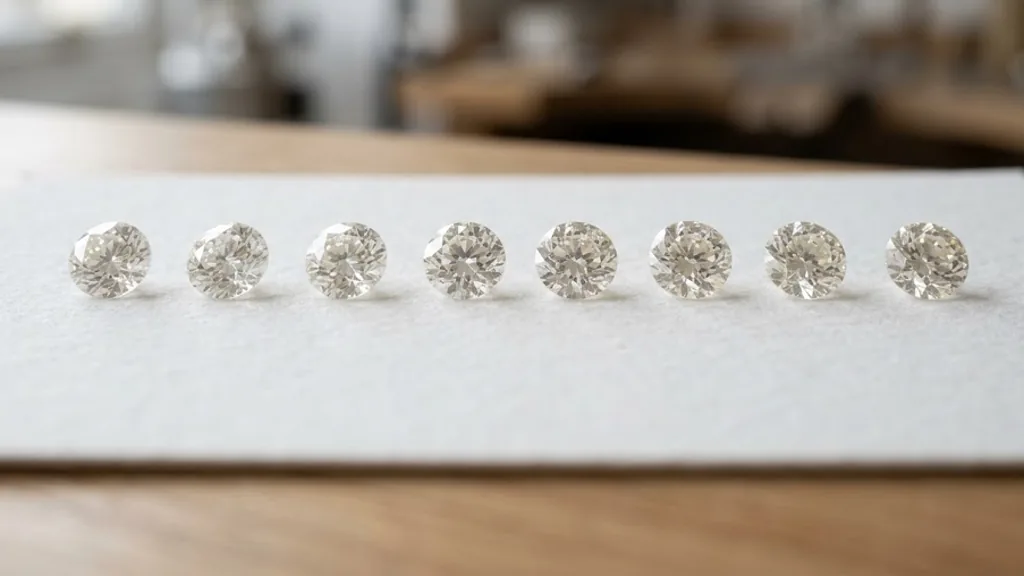
The D to Z diamond colour scale measures how little yellow or brown tint a white diamond contains, not how bright or sparkly it is. A grader compares the stone face-down against a set of pre-graded masterstones under controlled lighting, because colour is far easier to judge through the side of a diamond than through the top. Each letter is a narrow band rather than a single exact shade, which is why two stones with the same grade can look very slightly different. The scale stops at Z; anything with more colour than Z is graded as a fancy colour diamond on a different scale entirely.
This table sets out the full D–Z scale, what each group looks like to the naked eye, and where it makes practical sense to buy.
| Grade | Group | What you actually see | Practical note |
|---|---|---|---|
| D | Colourless | No detectable colour, even face-down under grading light | The top grade and the price premium to match |
| E | Colourless | No colour visible face-up; a trained grader sees a trace face-down | Visually identical to D in a finished ring |
| F | Colourless | No colour face-up; a faint trace detectable by an expert | The last grade in the colourless group |
| G | Near colourless | Reads as white face-up; warmth only shows next to a D | The usual value sweet spot in white metal |
| H | Near colourless | Still reads white face-up in most lighting | Sensible in white gold and platinum |
| I | Near colourless | Slight warmth visible if compared side by side | Works well in yellow or rose gold |
| J | Near colourless | Faint warmth visible face-up in larger stones | Good value; better in warm metals |
| K–M | Faint | A noticeable warm or champagne tone | Set in yellow gold it can look intentional and vintage |
| N–R | Very light | Clearly tinted yellow or brown | Rarely used in modern engagement rings |
| S–Z | Light | Obvious yellow or brown body colour | Below Z the stone is graded as fancy colour instead |
Why does the diamond colour scale start at D and not A?
The diamond colour scale starts at D because the system deliberately broke with the confusing grading languages that came before it. Before a single standard existed, different traders used A, AA and AAA, or Roman numerals, or the word "river" for the finest stones — and the same letter meant different things in different offices. Starting the new scale at D put clear distance between it and every discredited A-based system, so nobody could claim their old "A" meant the same thing. There is no colour grade above D. The full history is in why diamond colour starts at D.
What gives a diamond its colour in the first place?
A diamond’s colour comes from tiny amounts of elements trapped in the carbon lattice as the crystal grows, and from defects in the lattice itself. Nitrogen is the usual cause of yellow tint; boron produces blue; structural distortion under pressure can produce pink, red or brown. A perfectly pure diamond with no impurities and no lattice distortion is colourless, which is why D-grade stones are scarce. The same chemistry applies to lab-grown diamonds, because they are the same material grown under controlled conditions. Read what gives a diamond its colour.
Does diamond colour actually matter once the ring is made?
Diamond colour matters far less in a finished ring than it does on a certificate, because the metal around the stone changes what you see. In white gold or platinum, warmth in the stone contrasts with the cool metal and becomes easier to spot, so G or H is a sensible floor. In yellow or rose gold, the metal reflects into the stone anyway, so an I or J looks perfectly white and saves money that is better spent on cut. Size matters too: colour is easier to see in a larger stone and in step cuts than in a small round brilliant. See does diamond colour actually matter.
Which colour grade should you choose?
Choose the colour grade by matching it to your metal and your stone size rather than by chasing the top of the scale. As a working rule used at the bench: D–F if you want certificated perfection and the budget allows it, G–H for white gold and platinum where you want it to read as white without paying the colourless premium, and I–J for yellow and rose gold where the metal does the work for you. Spend the money you save on cut quality, because cut affects sparkle far more than colour does. Our guide to how to choose a diamond colour grade works through it stone by stone.
What is the difference between a D, E, F and G colour diamond?
D, E and F are all in the colourless group and look identical face-up in a finished ring; G sits at the top of the near-colourless group and still reads as white to almost everyone. The differences are real but they live under grading light, face-down, against masterstones — not on a hand across a dinner table. What separates them commercially is rarity and price rather than appearance. Each grade has its own detailed guide: D colour, E colour, F colour and G colour.
Is an H, J or K colour diamond too yellow?
An H colour diamond is not too yellow for any setting, a J is not too yellow in warm metal, and a K is only too yellow if you set it in platinum and expect it to look colourless. The honest answer changes with the metal, the size and the cut. H reads white almost everywhere. J shows a faint warmth in larger stones set in white metal but disappears in yellow gold. K has a definite champagne warmth that some buyers actively want in a vintage-styled ring. We have written each one up separately: H colour, J colour and K colour.
What is diamond fluorescence and does it lower the value?
Diamond fluorescence is a glow, almost always blue, that some diamonds emit under ultraviolet light, and it is reported on certificates as None, Faint, Medium, Strong or Very Strong. It is a separate property from the D–Z colour grade and is not a fault. Blue fluorescence can very slightly offset a yellow tint in a lower colour grade, which some buyers treat as a bonus; at Strong or Very Strong a small number of stones look slightly milky in direct sunlight, which is worth checking in person. Read why diamonds glow blue under UV light and what colour a diamond looks under UV light.
Do lab-grown diamonds have fluorescence and colour grades too?
Lab-grown diamonds are graded on exactly the same D–Z colour scale and are tested for fluorescence in the same way, because they are the same material as mined diamonds. In practice, fluorescence is less common in lab-grown stones than in mined ones, and it is more likely to appear in a colour other than blue depending on the growth method used. Every centre stone CarbonstoneUK sells comes with a free IGI certificate stating its colour grade and fluorescence in writing. See do lab-grown diamonds have fluorescence.
How do fancy coloured diamonds fit into the D to Z scale?
Fancy coloured diamonds sit outside the D–Z scale completely and are graded on their own system, which describes hue, tone and saturation instead of the absence of colour. The fancy grades run Faint, Very Light, Light, Fancy Light, Fancy, Fancy Intense, Fancy Vivid, Fancy Deep and Fancy Dark. A yellow diamond that would be a poor Z on the white scale can be a desirable Fancy Yellow on the coloured scale — the same stone, judged by a different question. Read what coloured diamonds are called and how coloured diamonds are made.
Which diamond colour is the rarest, and are coloured diamonds valuable?
Red is the rarest diamond colour, with only a very small number of certificated examples known worldwide, followed by blue, green, pink and violet; yellow and brown are the most common fancy colours. Value in fancy colours is driven by saturation rather than by carat weight alone, so a small Fancy Vivid stone can be worth more than a large pale one. Among white diamonds, D is the rarest grade. Read which diamond colour is the rarest, are coloured diamonds valuable and are pink diamonds an off-colour diamond.
Can a diamond’s colour change over time?
A diamond’s colour does not change with normal wear, and a graded D stone will still be a D in fifty years. What changes is what you see: a dirty diamond looks warmer and duller because grease and skin oil sit on the pavilion facets, and a yellowing white gold ring whose rhodium plating has worn off makes the stone look warmer by contrast. Both are cleaning and maintenance issues, not colour changes. True permanent colour change only comes from laboratory treatment. Read can a diamond change colour.
Which diamond colour guide should you read next?
This table maps each question about diamond colour to the guide that answers it in full.
| Your question | Guide |
|---|---|
| Why does the scale begin at D? | Why diamond colour starts at D |
| What is a D colour diamond? | D colour explained |
| What is an E colour diamond? | E colour explained |
| Is F worth paying for? | F colour explained |
| Is G the best value? | G colour explained |
| Is H too yellow? | H colour explained |
| Is J too yellow? | J colour explained |
| Is K too yellow? | K colour explained |
| Which grade should I buy? | Choosing a colour grade |
| Does colour even matter? | Does diamond colour matter |
| Where does the tint come from? | What gives a diamond its colour |
| Why do some diamonds glow? | Diamond fluorescence explained |
| What colour is it under UV? | Diamonds under UV light |
| Do lab-grown stones fluoresce? | Lab-grown fluorescence |
| What are fancy colours called? | Fancy colour grades |
| How are coloured diamonds made? | How coloured diamonds are made |
| Which colour is rarest? | The rarest diamond colour |
| Are coloured diamonds valuable? | Coloured diamond value |
| Are pink diamonds off-colour? | Pink diamonds explained |
| Can colour change over time? | Can a diamond change colour |
How does CarbonstoneUK handle colour grading?
CarbonstoneUK is a lab-grown diamond jeweller in North Harrow, London, and every centre stone we sell arrives with a free IGI certificate stating its colour grade in writing rather than as a verbal claim. We make rings only. Because metal changes how colour reads, the choice is worth making alongside the setting: white metal is the least forgiving, as in the Solitaire Round Cut Ring in White Gold at £563, while a warm metal hides a lower grade well, as in the Vintage Round Cut Ring in Yellow Gold at £1,051. Step cuts show colour most of all, which is worth knowing before choosing the Solitaire Emerald Cut Ring at £672 (prices correct at the time of writing). Browse the full range in engagement rings or narrow to round cut rings.
Frequently asked questions about diamond colour
What is the best diamond colour to buy?
There is no single best grade, only the best grade for your metal. G or H is the usual recommendation for white gold and platinum because it reads as white without paying the colourless premium. In yellow or rose gold, I or J looks equally white because the metal reflects warmth into the stone regardless.
Can you tell the difference between D and G colour with the naked eye?
Not reliably, once the stone is set. Trained graders separate D from G face-down against masterstones under standardised light, which is nothing like the conditions a ring is seen in. Placed side by side and loose, a difference is sometimes visible; on a hand, in a setting, almost never.
Is diamond colour or clarity more important?
Cut matters more than either, and between the two it depends on the shape. Step cuts such as emerald and Asscher have large open facets that show inclusions and colour clearly, so both grades matter more. Brilliant cuts scatter light and hide flaws, so you can drop a grade on both without it showing.
Does a diamond colour grade appear on the certificate?
Yes. An IGI or GIA certificate states the colour grade as a single letter alongside clarity, cut and carat weight, and reports fluorescence separately. Certificates use the American spelling "Color" on the document itself. If a seller cannot show you a certificate, treat any colour claim as unverified.
Are lab-grown diamonds always colourless?
No. Lab-grown diamonds are graded on the same D–Z scale and cover the same range, though colourless and near-colourless grades are more widely available than in mined stones because growth conditions are controlled. A lab-grown diamond is not automatically a D, and any seller implying otherwise should be asked for the certificate.
Does yellow gold make a diamond look more yellow?
Yellow gold reflects warmth into the stone, so a diamond set in it will pick up a warmer tone regardless of its grade. That works in your favour: a J or K set in yellow gold looks harmonious, while a D set in yellow gold loses much of the colourless quality you paid for. Match the grade to the metal.
Should you pay extra to avoid fluorescence?
Usually not. Faint and Medium fluorescence has no visible effect on the vast majority of diamonds, and mild blue fluorescence can even make a warmer stone look slightly whiter. Only Strong and Very Strong fluorescence is worth inspecting in daylight, because a small number of those stones look faintly hazy.
If you would like a stone compared in more than one metal before you commit, we can talk it through — every order carries free insured UK delivery and 30-day returns, and bespoke design is available at no extra design cost.
Ready to find your perfect ring?
Explore our lab-grown diamond collection or book a virtual appointment with our team.