
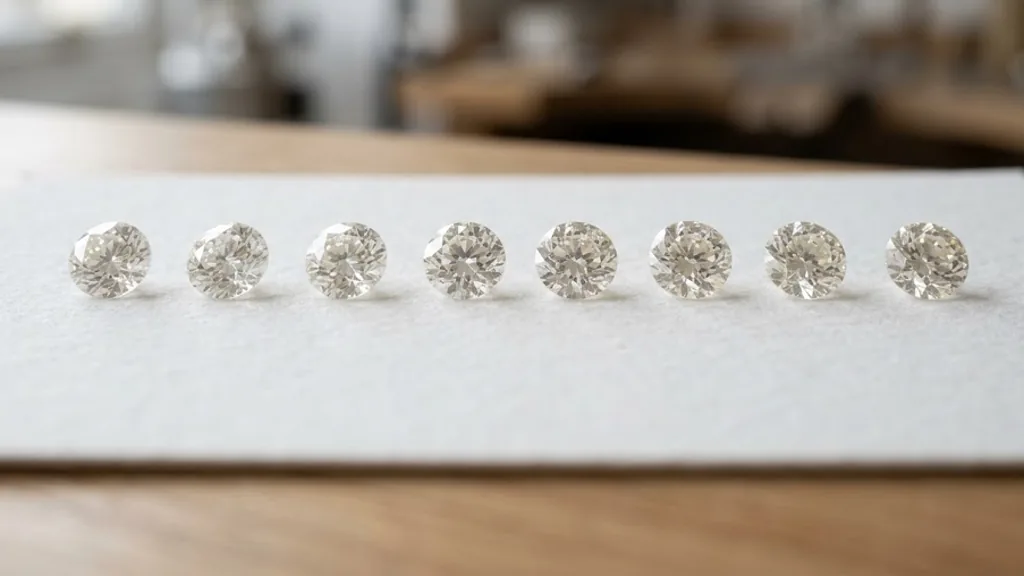
What Is a D Colour Diamond? The Top of the Scale, Explained
D is the highest diamond colour grade on the D-to-Z scale. What it means, when it is worth paying for, and why D is common in lab-grown stones.
A D colour diamond is the highest colour grade a diamond can be given. On the IGI and GIA scale, which runs from D down to Z, a D stone shows no detectable body colour at all when examined face-down against master stones under controlled lighting. It is the clearest, whitest grade available. In a finished ring, most people cannot tell a D from an E colour or an F.
What is the clearest diamond colour?
The clearest diamond colour is D. Diamond colour is graded on a lettered scale that starts at D and runs to Z, where D means completely colourless and Z means a light yellow or brown tint you can see easily. D is the top of that scale, so a D colour diamond is the whitest grade obtainable. There is no grade above D, and no letters A, B or C exist — the scale deliberately began at D to break with older, inconsistent grading systems that had already used those letters.
How is a D colour grade decided?
A D colour grade is decided by a trained grader comparing the diamond face-down against a set of master stones of known colour, under standardised daylight-balanced lighting, in a neutral white tray. Face-down matters: viewed from the top, a well-cut diamond bounces so much light back that body colour is hard to judge. Grading upside down removes the sparkle and shows the true tint of the crystal. Two graders must usually agree before the grade is issued, and the result is printed on the IGI or GIA report.
What the full colour scale looks like
The table below shows where D sits and what each band of the scale actually looks like in a finished ring.
| Grades | Band name | What you see face-up in a ring |
|---|---|---|
| D, E, F | Colourless | No tint. D, E and F are near-impossible to separate by eye once set |
| G, H, I, J | Near colourless | Looks white on its own; a faint warmth only next to a D |
| K, L, M | Faint | A noticeable warm tint, which some people like in yellow gold |
| N to R | Very light | Clearly tinted |
| S to Z | Light | Obviously yellow or brown |
Can you tell a D colour diamond from an E or an F?
Almost nobody can tell a D colour diamond from an E or an F by eye once the stone is set in a ring. Graders separate them face-down, loose, against master stones, in controlled light — conditions that never occur in daily life. Face-up in a setting, surrounded by metal and reflecting the room, D, E and F look identical. This is the single most useful fact about the top of the colour scale, and it is why we tell customers the difference between D and F is a difference on paper before it is a difference in the ring.
Is a D colour diamond worth the extra money?
A D colour diamond is worth the extra money in a few specific situations and is money wasted in most others. It earns its price in large stones, in step cuts, in platinum or white gold, and where several stones must match. It is wasted in yellow or rose gold, which reflects warmth into the stone anyway, and in small accent stones where nobody is looking that closely. The honest trade view is that colour is the C where buyers most often overspend, and cut is the C where they most often underspend.
When D colour genuinely matters
D colour genuinely matters when the design gives the eye a fair chance to see body colour. That means:
- Step cuts. Emerald, asscher and baguette cuts have large flat facets like windows into the stone, so tint shows more readily than in a brilliant cut.
- Large stones. The deeper the stone, the further light travels through it, and the more any tint accumulates. Above roughly two carats, colour becomes easier to see.
- Cool metals. Platinum and white gold give no warmth back to the stone, so a warmer grade has nowhere to hide.
- Matched sets. In an eternity band or a three stone ring, stones must match each other. A mismatch is far more visible than an absolute grade.
Are D colour lab-grown diamonds common?
D colour lab-grown diamonds are far more common than D colour mined diamonds, and this is the most useful practical difference between the two. Yellow tint in a diamond usually comes from nitrogen trapped in the crystal, and a CVD growth chamber can be run with almost no nitrogen present. The result is that colourless D to F material is routine in lab-grown production rather than exceptional. In mined diamonds, D colour is genuinely rare and priced accordingly. If you have always wanted a top colour grade, lab-grown is where it becomes affordable.
Does a D colour diamond sparkle more?
A D colour diamond does not sparkle more than a G, an H or a J. Sparkle is produced by cut — the angles, proportions, polish and symmetry that decide how much light re-enters your eye. Colour is a description of the crystal’s tint, not its optical performance. A superbly cut J colour diamond will out-sparkle a mediocre D every time. If you have a fixed budget, taking the money from colour and spending it on cut quality is the change that makes the biggest visible difference, as our guide to what ideal cut means explains.
Choosing a colour grade for your setting
Match the grade to the metal and the shape rather than buying the top of the scale by reflex. In a platinum step cut such as our Solitaire Emerald Cut Engagement Ring at £672, a colourless grade earns its keep. In a matched band such as the Stackable Emerald Cut Eternity Band at £2,121, consistency between stones matters more than the letter itself. In a classic brilliant like the Solitaire Round Cut Engagement Ring in Platinum at £657, most buyers are perfectly happy a grade or two down (prices correct at the time of writing). Every centre stone we sell comes with a free IGI certificate showing the exact grade.
Frequently asked questions
What is the clearest diamond colour grade?
D is the clearest diamond colour grade. The scale runs D to Z, with D meaning completely colourless and Z meaning a visibly tinted stone. D, E and F together make up the colourless band. There is no grade above D, and the letters A, B and C are not used on the modern scale at all.
Is there anything better than a D colour diamond?
No. D is the top of the colour scale and nothing outranks it. Sellers who advertise something “whiter than D” are using marketing language, not a grading term. What can improve beyond D is a different characteristic entirely — clarity, cut grade or polish — because colour has already reached its ceiling.
Does D colour mean the diamond is flawless?
No. Colour and clarity are separate grades measuring different things. D describes the absence of tint; clarity describes the absence of internal inclusions and surface blemishes and is graded from FL down to I3. A D colour diamond can have visible inclusions, and a Flawless diamond can be a warm K colour. Both appear on the certificate.
Is D colour worth it for a lab-grown diamond?
Often yes, because the premium is much smaller than for a mined stone. Colourless material is routine in lab-grown production, so paying for D costs far less than it would on the mined side. Even so, in yellow or rose gold, or in small stones, the money is usually better spent on cut quality.
Will a D colour diamond look white in yellow gold?
A D colour diamond will look white in yellow gold, but so will an H or an I, because the gold reflects a little warmth into any stone set in it. This is why buying a top colour grade for a yellow gold ring rarely pays for itself. In white gold or platinum the difference between grades is easier to see.
What colour grade should I actually buy?
For most brilliant cut rings in white metal, G or H gives a stone that looks completely white on the hand at a sensible price. For step cuts, large stones or matched sets, move up towards E or D. Our separate guides to F colour and G colour cover those grades in detail, and what colour and clarity diamond to buy works through the decision.
Why does the diamond colour scale start at D?
The scale starts at D because older grading systems had already used A, B and C loosely and inconsistently, and the creators of the modern scale wanted a clean break that could not be confused with them. Starting at D signalled a new, stricter system. Our complete guide to diamond cut, clarity and colour sets the scale in context.
Choosing with clear eyes
D is the top of the scale, and in lab-grown diamonds it is genuinely attainable rather than aspirational — but it is only one line on a certificate. Look at the cut grade first, then decide how much colour you are actually going to see in the metal you have chosen. Have a look through our lab-grown diamond engagement rings or the emerald cut rings where colour matters most. Everything is hand-made in North Harrow, London, with a free IGI certificate, free insured UK delivery and 30-day returns.
Ready to find your perfect ring?
Explore our lab-grown diamond collection or book a virtual appointment with our team.











