What Is an E Colour Diamond?
E is the second-highest colour grade and looks identical to D once set. When it is worth paying for and when it is not.
An E colour diamond is the second-highest colour grade a diamond can have. It sits directly below D, the top of the scale, and it belongs to the group the trade calls colourless. In plain terms: an E stone has no visible tint whatsoever, and a trained grader needs controlled laboratory lighting and a set of comparison stones to tell it apart from a perfect D.
That last sentence is the whole story of E colour, and it is why the grade is interesting to buyers. Here is what it means in practice, what it costs you, and when it is genuinely worth choosing.
Where E sits on the scale
Diamond colour is graded from D, meaning completely colourless, down to Z, meaning a light but obvious yellow or brown. The scale measures the absence of colour, not the presence of it.
| Grade | Group | Visible tint face up |
|---|---|---|
| D | Colourless | None |
| E | Colourless | None |
| F | Colourless | None |
| G to J | Near colourless | None to almost none |
| K to M | Faint | Visible warmth |
| N to Z | Very light to light | Clear body colour |
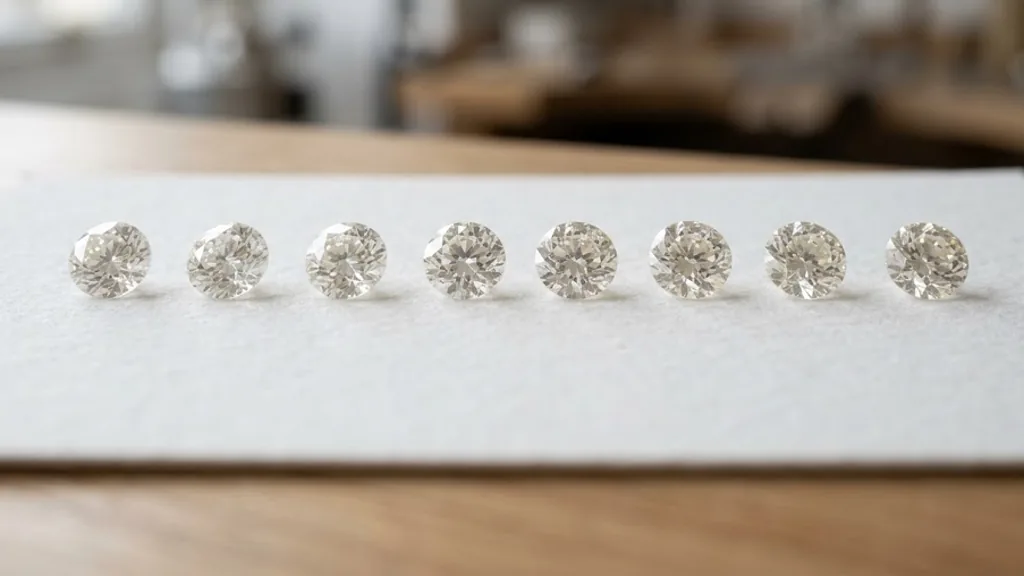
D, E and F are grouped together for good reason. Set into a ring and viewed face up, they are indistinguishable to essentially everyone, including most people in the trade.
How graders actually separate D from E
The stone is placed face down in a white tray, under standardised daylight-equivalent lighting, and compared against master stones of known grade. Face down, because that is where any faint body colour is easiest to detect. Face up, the sparkle drowns it out.
An E stone will show the very faintest hint of colour relative to a D master, which a D will not. That is the entire difference. It is real, it is measurable, and it is invisible once the stone is set.
Is an E colour diamond worth paying for?
It depends on what you value, and we will give you the honest version rather than the flattering one.
Reasons to choose E:
- You want a certificate in the colourless range, and E costs less than D while looking the same.
- You are buying a step cut, where colour genuinely shows more.
- You are buying a large stone, where colour becomes more visible.
- You are setting in platinum or white gold, where the metal offers no camouflage.
- Stones must match across a multi-stone design.
Reasons to skip E:
- You are setting in yellow or rose gold, which reflects warmth into the stone anyway.
- The stone is under about half a carat, where colour is very hard to judge by eye.
- The money would meaningfully improve the cut grade or the setting instead.
- You are buying a round brilliant, the shape best at hiding faint tint.
The trade view, and it is a rule of thumb rather than a measured figure, is that G and H look colourless in a finished ring to almost every observer. If that is true, E is a luxury rather than a necessity for most buyers. It is a very reasonable luxury, and it is far more defensible than D.
Where E genuinely earns its place: step cuts
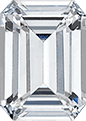
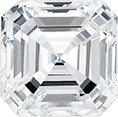
Emerald, asscher and baguette cuts are step cuts. Instead of the busy triangular faceting of a round brilliant, they have long, parallel, open facets that behave like a series of mirrors and windows. They give that famous “hall of mirrors” effect, and they are wonderfully architectural.
They also hide nothing. Faint colour that vanishes in a round brilliant is plainly visible in an emerald cut. If you are drawn to a piece like our Solitaire Emerald Cut Engagement Ring or the Hidden Halo Emerald Cut Engagement Ring, spending on colour is one of the few upgrades that will actually show.
The same logic applies to our Stackable Asscher Cut Wedding Band in Yellow Gold, although yellow gold does soften the requirement somewhat.
E colour and lab-grown diamonds
Lab-grown diamonds are graded on exactly the same D to Z scale, by the same laboratories, using the same method. An E grade means the same thing whether the stone grew in the earth or in a reactor.
There is a practical consequence worth knowing. Because the price steps between colour grades are smaller for lab-grown stones, a high colour grade is much easier to justify. Buyers who would have settled for H in a mined stone frequently sit comfortably at E or F in lab-grown, and still spend less overall. That is one of the quieter advantages of the category.
Every centre stone we set comes with a free IGI certificate stating the colour grade, so you are never relying on a description.
How E stacks up against the other three Cs
If your budget is fixed, and it usually is, we would order the priorities like this.
- Cut. The only C that decides how much light comes back to your eye. It cannot be improved later.
- Carat. Size is what people notice from across a room.
- Colour. Important down to about G in white metal, further in yellow gold.
- Clarity. Anything eye-clean looks identical in wear.
A beautifully cut G will look better on the hand than an indifferently cut E. That is not a slight on E, it is a statement about how much cut matters.
E colour in a multi-stone design
There is one situation where a high colour grade earns its money for a reason nobody mentions in the shop: matching.
In a three stone ring, a five stone ring or an eternity band, the stones sit millimetres apart and your eye compares them constantly. A slight difference in warmth between neighbouring stones is far more visible than the same difference would be in a solitaire, because you have a reference right there.
Buying at E gives you room. Stones in the colourless group are close enough to one another that matching is straightforward, and a set assembled from D, E and F stones will look uniform. Assemble a set from H, I and J stones and the risk of one looking noticeably warmer than its neighbours rises sharply.
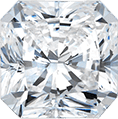
This applies to a design such as our 5 Stone Radiant Cut Engagement Ring in Yellow Gold, where five stones sit in a row, and it applies just as much to a wedding band worn tight against an engagement ring. If the band’s stones are warmer than the centre stone, you will see it every day.
Our practical advice: pick the colour grade for the piece you are buying now, write it down, and keep the certificate. When you come back for a matching band in a few years, the grade is the piece of information that makes the match easy.
Frequently asked questions
Is E colour better than F?
Technically yes, by one grade. Visually, no. Both are in the colourless group and both look identical face up in a finished piece. The gap between them exists on paper and in price, not on your hand.
Will an E colour diamond look white in yellow gold?
Yes, though so will a considerably lower grade. Yellow gold reflects warmth into any stone set within it, which is why buyers choosing yellow or rose gold usually get better value from a G, H or even J.
Does E colour affect sparkle?
No. Sparkle is governed by cut: proportions, symmetry and polish. Colour affects the tone of the returning light, not how much of it there is.
Can two E stones look different?
Yes. Each grade covers a small range, and fluorescence, cut quality and the setting all shift how a stone reads. Two certificates saying E do not guarantee two identical-looking stones.
Do you stock every shape in E colour?
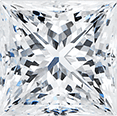
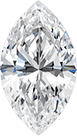
We work across round, pear, emerald, marquise, baguette, hexagon, cushion, oval, heart, radiant, rose cut and asscher. We do not stock princess cut or old European cut. If you want either, we design and make it bespoke at no extra design cost.
Choosing well
E colour is a genuinely excellent grade, and it costs less than the grade above it while looking exactly the same. If you want a colourless certificate without paying for the top letter, it is the sensible choice. If your stone is small, warm-set or a round brilliant, put the money into cut instead.
Browse our engagement ring collection or the emerald cut rings where colour choice matters most, and ask us to talk you through the certificate on anything you are considering. Free insured UK delivery and 30-day returns apply to everything we make.
Ready to find your perfect ring?
Explore our lab-grown diamond collection or book a virtual appointment with our team.