
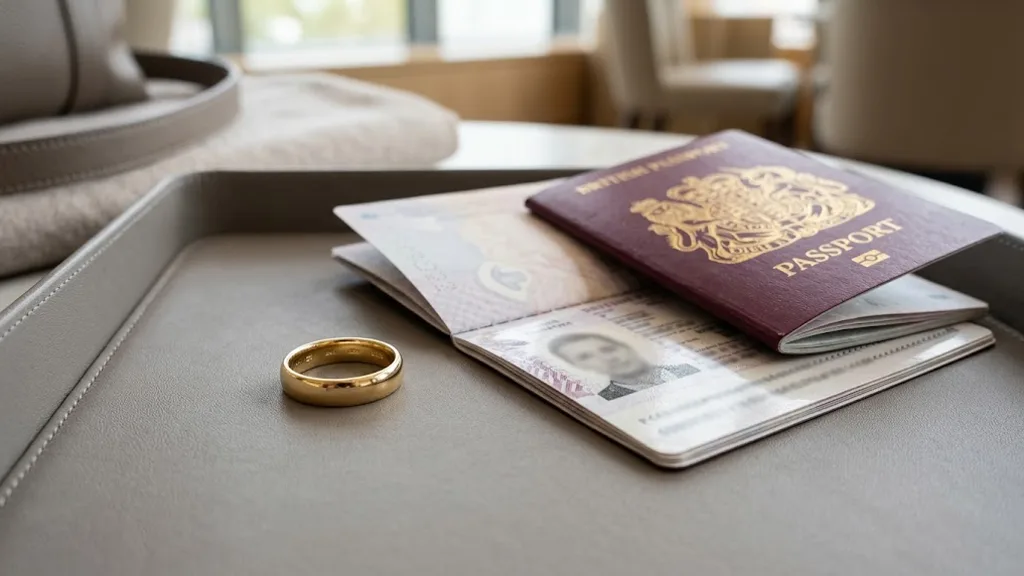
Can You Wear Your Wedding Ring Through Airport Security?
A wedding ring will not set off an airport metal detector. Gold, platinum and silver are not ferromagnetic, and a 9ct or 18ct band is no different.
Yes, wearing a wedding ring through airport security is not usually a problem: gold, platinum, silver and palladium are non-ferromagnetic metals, so a plain band will not set off a walk-through metal detector, and a body scanner simply shows it as jewellery. Even the hallmark stamped inside the band plays no part in airport screening.
Can you wear a wedding ring through airport security?
Yes, wearing a wedding ring through airport security causes no issue for the ring itself in the vast majority of cases, because fine jewellery metals are not the kind that respond to a walk-through detector. Gold, platinum, silver and palladium — the metals used across our wedding ring collection — share this property, which is covered in full below. The only genuine friction point is a loose ring in a security tray, not the detector itself.
A bulkier ring is more likely to cause a moment’s fuss at a checkpoint, not because it reacts to a detector, but because it has to come off a hand, go into a tray, and go back on again without getting lost or scratched. A fuller style such as our stackable eternity band takes a moment longer to handle in a tray than a flush, low-profile band, though both pass through screening the same way; the real difference is ease of handling, not detection.
Will a wedding ring set off a metal detector?
No, a plain wedding ring will not set off a standard walk-through metal detector at airport security, because the detector is built to react to ferromagnetic metals — the kind that are magnetic or strongly interact with a magnetic field. Gold, platinum, silver and palladium are not ferromagnetic, which is the actual mechanism behind that result, a fact that has nothing to do with airport policy and everything to do with the metal itself.
The hallmark stamped inside the band, the small marks proving the metal’s purity, applied by a UK Assay Office, plays no part in security screening either; a scanner has no way to read it and no reason to look for it. At the bench, that hallmark matters for a different reason: it is often the detail that helps identify a ring later if it is ever lost or needs insuring, which is more useful to know before a flight than anything about the detector.
Are gold and platinum wedding rings magnetic?
No, gold and platinum are not magnetic, and neither are silver or palladium, none of the four metals is ferromagnetic, the property that lets a detector or a magnet respond to a material. This is separate from how a metal affects skin: an irritated finger usually points to trace nickel content rather than the gold or platinum itself, which our wedding ring allergy guide covers in detail.
We stock all four of these metals across our wedding ring range, including sterling silver pieces such as our solitaire wedding band in sterling silver, so the metal question above has the same answer whichever option you choose.
The table below sets out why: it lists the four precious metals we work with, whether each is ferromagnetic, and what that means at a security checkpoint or anywhere else a magnet is involved.
| Metal | Ferromagnetic? | What that means at a detector |
|---|---|---|
| Gold (9ct, 14ct, 18ct) | No | Does not respond to a walk-through detector |
| Platinum | No | Does not respond to a walk-through detector |
| Sterling silver | No | Does not respond to a walk-through detector |
| Palladium | No | Does not respond to a walk-through detector |
| Mild steel | Yes | Can trigger a detector; not used in our jewellery |
| Iron | Yes | Can trigger a detector; not used in fine jewellery |
Does a wedding ring show up on a body scanner?
Yes, a wedding ring shows up on a body scanner in the same way any small metal or dense object does, appearing as a shape the operator can see and identify rather than something hidden. A flush, low-set band such as our minimalist wedding band reads simply as a small metal shape, while a bulkier eternity design with more metal and more stones is still just as unremarkable to a scanner built to flag far larger threats.
Do you need to remove your wedding ring at airport security?
Whether you are asked to remove a wedding ring at security is a decision made at that specific checkpoint, not a fixed rule about the ring, and it varies by airport and even by officer on the day. A ring built around how you actually live, including how often you fly, is ultimately a bespoke conversation with a jeweller rather than a stock decision, which our guide to designing your own wedding ring covers.
Can a stuck wedding ring cause a problem at security?
A stuck wedding ring is a sizing and comfort problem, not a security one, and it is worth knowing about before you fly because swelling on a long flight can make an already-snug ring harder to remove than usual. If that is the situation you are actually worried about, our guide to getting a stuck wedding ring off covers safe ways to ease a swollen-finger ring free without cutting it, at home or before you travel.
Is it safer to travel without wearing your wedding ring?
No single reliable published figure exists comparing the safety of wearing versus removing a wedding ring while travelling, so the honest answer depends on what you are actually protecting against, theft, loss or damage, rather than on the detector itself. In practice, the more realistic risk in daily wear at security is a ring catching on something or slipping off in a tray or pocket; a setting that sits proud of the band, such as a three-stone engagement ring, catches on more than a flush wedding band does.
Frequently asked questions
Will my wedding ring set off a metal detector?
No, a plain gold, platinum, silver or palladium wedding ring will not set off a standard walk-through metal detector, because none of those metals is ferromagnetic, the property detectors are built to react to. This is a fact about the metal, not about airport rules.
Are gold wedding rings magnetic?
No, gold wedding rings are not magnetic, and this holds across yellow, rose and white gold alike, because gold in any of its jewellery purities, 9ct, 14ct or 18ct, is not a ferromagnetic metal. Platinum, silver and palladium behave the same way at a detector.
Do I need to remove my ring at security?
Whether you are asked to remove a ring at security depends on the checkpoint and the officer on duty, not on a fixed rule, so policies genuinely vary by airport. The honest answer is to follow whatever instruction you are given at the actual checkpoint on the day.
Can a body scanner see my wedding ring?
Yes, a body scanner shows a wedding ring as a small dense shape, the same way it shows any other piece of metal jewellery. It does not identify the ring as a wedding ring specifically, and the hallmark stamped inside the band plays no part in how the scanner reads it.
What if my wedding ring is too tight to remove?
A tight ring at security is a comfort and sizing problem, not a security one, heat, humidity and long periods sitting still on a flight can all make a finger swell slightly. If a ring genuinely will not budge, gently working it off with soap or a cold compress is safer than forcing it.
Is platinum safe to wear through security?
Yes, platinum is just as safe to wear through security screening as gold or silver, because it is not ferromagnetic either. Nothing about platinum’s higher density or purity changes how a walk-through detector or a body scanner reads it, since screening responds to magnetic behaviour, not weight.
More guides on this topic
Ready to find your perfect ring?
Explore our lab-grown diamond collection or book a virtual appointment with our team.