What Are the Different Engagement Ring Settings?
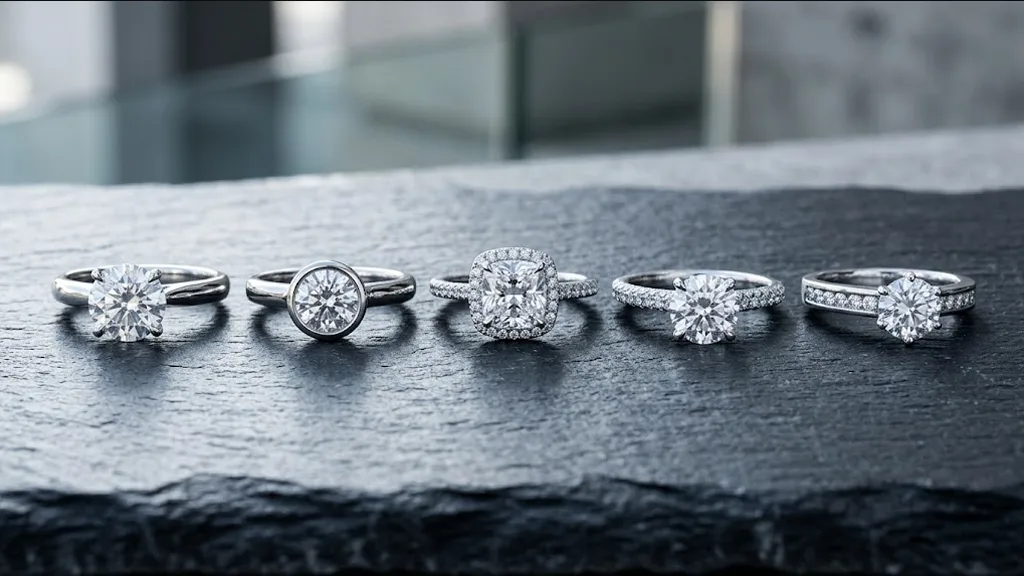
Five settings cover almost every ring we make: claw, rubover, halo, pave and channel. A claw setting holds the stone with 4 or 6 small metal fingers.
Engagement ring settings fall into five main types: claw, rubover, halo, pavé and channel. A claw setting grips the stone with 4 or 6 small metal fingers and is by far the most common. A rubover, also called a bezel, wraps a thin collar of metal right around the stone instead. The rest are variations on holding a stone or filling a band.
Which settings do most engagement rings use?
Settings on most engagement rings come down to five families, and every other name you meet is a variation on one of them. A claw setting lifts the stone on metal fingers. A rubover surrounds it with a collar. A halo rings it with small diamonds. Pavé sets tiny stones along the band. A channel drops small stones into a groove between two metal walls, with no claws showing at all.
One thing no setting can do is fix the stone itself. A shallow diamond with a see-through patch across the middle looks just as flat in a rubover as it does in claws, which is why we look at the stone on the bench before choosing a mount for it. Our guide to what windowing looks like in a diamond covers that fault in detail.
What is a claw setting, and how many claws does it use?
A claw setting holds the diamond in three to six small metal fingers, bent over the girdle (the widest edge of the stone) so the stone sits up in the light. Four claws is the usual count on a round or square stone under about 1.5 ct. Six is normal above that weight, on softer 18ct yellow gold, and on any ring worn while gardening. Claws are also called prongs, which is the American word for the same part.
Claw count changes how much light reaches the stone and how much metal covers its outline, and our guide to claw counts on a solitaire ring sets out four against six in full. At the bench the practical point is simpler: claws wear from the tip down, and a claw thin enough to lift will catch on a jumper long before it lets a stone go. That catching is your warning.
A plain claw setting is also the cheapest way to buy the biggest stone, because there is almost no side metal to pay for. Our platinum round cut solitaire engagement ring is £657, correct at the time of writing, and shows a four-claw head at its plainest.
What is a rubover setting, and who is it for?
A rubover setting wraps a thin wall of metal all the way around the edge of the stone, so nothing sticks out above the surface. Rubover is the British trade word; most websites call the same thing a bezel, and there is no difference between them. Because the metal covers the girdle, a rubover is the setting we suggest for nurses, gardeners, climbers and anyone who catches a ring on things all day.
The trade-off is light. A collar of metal around the girdle blocks the edge where light would otherwise enter from the side, so a rubover stone can read a shade darker than the same stone held in claws. A half rubover, open at two sides, is the usual compromise. Our bezel set cushion cut platinum ring is £904, correct at the time of writing.
How do halo and pavé settings differ from each other?
A halo and a pavé setting both use small diamonds, but they put them in different places. A halo is a ring of small stones set tightly around the centre diamond, which makes the centre read perhaps a size larger from a normal viewing distance. Pavé, from the French for paved, sets small stones along the band itself. A hidden halo does the same job as a halo but faces sideways, under the centre stone, so you only see it from the side.
Whether a halo genuinely makes a stone look bigger is a question of millimetres rather than opinion, and our guide to how many millimetres is a 1 carat round diamond gives real figures to compare against. A halo round cut engagement ring from our own range is £707, correct at the time of writing.
What do cathedral, basket and channel settings mean?
Cathedral, basket and channel are the three setting words people meet most often and rarely have explained. A cathedral setting sweeps the shoulders of the band up to meet the stone, like the arches of a church, which lifts the head and adds side support. A basket is the little cage of metal that sits under the stone and holds the claws together. A channel drops small stones into a groove between two raised walls, with no claws at all.
A cathedral shoulder also lifts the stone away from the finger, which matters if you want a wedding band to sit flush against it later. The table below matches each setting to what it is good at and what it costs you, so you can pick one without reading every section again.
| Setting | What it does well | The trade-off |
|---|---|---|
| Claw, also called prong | Lets the most light into the stone | Claw tips wear thin and catch |
| Rubover, also called bezel | Nothing proud to snag or knock | Less side light, reads smaller |
| Halo | Adds roughly 1 size of visual spread | More small settings to check |
| Pavé | Sparkle along the whole band | Hard to resize past the stones |
| Channel | Stones sit flush with the metal | Grease collects along the groove |
Which setting protects the stone best day to day?
The setting that protects a stone best day to day is a full rubover, because a continuous wall of metal covers the girdle, which is where chips start. A half rubover comes next, then six claws, then four. Pointed shapes change the answer: a marquise, pear, heart or trillion ends in a thin tip that needs its own V-shaped claw wrapped over it, whatever the rest of the setting is doing.
Shape drives that decision more than style does, and our complete guide to diamond shapes sets out which outlines carry a point. Trillion cuts have three of them, and what trillion cut diamonds cost explains why that shape is priced as it is. No setting makes a ring impossible to lose or damage, and we will not tell you otherwise.
Do we make tension set engagement rings?
Tension settings are the one style on this list we do not make. A tension setting appears to squeeze the stone between two ends of a springy band with no visible metal holding it, and it needs a specific alloy and a precise cut to hold for years. We would rather say no than build one badly. If you want that look, our bespoke service carries no extra design cost, and a half rubover reads almost the same.
Every ring we make is set by hand in our North Harrow workshop in London, in solid gold or platinum, with a free IGI certificate on the centre stone. You can see which settings we actually build across the whole engagement ring collection rather than take our word for it.
Frequently asked questions
What is a halo setting on an engagement ring?
A halo setting on an engagement ring is a circle of small diamonds set tightly around the centre stone, so the centre looks larger and the ring reads brighter across the top. A halo adds carat weight cheaply, because many tiny stones cost far less than one big one. It also adds more settings to check over time.
What is a channel setting?
A channel setting is a groove cut between two raised walls of metal, with small stones dropped in side by side so their tops sit flush with the band. Nothing sticks up to snag, which suits a wedding band worn under gloves. Cleaning is the catch, because grease collects along the channel and a soft brush cannot always reach it.
Which setting is easiest to resize?
A plain claw or rubover solitaire is easiest to resize, because the band is bare metal and a jeweller can cut, add or remove a section without touching a stone. Full eternity bands, pavé shanks and channel settings are the hard ones, since stones run all the way round and the metal between them cannot simply be shortened.
Which setting suits a hand that works hard?
A full rubover suits a hand that works hard, because the metal collar sits level with the stone and there is nothing proud to knock. Six claws in platinum come a close second, since platinum tends to move rather than snap when it takes a blow. Avoid tall cathedral heads and fine pavé if you use your hands all day.
How much does the setting add to the price?
Setting style moves the price less than the centre stone does, and we do not bill the mount separately. Across our own range a plain solitaire starts at £563 and a halo or pavé ring runs to about £1,143, both correct at the time of writing. The gap is mostly the extra small diamonds, not the bench work.
Is a rubover the same thing as a bezel?
Yes. Rubover and bezel are two names for the same setting: a continuous collar of metal wrapped around the edge of the stone. Rubover is the word used on a British bench and on most UK websites, while bezel is the American term and the one most search results use. Ask which a jeweller means and you will find it is this.
More guides on this topic
Ready to find your perfect ring?
Explore our lab-grown diamond collection or book a virtual appointment with our team.