
What Is a Chevron Wedding Band?
A chevron wedding band dips into a V to sit flush under a pear or marquise stone. Most are 1.4 to 1.6 mm wide and made to match the engagement ring.
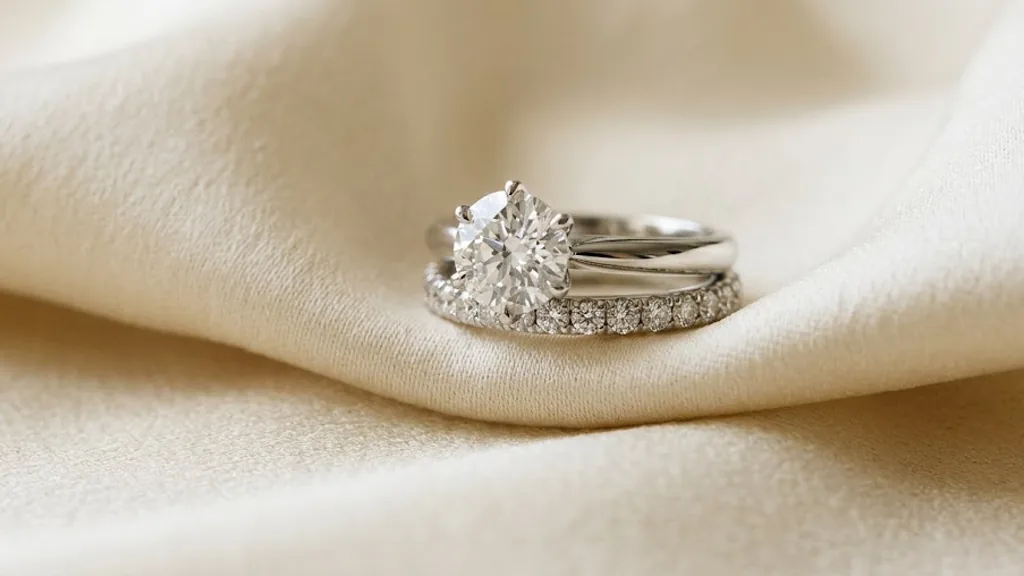
A chevron wedding band is a ring that dips into a V-shaped point at the front, so it can sit snugly beneath an engagement ring’s centre stone instead of leaving a gap. It is also sold as a V-shaped or wishbone band. Most are slim, around 1.4 to 1.6 mm wide, and the V must match the engagement ring it is worn with.
What does a chevron wedding band look like?
A chevron wedding band looks like an ordinary slim band from the back, but at the front the metal bends into a point, like a shallow letter V. Many are half eternity bands, with diamonds across the front half only. Our marquise chevron band, for example, carries 0.38 ct of lab-grown diamonds on a band 1.4 mm wide, and the pear version carries 0.29 ct on 1.60 mm.
How is a chevron band different from a curved band?
A chevron band differs from a curved band in the shape of the dip: a chevron comes to a defined point, while a curved band, also called a contour band, follows a soft, rounded arc. A curved band suits round and oval stones whose outline is itself rounded. A chevron suits pointed outlines. Our curved round cut band is 2.10 mm wide, slightly broader than a typical chevron.
A tiara band has a raised, crown-like top instead. For every profile, see the different types of wedding rings. For the crown-shaped version, see what a tiara wedding band is.
Put simply, the more pointed the engagement ring’s outline, the more pointed the band needs to be.
| Band shape | Profile | Usually paired with |
|---|---|---|
| Straight band | Even all the way round | High-set solitaires |
| Curved (contour) band | Soft arc at the front | Low-set round or oval rings |
| Chevron (V-shaped) band | Defined point at the front | Pear and marquise rings |
| Tiara (crown) band | Raised, scalloped top | Plain solitaires |
Which engagement rings need a chevron wedding band?
Engagement rings that need a chevron wedding band are mostly pear and marquise rings, plus any low-set stone that is wider than its band. A pointed stone of 1.00 ct or more often overhangs the band, so a straight wedding ring stands away from it and leaves a gap. The V of a chevron tucks around the point or the base of the stone, bringing both rings together.
We cover each shape in detail: which band goes with a marquise ring and which band goes with a pear ring.
How do you match a chevron band to your engagement ring?
A chevron band is matched to an engagement ring by the angle and depth of its V, which should follow the stone’s outline closely. A V that is too shallow leaves a gap; one that is too deep pushes the rings apart. Most chevron bands, including ours, are made to order, so a jeweller can shape the V to your actual ring. Bring the ring, or order both together.
At the time of writing, the Chevron Pear Cut Wedding Band is listed from £656 and the Chevron Marquise Cut Wedding Band from £789. For round or oval rings, the Curved Round Cut Wedding Band is listed from £707. CarbonstoneUK, of North Harrow, London, makes each to order. Or browse all lab-grown diamond wedding rings.
Can a chevron wedding band be resized?
A chevron wedding band can usually be resized by 1 or 2 sizes, because the jeweller works on the plain back of the ring and leaves the V untouched. A half eternity chevron has diamonds only across the front, so the back has metal to cut or stretch. Larger changes shift the V’s position on the finger, so a bigger resize usually means remaking the band.
Frequently asked questions
Is a chevron band the same as a wishbone ring?
Yes, broadly. Wishbone is another name for a V-shaped band, after the shape of a bird’s wishbone. Some jewellers use wishbone for a plain V and chevron for a diamond-set one, but there is no fixed rule. A typical example is around 1.4 to 1.6 mm wide with the point at the front.
Does a chevron band only work with pointed stones?
No. A chevron band suits pear and marquise stones best, but it also works as a stand-alone ring or stacked with plain bands. Some people wear a chevron beneath a round solitaire set high on 4 claws, where the V simply adds a decorative point rather than closing a gap.
Which way should a chevron band’s V point?
The V of a chevron band normally points towards the hand, away from the engagement ring, so the centre stone nestles into the dip. In the UK the wedding ring usually goes on first, closest to the hand, with the engagement ring above it on the fourth finger of the left hand.
Is a chevron wedding band comfortable to wear every day?
Yes. Most chevron bands are slim, around 1.4 to 1.6 mm wide, and the V sits at the front, not between your fingers. The point can feel unusual for the first week. Diamond-set chevrons should have the claws checked about once a year, as with any eternity band.
Can a chevron wedding band be made in platinum?
Yes. A chevron band can be made in 950 platinum, which is 95% pure and naturally white, or in 18ct yellow, white or rose gold. Platinum is heavier and wears by shifting metal rather than losing it, which suits the fine point of a V. Either metal suits daily wear.
How much does a chevron wedding band cost?
A diamond-set chevron wedding band in lab-grown diamonds is listed from £656 to £789 at the time of writing on our own range. A natural-diamond chevron of the same size would typically cost considerably more, because mined diamonds are priced far higher than lab-grown ones. Plain metal chevrons cost less again.
More guides on this topic
For emerald cut rings, read which band goes with an emerald cut.
Ready to find your perfect ring?
Explore our lab-grown diamond collection or book a virtual appointment with our team.











