Are Pear Shaped Diamonds Cheaper Than Round?
Pear shaped diamonds usually cost less than round of the same carat. Here is why, how much you save, and what to check first.
If you have compared two diamonds of the same weight and seen two very different prices, you are not imagining things. Shape changes the price. In almost every case, a pear shaped diamond costs less than a round diamond of the same carat weight and the same quality.
This guide explains why that happens, how much difference you can expect, and when the saving is worth taking. Everything below applies to lab-grown diamonds, which is what we make at CarbonstoneUK, but the same pattern holds for natural stones.
The short answer
Yes. Pear shaped diamonds are usually cheaper than round diamonds, comparing like for like.
“Like for like” matters. It means the same carat weight, the same colour grade, the same clarity grade and a similar standard of finish. If you change any of those, the comparison stops being fair.
The saving comes from two things: how much of the raw diamond is thrown away when it is cut, and how many people are asking for each shape.
Why round diamonds cost more
A quick note on words first. Carat is a measure of weight, not size. Rough is the raw diamond crystal before a cutter shapes it. Yield is how much of that rough survives as the finished stone.
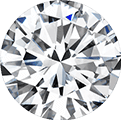
A round brilliant cut is the most wasteful shape to cut. To hit the exact angles that make a round diamond sparkle, the cutter has to grind away a large part of the rough. A great deal of weight is lost. That lost weight still has to be paid for, so it is priced into the finished stone.
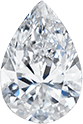
A pear shape is far kinder to the rough. It has a rounded end and a point, so a cutter can follow the natural shape of the crystal and keep more of it. Better yield means a lower price for the same finished weight.
Demand is the second reason. Round is the shape most people ask for by default. Pear, marquise and other so-called fancy shapes (any shape that is not round) sell in smaller numbers. Lower demand keeps prices softer.
How big is the difference?
As general guidance only, a pear shaped diamond typically sits somewhere in the region of 10 to 25 percent below a round diamond of matching weight and quality. That is a rule of thumb from years of comparing stones, not a fixed rate, and it moves with the market. Always compare two real certificates side by side rather than trusting a percentage.
Here is what the money actually buys you in each shape.
| What you are paying for | Round brilliant | Pear shape |
|---|---|---|
| Waste when cutting | High — the most wasteful common shape | Lower — follows the rough more closely |
| Demand | Highest of any shape | Steady but much smaller |
| Price for the same carat | The benchmark | Usually below the round |
| Face-up size for the same carat | Smaller | Larger — a pear looks bigger |
| Cut grading on the certificate | Graded Excellent down to Poor | Not graded for cut — you judge it by eye and by the measurements |
A pear also looks bigger
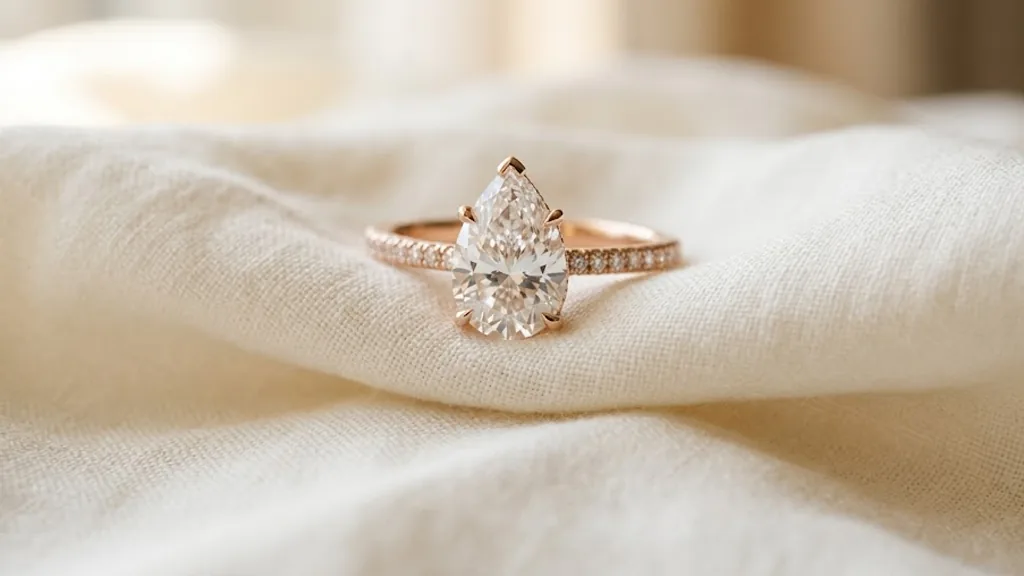
The saving is only half the story. A pear shape is long and shallow compared with a round, so more of its weight sits on the top surface where you can see it. Two stones of the same weight do not cover the same amount of finger.
These are typical approximate measurements for well cut one carat stones. Individual stones vary.
| Shape | Approximate size at 1 carat | How it reads on the hand |
|---|---|---|
| Round brilliant | About 6.5 mm across | Compact and even |
| Pear | About 8.7 mm long by 5.6 mm wide | Longer, and it lengthens the finger |
So for the same budget you can often have a pear that is both larger to look at and cheaper to buy. That is why pears are such a sensible choice for a first engagement ring.
Where the saving can disappear
Being honest about the downsides is more useful than a sales pitch. Three things to watch.
The bow-tie. Long shapes can show a dark shadow across the middle that looks like a bow tie. Every pear has one to some degree. A good one is barely visible. A bad one swallows the sparkle and no discount makes up for it. Always look at the actual stone, or a video of it, before you commit.
No cut grade. Certificates from IGI grade round diamonds for cut quality, but fancy shapes are not given a cut grade in the same way. That means a poorly proportioned pear can carry a perfectly respectable certificate. You have to judge the shape by eye, and by its length-to-width ratio. Around 1.45 to 1.75 to one suits most people.
The point. A pear has one sharp end and that end needs protecting. A well made setting will hold it in a V-shaped claw. Ours do. Ask before you buy if you are shopping elsewhere.
Lab-grown or natural?
The shape rule works the same way in both. A pear is cheaper than a round in natural diamonds, and a pear is cheaper than a round in lab-grown diamonds.
The bigger price difference is the one between lab-grown and natural. Lab-grown diamonds are real diamonds with the same chemistry, hardness and sparkle, grown in a laboratory rather than dug out of the ground, and they cost a great deal less. Every diamond we sell at CarbonstoneUK is lab-grown, and every centre stone comes with a free IGI certificate so you can check exactly what you own.
Pear and round rings we make
All of our rings are hand-made in solid gold or platinum in North Harrow, London. Prices below are for the pieces as listed on the site.
If you want the pear look at the gentlest price, the Stackable Pear Cut Engagement Ring starts at £503. For something with more presence, the Toi et Moi Pear Cut Engagement Ring in White Gold is £685 and pairs two stones on one band.
For a direct comparison, our Solitaire Round Cut Engagement Ring in White Gold is £563. Setting styles differ, so treat these as a feel for the range rather than a stone-for-stone test.
You can see every shape we hold on the pear diamond collection and the round diamond collection.
Common questions
Is a pear diamond cheaper than a round of the same size?
Careful with the word size. If you mean the same carat weight, yes, the pear is normally cheaper. If you mean the same visible width on the finger, the gap narrows, because a pear needs less weight to reach that width in the first place.
Do pear diamonds sparkle less than round?
A round brilliant is the sparkliest shape ever designed, so nothing beats it outright. A well cut pear is still very lively, with longer flashes of light rather than the round’s even fire. A badly cut pear with a heavy bow-tie will look dull, which is why the individual stone matters more than the shape.
Are pear diamonds harder to wear day to day?
Only slightly. The point is the one vulnerable spot, and a V-claw setting protects it. Diamond is the hardest natural material there is, so the stone itself is not the worry — knocks to the tip are. Take the ring off for the gym and for heavy DIY.
Which way should the point face?
Most people wear the point towards the fingernail, which makes the finger look longer. Some prefer it towards the wrist. There is no rule and both are correct.
Can I have a pear stone in a design of my own?
Yes. We do bespoke design at no extra design cost, so you only pay for the metal and the stones. Send us a sketch or a photograph of something you like and we will make it.
If you are choosing between the two shapes, the pear is the better value on paper and the more distinctive on the hand. The round is the safest classic. Both come with free insured UK delivery and 30 days to return, so you can see the ring in your own light before you decide.
Ready to find your perfect ring?
Explore our lab-grown diamond collection or book a virtual appointment with our team.