Can a Marquise Diamond Be Recut? What It Costs You
Yes, a marquise diamond can be recut - but it always loses weight. When it is worth doing, what the process involves, and when not to.
Yes, a marquise diamond can be recut. Diamond is the hardest natural material there is, but it can still be cut and polished by another diamond, and a skilled cutter can reshape a marquise that has been chipped, damaged or badly proportioned.
The real question is not “can it be done” but “should it be, in your case”. Recutting always costs weight, always costs money, and cannot be undone. Here is how to decide honestly.
Why marquise diamonds get recut more often than most shapes
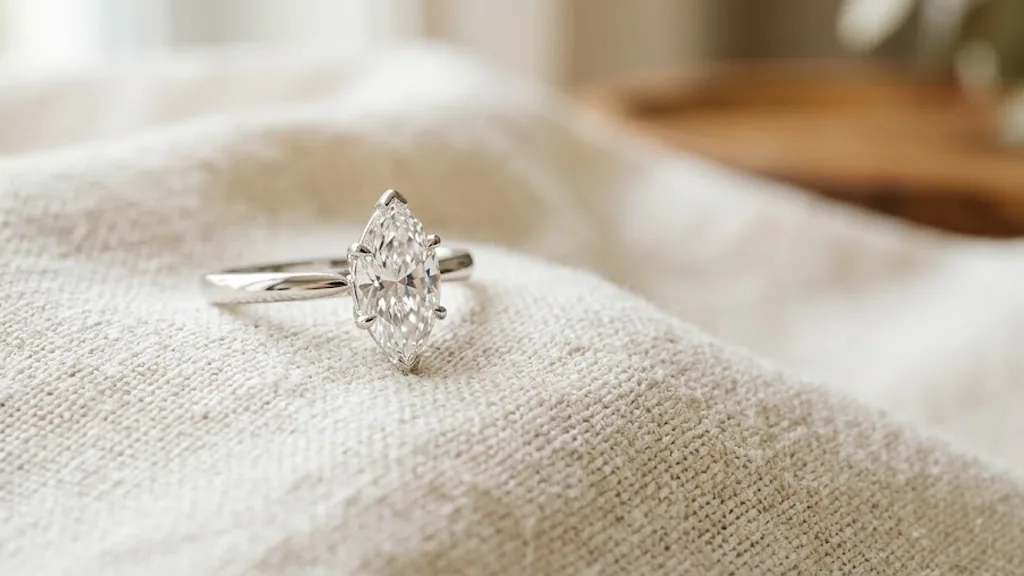
A marquise is a long boat shape with a sharp point at each end. Those two points are the thinnest part of any diamond shape in common use, and they take the most punishment.
Diamond is extremely hard — it resists scratching better than anything — but hardness is not the same as toughness. Diamond has cleavage planes, natural directions along which it can split under a sharp knock. A marquise point catching the edge of a door frame or a kitchen worktop at the wrong angle is the classic way a stone gets chipped.
The other common reason for recutting is proportion. A marquise cut too shallow, or with uneven ends, can show a heavy dark band across the middle — a bow-tie — or look lopsided from above. Both can sometimes be improved by recutting.
The four honest reasons to recut a marquise
- A chipped or broken point. The most common reason by far. A cutter removes the damage and re-forms the point, usually shortening the stone slightly at one or both ends.
- A visible surface chip or feather elsewhere on the girdle. Polishing away the damaged area can raise the clarity grade.
- Poor symmetry. If the two halves of the stone do not mirror each other, recutting can even them up — but this usually means removing weight from the fuller side.
- Changing the shape entirely. A damaged marquise is sometimes recut into a pear, an oval or a smaller marquise. This is the most drastic option and the one that loses the most weight.
What it costs you — in weight, not just money
Every recut removes material. That material is gone permanently, and carat weight is the largest single driver of a diamond’s value.
How much you lose depends entirely on the damage and the stone. A light polish to remove a small chip on a point might cost a few per cent of the weight. Re-forming a badly broken point, or correcting significant asymmetry, can cost considerably more. A cutter who has the stone in hand is the only person who can give you a real number — anyone quoting a percentage without seeing the diamond is guessing.
The practical trap is the weight thresholds. Diamond prices step up at round numbers, particularly at 0.50, 1.00, 1.50 and 2.00 carats. A 1.02 ct marquise recut down to 0.96 ct has crossed below the one-carat line, and the price per carat drops as well as the weight. You can lose more value than the visible damage was costing you.
| Situation | Usually worth recutting? |
|---|---|
| Chipped point, stone comfortably above a weight threshold | Often yes |
| Chipped point, stone just above 1.00 ct | Consider a setting that hides the chip instead |
| Small chip hidden under a claw, not visible | Usually no — leave it alone |
| Heavy bow-tie from shallow cutting | Sometimes, but improvement is not guaranteed |
| Sentimental heirloom, value secondary | Yes, if the goal is to wear it again |
| Small accent marquise in a band | No — replacement is nearly always cheaper |
What the process actually involves
- Assessment. The stone is unset and examined loose under magnification. A chip hidden under a claw may turn out to be larger than it looked.
- A plan and a weight estimate. The cutter tells you the likely finished weight and shape before starting. Get this in writing.
- Cutting and polishing. The damaged area is removed and the facets are re-polished so the stone stays balanced.
- Re-certification. The old certificate is now void — it describes a stone that no longer exists. A new report is needed for the new weight, measurements and clarity grade.
- Resetting. The stone is smaller, so the original setting will usually need adjusting or remaking.
Add all five together and the total cost is rarely trivial. For a smaller stone, the honest answer is often that replacing it costs less than restoring it — and any jeweller who tells you otherwise without doing the sums is not looking after you.
How to avoid needing a recut at all
Prevention is genuinely the better strategy with this shape:
- Choose a setting that covers the points. V-shaped claws that wrap over each end are the standard solution and are far more effective than a simple prong.
- Check the claws once a year. Most point damage happens after a claw has loosened and the end has become exposed.
- Take the ring off for the rough jobs. Gardening, gym bars, moving furniture, DIY. Not because diamond is weak, but because the point is thin.
- Avoid an extremely thin girdle at the ends. If you are buying now, ask about girdle thickness at the points. A slightly thicker girdle there is meaningfully more robust.
Our marquise settings are built with this in mind. The V Shaped Marquise Cut Engagement Ring at £1,143 at the time of writing uses exactly the wrapped V-claw arrangement described above. The Halo Marquise Cut Engagement Ring in White Gold at £1,143 at the time of writing surrounds the whole outline with small diamonds, which shields the points behind a rim of metal and stone. If you prefer the shape unadorned, the Solitaire Marquise Cut Engagement Ring at £538 at the time of writing is the simplest version — just be a little more careful with it.
The full marquise cut collection holds six designs, and there is more in the wider engagement ring range. If a damaged heirloom marquise is what brought you here and you would like it rebuilt into something wearable, we do bespoke work at no extra design cost.
Frequently asked questions
Can a chipped marquise diamond be repaired?
Not repaired in the sense of filling the gap — nothing can be added back. It is repaired by removing material until the damage is gone, which means the stone comes back smaller.
How much weight will a recut lose?
It depends entirely on the damage and the stone’s proportions. Only a cutter with the diamond in hand can give a real estimate. Be sceptical of any percentage quoted sight unseen.
Will a recut marquise still be certified?
Not on the old certificate — that document no longer describes the stone. You will need to submit it for a new report showing the new weight, measurements, clarity and cut grade.
Can a marquise be recut into a different shape?
Yes. Pear and oval are the usual destinations, because both fit inside a marquise outline. Expect to lose a significant amount of weight in the process.
Is it cheaper to recut or replace a marquise?
For smaller stones, replacing is almost always cheaper once you add assessment, cutting, re-certification and resetting. For larger stones or heirlooms with personal history, recutting is usually the better answer.
Does recutting work on lab-grown marquise diamonds too?
Yes, identically. Lab-grown diamonds are the same material with the same hardness and the same cleavage behaviour, so they cut and polish in exactly the same way. The maths on cost tends to favour replacement more often, simply because the stone costs less to begin with.
Can you recut a diamond while it is still in the ring?
No. It must be unset first, which is also when any hidden damage becomes visible. Expect the setting to need work afterwards, because the stone will no longer be its original size.
If you have a marquise you are worried about, bring it in or send us photographs and we will tell you honestly whether it is worth recutting. We are in North Harrow, and everything we make comes with free insured UK delivery and 30-day returns.
More guides on this topic
Ready to find your perfect ring?
Explore our lab-grown diamond collection or book a virtual appointment with our team.