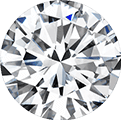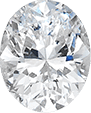
How Lab-Grown Diamonds Are Made, What They Are Made Of, and How Long They Take
HPHT and CVD explained in plain English: what a lab diamond is made of, how it is grown, and how long the whole process really takes.
People often assume a lab-grown diamond is assembled, or pressed, or somehow manufactured out of a different material that behaves like diamond. None of that is right. A lab-grown diamond is grown — a real diamond crystal, built up atom by atom from carbon, in a machine that recreates the conditions diamonds need.
This guide explains what they are made of, the two methods used to grow them, how long each takes, and what happens between a rough crystal and a finished ring.
What is a lab diamond made of?
Carbon. That is the entire answer.
A diamond is pure carbon in which every atom is bonded to four neighbours in a rigid three-dimensional lattice. That structure is what makes diamond the hardest natural material known, and what gives it the optical behaviour we call sparkle.
Graphite — pencil lead — is also pure carbon. The only difference is how the atoms are arranged. Growing a diamond is really the problem of persuading carbon atoms to lock into the diamond arrangement instead of the graphite one.
Because the material and structure are identical, a lab-grown diamond has the same hardness (10 on the Mohs scale), the same light-bending behaviour, the same density and the same thermal conductivity as a mined diamond. It is not a simulant. Cubic zirconia and moissanite are different materials entirely; a lab-grown diamond is diamond.
The starting ingredients depend on the growth method:
- A seed — a thin slice of existing diamond that gives the new crystal its pattern to follow. Every lab-grown diamond starts on one.
- A carbon source — high-purity graphite in one method, methane gas in the other.
- A metal catalyst — usually iron, nickel or cobalt, used in one method to help carbon dissolve and travel.
Method one: HPHT (High Pressure, High Temperature)
HPHT is the older method. It copies what happens deep in the earth’s mantle, where diamonds form under enormous pressure and heat.
A small diamond seed is placed at the bottom of a growth cell along with high-purity graphite and a metal catalyst. The cell goes into a press capable of generating pressures in the region of 1.5 million pounds per square inch and temperatures around 1,300 to 1,600 degrees Celsius.
Under those conditions the metal melts, the graphite dissolves into it, and the carbon migrates through the molten metal to the cooler seed — where it has no choice but to attach in the diamond arrangement. The crystal grows outward from the seed, taking the classic cuboctahedral shape.
Tell-tale signs: HPHT stones can contain tiny metallic flux inclusions left over from the catalyst. These are dark, and in rare cases large enough for the finished stone to be very slightly magnetic. They are graded exactly like any other inclusion.
Method two: CVD (Chemical Vapour Deposition)
CVD is the newer approach and now accounts for a large share of gem-quality production, particularly in larger sizes.
Flat diamond seed plates are laid in a vacuum chamber. The chamber is filled with a carbon-rich gas — mainly methane, with hydrogen. Microwave energy heats the gas until it becomes a plasma, which strips the methane molecules apart and frees individual carbon atoms.
Those carbon atoms rain down onto the seed plates and bond in the diamond lattice, building the crystal upwards in layers. Because it grows layer by layer, a CVD diamond forms as a flat, roughly square tablet rather than a rounded crystal.
CVD runs at far lower pressure than HPHT — closer to a vacuum than to a press — but still at very high temperature, typically around 800 to 1,200 degrees Celsius.
Tell-tale signs: CVD stones can show faint internal graining from the layered growth, usually invisible to the eye. Many CVD diamonds are given a brief post-growth HPHT or annealing treatment to improve colour. This is standard practice, is noted on the certificate, and is permanent — it changes nothing about the stone’s structure or durability.
HPHT and CVD compared
| HPHT | CVD | |
|---|---|---|
| Copies | Conditions in the earth’s mantle | Nothing in nature; an engineered process |
| Carbon source | Graphite | Methane gas |
| Pressure | Extremely high | Low, near vacuum |
| Rough shape | Cuboctahedral crystal | Flat square tablet |
| Typical inclusions | Metallic flux | Faint graining |
| Best suited to | Smaller stones, fancy colours | Larger stones, high clarity |
Neither method produces a “better” diamond. Both are graded on the same scales by the same laboratories, and a finished stone is judged on its cut, colour, clarity and carat — not on which chamber it came out of.
How long does it take to grow a lab diamond?
This is where you will see wildly different numbers quoted online, so here is an honest framing. Growth time depends on the target size, the target quality and the specific equipment. The figures below are the ranges commonly quoted in the trade rather than a measured industry standard.
| Stage | Typical time quoted |
|---|---|
| Growing a one-carat rough crystal | Roughly one to four weeks |
| Growing larger rough (two to three carats and up) | Longer again, often several weeks |
| Cutting and polishing | Several days to a couple of weeks |
| Laboratory grading and certification | Days to weeks depending on queue |
| Setting into a hand-made ring | Days to weeks depending on the design |
Two points people find surprising. First, growth is not linear — pushing for a larger or cleaner crystal usually means slowing the process down, not just running it longer. Rushing produces flaws. Second, the growing is often the fastest part of the whole journey. Cutting a rough crystal into a well-proportioned brilliant is skilled human work, and no amount of technology speeds up a grading laboratory’s queue.
Compare that with a natural diamond, which formed over a period usually described in the hundreds of millions to billions of years, roughly 150 kilometres below the surface. That timescale is the only genuine difference in origin between the two.
From rough crystal to finished ring
Growing is barely half the story. Here is what happens next.
- Removal from the growth cell. The crystal is cleaned of catalyst metal or lifted from the seed plate.
- Planning. The rough is scanned in three dimensions and software maps the best possible finished stone, working around any inclusions. This decides how much weight is lost.
- Sawing and bruting. The rough is cut, and the outline shape is formed. Diamond is only cut by diamond, using diamond-charged saws and lasers.
- Faceting and polishing. Each facet is placed at a precise angle. This is where sparkle is created or lost, and it is the single most important stage for the finished look.
- Grading. An independent laboratory such as IGI assesses cut, colour, clarity and carat and laser-inscribes the report number on the girdle, along with wording identifying it as lab-grown.
- Setting. The stone is set by hand into solid gold or platinum.
You can see the end of that chain in our Solitaire Round Cut Engagement Ring in White Gold at £563 or the Three Stone Oval Cut Engagement Ring at £1,021 (prices correct at the time of writing). Every centre stone comes with a free IGI certificate recording exactly what came out of that process.
Frequently asked questions
Can you make a diamond at home?
No. Both processes need industrial equipment — a press capable of extreme pressure, or a microwave plasma reactor under vacuum, both operating at well over a thousand degrees. There is no domestic version.
Are lab-grown diamonds made from ashes or hair?
Memorial diamonds do exist and are grown by HPHT using carbon extracted from ashes or hair. It is a specialist service and quite separate from ordinary jewellery production. The stones we sell are grown from industrial-purity carbon.
Does the growth method affect the price?
Not directly. Price follows the finished stone’s cut, colour, clarity and carat weight, plus how difficult that combination was to achieve. Certificates state the method, but it is not a quality ranking.
Is a lab-grown diamond as hard as a natural one?
Yes — 10 on the Mohs scale, identical. It will not scratch, cloud or wear differently, and it can be resized, retipped and repolished like any diamond.
How long until I can wear one?
If we have the design in stock, it ships to you with free insured UK delivery in days, not weeks. A bespoke piece takes longer because it is made for you, and we charge no extra design cost for it.
Have a look at the results
Browse the engagement ring collection or the round cut selection. Everything is hand-made in North Harrow, London, in solid gold or platinum, with 30-day returns.
If you want to know how these stones compare with mined ones, read lab-grown versus natural diamonds: what is actually different and do lab-grown diamonds test as real diamonds.
More guides on this topic
Ready to find your perfect ring?
Explore our lab-grown diamond collection or book a virtual appointment with our team.