
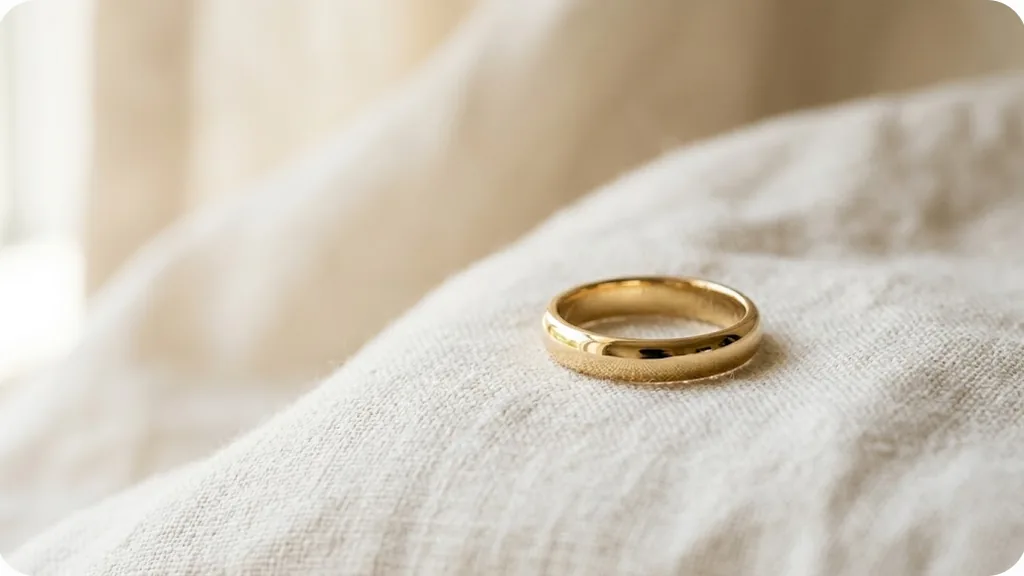
How Many Rings Do You Need for a Wedding?
How many wedding rings you actually need, how many ring bearers are traditional, and how to budget across the whole set.
Somewhere between the proposal and the wedding, most couples realise they are not sure how many rings they are actually supposed to buy. Two? Three? Four? And then a separate question arrives from the other direction: how many ring bearers should there be, and how many rings does each one carry?
Both are practical questions with short answers, so let us deal with them properly and save you a stressful afternoon.
The minimum: two rings
For a two-person wedding, the absolute minimum is two wedding rings — one for each of you. That is it. Nothing else is required by law, by the church, or by the registrar.
You do not legally need any rings at all in the UK. Rings are a custom, not a legal requirement of marriage. Plenty of couples exchange one ring, or none.
The usual count: three rings
In practice, most couples who follow the common British pattern end up with three:
- The engagement ring — given at the proposal, worn by one partner
- Their wedding band — added on the wedding day, worn beneath the engagement ring
- The other partner’s wedding band — usually a single plain or textured band
So the honest answer to “how many rings do I need to buy for the wedding itself” is normally two, because the engagement ring already exists.
The full traditional set: four rings
The fourth ring is the eternity ring, and it is not a wedding-day purchase. Traditionally it is given later — at a milestone anniversary, or at the birth of a first child. It is a band set with diamonds all or part of the way round, worn stacked with the other two.
Nobody should be buying an eternity ring at the same time as the wedding rings. It is a later gift by design, and the tradition works better when it is kept that way.
How many rings by situation
| Situation | Rings needed | Notes |
|---|---|---|
| Both partners wearing rings | 2 bands | Plus the existing engagement ring |
| Only one partner wears a ring | 1 band | Increasingly common and entirely normal |
| Both had engagement rings | 2 bands + 2 existing | Consider two bridal sets for a flush fit |
| Engagement ring doubles as the wedding ring | 0 new rings | Perfectly valid; the ring is simply blessed or re-given |
| A bridal set was bought at proposal | 1 more band | The set already includes both of that partner’s rings |
If you are buying an engagement ring and know a matching band is coming, a bridal set solves two purchases at once and guarantees the two rings sit flush against each other. The Tiara Pear Cut Bridal Set in Platinum is a good illustration of how a set is designed to interlock rather than just sit near each other.
Do you need a spare ring for the day?
Not officially, but a fair number of experienced wedding planners quietly recommend it, and here is why. Rings get left in hotel safes. Best men get nervous. Rings roll. A cheap plain band in the right size, kept in someone’s pocket, costs very little and removes one entire category of wedding-day disaster.
If it never comes out of the pocket, nothing is lost. That is a practical suggestion from the trade rather than a tradition, and we are labelling it as such.
How many ring bearers are there in a wedding?
Traditionally, one.
The ring bearer is usually a child, often a young boy, who carries the rings down the aisle — normally on a small cushion, in a box, or increasingly in a ring bearer’s pouch, which is far harder to drop.
But there is no rule, and modern weddings vary a lot:
- One ring bearer carrying both rings — the classic arrangement
- Two ring bearers, one per ring — useful when you have two children who would each like a job, and it halves the drama if one goes off-script
- No ring bearer at all — the best man, maid of honour, or officiant simply holds the rings. Extremely common.
- An adult ring bearer — a sibling, a close friend, a grandparent. A lovely way to include someone who does not have another role.
- A dog — genuinely common now. Attach the rings securely, and please have a human on standby.
One point worth making from experience: if the ring bearer is under about six, most families give them a decoy. The real rings travel with the best man or officiant, and the child carries a beautifully presented empty box or a pair of inexpensive substitute rings. Everyone gets the photograph and nobody spends the reception on hands and knees.
How many rings does each person actually wear?
On the wedding day itself, one partner typically ends up wearing two rings on the left ring finger — the wedding band nearest the hand, engagement ring above it — and the other partner wears one.
Over the following years the stack often grows. Eternity bands, anniversary bands and stacking rings get added. There is no maximum. Practically, three narrow bands on one finger is comfortable; beyond that most people move to the other hand or start wearing them in rotation.
If you plan to build a stack over time, buy narrow bands rather than wide ones. A ring like the Stackable Round Cut Three Quarter Eternity Band is designed for exactly that, and it stacks far better than a single chunky band would.
Budgeting across the rings
A pattern worth knowing: couples routinely spend most of the ring budget on the engagement ring and then find themselves surprised by the cost of two wedding bands a year later. Wedding bands are not free, particularly if one is diamond-set.
Two honest suggestions. First, if you know both bands are coming, get a rough price for them before you finalise the engagement ring, so the whole plan is visible at once. Second, the two bands do not have to cost the same — there is no etiquette requiring it, and a plain band and a diamond-set band naturally sit at different prices.
A plain or simply set band such as the 7 Stone Round Cut Wedding Band in Yellow Gold pairs well with almost any engagement ring and keeps the second purchase manageable. Prices on our product pages are correct at the time of writing.
Frequently asked questions
Do both partners have to wear a wedding ring?
No. It is common but not required. Some people cannot wear rings for work reasons — electricians, machinists, some medical roles — and wear the ring on a chain instead, or a silicone band during working hours.
Can the engagement ring be the wedding ring?
Yes. Many couples simply use the same ring, with the officiant blessing or re-presenting it at the ceremony. It is a good option if the engagement ring is a family piece, or if you would rather put the money elsewhere.
When should we buy the wedding bands?
Two to three months before the wedding for a hand-made ring, longer if you want engraving or a bespoke design. Rings that are made rather than pulled off a shelf take time, and rushing the sizing is the main cause of problems.
Who traditionally pays for the wedding rings?
The tradition is that each partner buys the other’s ring. In practice most couples now pay for both jointly. Neither approach is more correct.
What does the ring bearer do with the rings before the ceremony?
Nothing, ideally. Give them to the ring bearer at the last sensible moment — usually just before entering — and have the best man or a parent hold them until then. Rings handed to an excited child an hour early are rings you will be looking for.
To sum up
Two rings is the minimum, three is the usual total, four including an eternity ring given later. One ring bearer is traditional, none is perfectly fine, and two works nicely if you have two children who want the job.
When you are ready to look, our wedding ring collection covers plain, patterned and diamond-set bands in solid gold, platinum and sterling silver, all hand-made with lab-grown diamonds. Free insured UK delivery, 30 days to return, and bespoke design at no extra cost if you want something we do not stock.
More guides on this topic
Ready to find your perfect ring?
Explore our lab-grown diamond collection or book a virtual appointment with our team.