
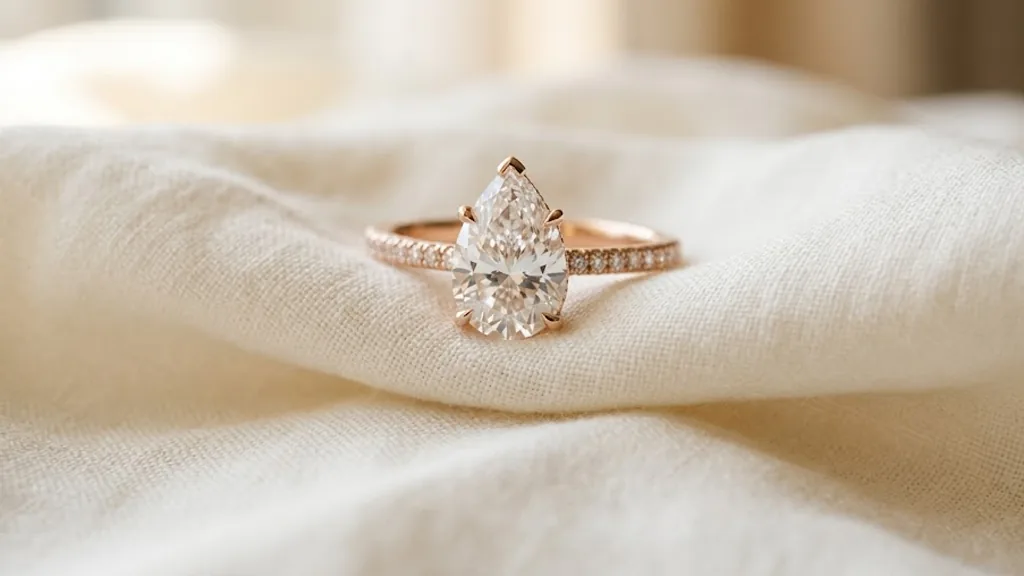
How Much Does a 2 Carat Pear Shaped Diamond Cost? A Full Guide
What a 2 carat pear shaped diamond costs in the UK, how big it looks, the six factors that move the price, and how to spend less.
Two carats in a pear shape is a genuinely striking ring. The stone stretches down the finger, catches light along its whole length, and reads as far larger than two carats of most other shapes. It is also one of the best value combinations of size and shape you can buy.
This guide sets out what a two carat pear actually costs, why the number swings so widely, and which decisions save you real money without changing how the ring looks.
How big two carats looks in a pear
Before price, size — because size is the reason most people want a pear in the first place.
A carat is a unit of weight, not width. Two carats is 0.40 grams. Because a pear spreads its weight along a long axis rather than piling it into a compact circle, it covers noticeably more finger than a round of the same weight.
| Shape at 2.00ct | Approximate size across the top |
|---|---|
| Pear (about 1.55 ratio) | Around 12.5mm long x 8.0mm wide |
| Round brilliant | Around 8.1mm across |
| Cushion, square | Around 7.5mm x 7.5mm |
Those are working approximations; the certificate for your specific stone gives the exact figures. But the pattern is reliable — at the same weight, the pear is the one that dominates the finger.
What a 2 carat pear costs
There is no single price, and any article that gives you one number is guessing. What follows is broad market guidance for the UK, not a quote, and prices move over time.
| What you are buying | Typical UK guidance |
|---|---|
| 2.00ct pear lab-grown, loose stone | Several hundred pounds |
| 2.00ct pear lab-grown, finished gold or platinum ring | Roughly one to a few thousand pounds depending on the setting |
| 2.00ct pear natural, loose stone | Several thousand pounds |
| 2.00ct pear natural, finished gold or platinum ring | Well into five figures for good grades |
The gap between the lab-grown and natural rows is the single biggest lever you have. A lab-grown diamond is a real diamond: identical carbon crystal, identical hardness, identical way of handling light. It is grown in a laboratory over a few weeks rather than formed underground. Nobody can tell the difference by eye, and a jeweller with a loupe cannot either — it takes specialist equipment.
Six things that move the price
1. Crossing the two carat line
Diamond prices jump at round numbers because those are the numbers people ask for. A 1.90ct pear is around a fifth of a millimetre shorter than a 2.00ct — invisible on a hand — but it sits in a cheaper band. Asking for stones just under a milestone weight is a rule of thumb worth using, not a measured statistic, and it works.
2. The outline ratio
Pears vary from short and plump to long and slender. Longer pears look bigger for the same weight but need more careful cutting. Ratios around 1.50 to 1.70 are the most common; below that a pear starts to look stubby, above it the point becomes fragile.
3. The bow tie
Every elongated shape shows a dark band across the middle, shaped like a bow tie, caused by facets blocking light in the centre. A faint one that appears only at certain angles is completely normal. A heavy dark band is a badly cut stone, and it is not graded on any certificate — you have to look. At two carats a bow tie is more visible than at half a carat, simply because there is more stone.
4. Colour
Pears concentrate colour toward the point, so warmth shows there first. At two carats that is noticeable. If you want a bright white stone, aim for G colour or better. If you like a warm tone, a lower grade in yellow or rose gold looks lovely and costs less.
5. Clarity
Aim for eye-clean — nothing visible without magnification. VS2 and many SI1 stones qualify. Paying for VVS or Flawless buys a better certificate, not a better ring. One extra check at this size: make sure there is no inclusion near the point, which is the weakest part of the stone.
6. The setting
A pear needs a V-shaped prong — a small claw shaped like a V — to shield the point. That is more work than the four simple prongs on a round. Add a halo, pavé shoulders or platinum instead of gold and the setting cost climbs further. A plain solitaire is always the cheapest mount.
Our pear rings and their prices
Pear is our second largest shape collection after round, with around eleven designs. Every ring is hand-made in solid gold or platinum with lab-grown diamonds, and every centre stone carries a free IGI certificate. Prices correct at the time of writing.
| Ring | Style | Price |
|---|---|---|
| Pear Cut Engagement Ring in Yellow Gold | Three stone design, warm gold frames the outline | £938 |
| Teardrop Pear Cut Bridal Set in Rose Gold | Engagement ring and matching band together | £999 |
| Tiara Pear Cut Bridal Set in Platinum | Platinum set with a raised tiara profile | £999 |
See the whole range in our pear cut collection, or look at bridal sets if you want the engagement ring and wedding band designed as a pair. That matters more with pears than with any other shape, because a straight band often will not sit flush against a pointed stone.
Getting two carat presence for less
- Buy just under. A 1.85ct to 1.95ct pear looks the same and costs less.
- Go longer. A more elongated outline covers more finger for the same weight.
- Add a halo. A ring of small stones around a smaller centre can read close to a bare two carat, for far less.
- Slim the band. A narrow shoulder makes the centre stone look larger. This is free.
- Take G or H colour instead of D to F. In a white metal setting the difference is invisible to almost everyone.
- Choose lab-grown. Same stone, dramatically lower price.
Frequently asked questions
How much does a 2 carat pear shaped diamond cost?
As guidance only: a loose two carat lab-grown pear typically sits in the several hundreds of pounds, while a comparable natural stone typically runs into the several thousands. Set into a finished hand-made ring, expect the metal and craftsmanship on top. Our pear engagement rings start at £503 at the time of writing for smaller designs, with pear bridal sets at £999.
How big is a 2 carat pear on the finger?
Roughly 12.5mm long and 8.0mm wide for a typical outline — substantially longer than a two carat round, which measures about 8.1mm across. It is a ring people notice from across a room.
Is a 2 carat pear cheaper than a 2 carat round?
Usually, yes, at the same colour, clarity and cut quality. Cutting a pear wastes less of the original rough crystal than cutting a round, and round is the more in-demand shape. Both factors push the pear price down.
Is a large pear fragile?
The point is the vulnerable part, and at two carats it is longer and thinner than on a small stone. A V-prong solves it. Never buy a pear ring where the tip is exposed, and have the prongs checked every year or two.
Can you make a 2 carat pear ring to my own design?
Yes. Bespoke design costs nothing extra with us — you pay for the materials and the making. Tell us your budget, the outline you want and the metal, and we will price it honestly rather than talk you upward.
A two carat pear is a lot of ring for the money, provided the stone is well cut and the point is properly protected. Every order includes free insured UK delivery and 30 days to return, so you can see how it sits on the hand before deciding.
Ready to find your perfect ring?
Explore our lab-grown diamond collection or book a virtual appointment with our team.











