
Are Emerald Cut Diamonds the Most Expensive? The Honest Answer
Emerald cuts cost less per carat than round diamonds, but they hide nothing. Here is the real price picture and how to buy one well.
Emerald cuts look expensive. They are long, clean, architectural and quietly glamorous, and they carry a reputation for being the connoisseur’s choice. So it is a fair question: are emerald cut diamonds the most expensive shape?
No. They are not. Weight for weight, emerald cuts are usually among the cheaper shapes to buy, and round is almost always the most expensive. But there is a real catch, and it is the reason emerald cut rings often end up costing more than people expected. This guide explains both halves honestly.
What an emerald cut actually is
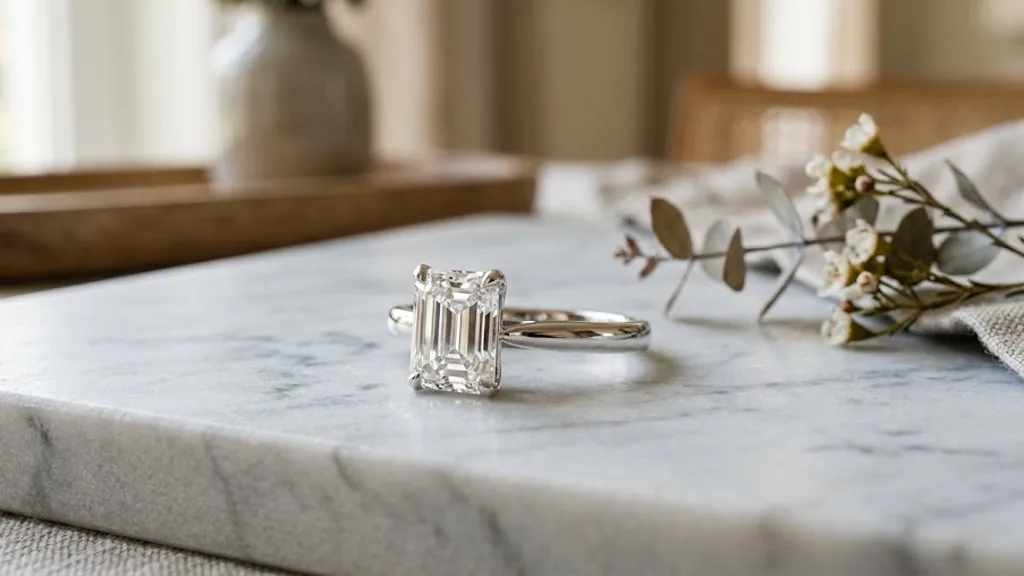
An emerald cut is a rectangle with the corners cut off, faceted in long parallel steps rather than in the small triangular facets of a round. Jewellers call this a step cut.
Because the facets are long flat planes, the stone does not throw fine rapid sparkle. Instead it produces broad flashes of white and dark, like looking down a hall of mirrors. People often describe it as a “hall of mirrors” effect, and it is exactly right.
That optical difference drives everything else about buying one.
Why emerald cuts cost less per carat than round
Two reasons, and both are structural rather than about fashion.
Less waste in the cutting. Turning a rough crystal into a round brilliant throws away a very large share of the original material. An emerald cut follows the natural elongated shape of many rough crystals far more closely, so less is lost. Less waste means a lower cost for each finished carat.
Lower demand. Round is the default engagement ring shape in Britain and always has been. High demand supports high price. Emerald cut is admired but chosen by a minority.
Put together, this is a long-standing trade rule of thumb rather than a measured figure: at the same colour, clarity and cut quality, an emerald cut of a given weight generally prices below a round of the same weight. It holds for lab-grown and natural stones alike.
The catch: emerald cuts hide nothing
Here is where the money goes back the other way.
A round brilliant’s tiny facets scatter light in every direction, which conveniently masks small inclusions and slight body colour. An emerald cut has a large open table — the flat top surface — and long clean planes. You are looking straight into the stone.
The consequences are direct:
- Inclusions show. A tiny mark that would vanish inside a round is plainly visible inside an emerald cut. You generally need VS2 or better to be reliably eye-clean, whereas many SI1 rounds are eye-clean.
- Colour shows. Warmth that hides in a round reads clearly in an emerald cut, especially along the length. Most buyers who want a white look aim for G or better.
- Cut precision shows. With long straight facets, any wobble in the symmetry is obvious to the naked eye.
So the stone is cheaper per carat, but you tend to buy higher grades. Those two effects partly cancel out. In practice a good emerald cut still usually comes in below an equivalent round, but the saving is smaller than the headline figure suggests.
How the shapes really compare
| Shape | Price per carat | Grades you typically need | Look on the finger |
|---|---|---|---|
| Round brilliant | Highest of all shapes | Forgiving — SI1 often eye-clean, H colour reads white | Compact, maximum sparkle |
| Emerald cut | Lower than round | Demanding — VS2 or better, G colour or better | Long, elegant, broad flashes not sparkle |
| Asscher | Lower than round | Demanding, same reasons as emerald | Square version of the emerald cut |
| Oval, pear, marquise | Lower than round | Moderate — but watch for the bow tie shadow | Elongated, look larger per carat |
| Cushion | Lower than round | Moderate — shows colour more than round | Soft square, broad flashes |
So the honest ranking is: round is the most expensive shape per carat, and every fancy shape sits below it. Emerald cut is not the most expensive — but it is one of the least forgiving, and that is a different kind of cost.
The size advantage nobody mentions
Emerald cuts have a large flat top relative to their weight, and they are elongated. Both mean the stone covers more finger per carat than a round does. A one carat emerald cut looks longer and more present on the hand than a one carat round, even though it costs less.
If your priority is visible size for a fixed budget, that combination is a genuine advantage.
Our emerald cut rings
We hold around six emerald cut designs. Every ring is hand-made in solid gold or platinum with lab-grown diamonds, and every centre stone comes with a free IGI certificate — which matters more with emerald cuts than any other shape, because you need the clarity grade in writing. Prices correct at the time of writing.
| Ring | Style | Price |
|---|---|---|
| Solitaire Emerald Cut Engagement Ring | Single stone, nothing competing with the outline | £672 |
| Hidden Halo Emerald Cut Engagement Ring | Small stones tucked beneath the centre — visible from the side only | £1,016 |
| Three Stone Emerald Cut Engagement Ring | Centre stone with a companion each side | £1,017 |
Compare those against the round designs in the same shop and you will see the pattern: a plain emerald cut solitaire sits at a similar level to a plain round solitaire, while giving you more length on the finger. Browse the full emerald cut collection or the wider range of engagement rings.
How to buy an emerald cut well
- Prioritise clarity over weight. This is the one shape where that advice is genuinely true. A visibly included emerald cut looks flawed to everyone, not just to a gemmologist.
- Look at the whole stone, not the grade. Two VS2 stones can look completely different depending on where the inclusion sits. Under a big open table, position matters more than the letter.
- Choose your ratio. Around 1.30 to 1.50 gives the classic elongated rectangle. Closer to 1.00 and you are heading toward an Asscher.
- Protect the corners. The clipped corners are the thinnest points. Prongs should sit over them.
- Choose lab-grown. The single largest saving available, with no visible difference — and it makes the higher clarity grade an emerald cut needs far more affordable.
Frequently asked questions
Are emerald cut diamonds the most expensive?
No. Round brilliants are generally the most expensive shape per carat, because cutting them wastes more rough material and demand for them is highest. Emerald cuts price below round at the same weight and quality.
Why do emerald cut rings sometimes cost more then?
Because emerald cuts hide nothing, so buyers usually step up to higher clarity and colour grades to get a stone that looks clean. That upgrade eats into the saving. The shape is cheaper; the grades you need are dearer.
Do emerald cut diamonds sparkle?
They flash rather than sparkle. Long step facets produce broad reflections of light and dark instead of the fine glitter of a round. If you want maximum sparkle, choose a round or a cushion. If you want quiet elegance and clean lines, an emerald cut is unbeatable.
Do emerald cuts look bigger than rounds?
For the same carat weight, yes — they have a larger flat top and an elongated outline, so they cover more finger. That is one of their strongest practical advantages.
Can you make an emerald cut ring to my own design?
Yes. We hand-make bespoke rings in solid gold and platinum with no extra design cost. If you want a particular ratio, carat weight or setting, send us the details and we will price it properly.
Emerald cut is the shape for someone who wants presence without glitter. Every order carries free insured UK delivery and 30 days to return, so you can judge those long flashes of light at home rather than under shop lights.
More guides on this topic
Ready to find your perfect ring?
Explore our lab-grown diamond collection or book a virtual appointment with our team.











