Are Baguette Cut Diamonds More Expensive?
Baguette diamonds cost less per carat than round ones, yet baguette rings can cost more. Here is exactly why, with real UK prices.
The short answer is no, and then yes. Baguette cut diamonds are usually cheaper per carat than round brilliants. But a finished baguette ring can easily cost the same as, or more than, a round one. Both statements are true, and the gap between them is where most of the confusion sits.
Here is what is actually going on, explained without jargon.
First, what a baguette is
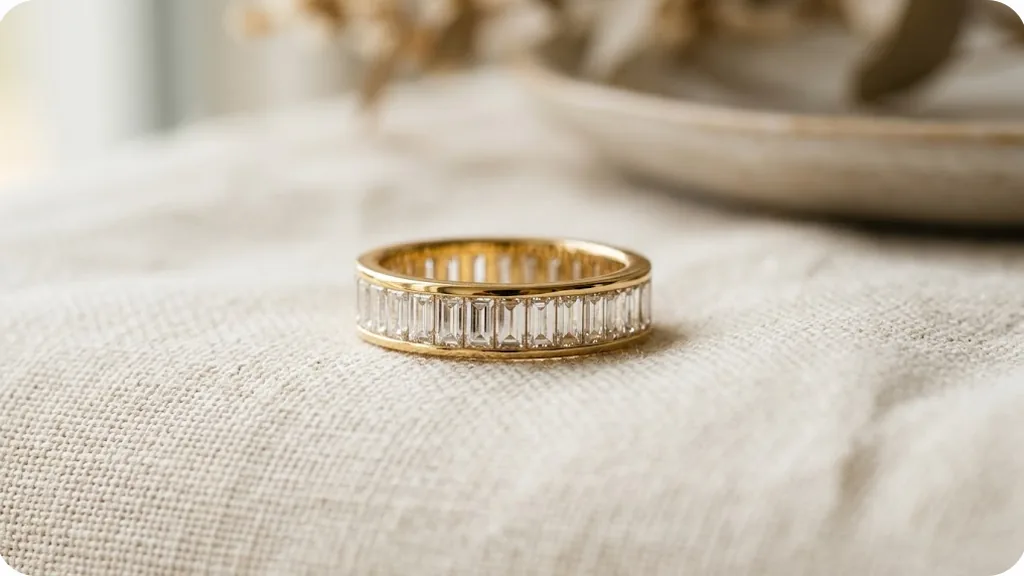
A baguette cut diamond is a long, narrow rectangle with the corners squared off. It is named after the French loaf because that is what the outline resembles.
It is a step cut, meaning its facets — the flat polished surfaces — are long and parallel, running around the stone like steps. A baguette has around 14 of them. A round brilliant has 57 or 58 much smaller ones arranged to scatter light everywhere.
That difference in faceting explains almost everything about the price.
Why baguettes cost less per carat
Less rough diamond is wasted
Diamond rough — the raw crystal a cutter starts with — is irregular. To carve a perfect circle out of it, a cutter has to grind away material in every direction, and a large proportion of the original crystal ends up as dust that nobody gets paid for.
A rectangle follows the natural geometry of a crystal far more closely. Much less is lost. That saving shows up directly in the price of the finished stone.
Fewer facets, less cutting time
Fourteen facets take considerably less bench time than fifty-eight, and the shape is geometrically simpler. Less labour, lower cost.
Lower demand
The round brilliant has been the default engagement ring shape for close to a century. That constant demand keeps its price firm. Baguettes are a specialist taste, and specialist tastes are cheaper.
They are almost always small
Baguettes are typically used as accent stones in rows or beside a centre stone, rather than as one large solitaire. Small diamonds cost far less per carat than large ones, because large rough is rare. Most baguettes you will see are well under 0.25ct each.
Relative price per carat by shape
All else being equal — same colour, same clarity, same size — this is roughly where the common shapes sit against each other. Treat it as a guide to position, not a price list.
| Shape | Relative price per carat | Reason |
|---|---|---|
| Round brilliant | Highest | Most rough wasted, strictest cutting standard, strongest demand. |
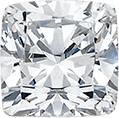
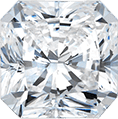
| Oval, cushion, radiant | Upper middle | Popular, brilliant-style faceting, reasonably efficient to cut. |
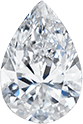
| Pear, marquise | Lower middle | Elongated outlines follow the rough well. |
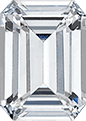
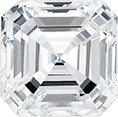
| Emerald, Asscher | Low | Step cuts, weight-efficient, simpler faceting. |
| Baguette | Lowest | Simplest step cut, fewest facets, least waste, usually small. |
So why can a baguette ring still cost more?
Because you are not buying one stone. You are buying a set of them, and the requirements on that set are unusually demanding.
1. They need better clarity and colour
Those big open step facets act like windows into the diamond. There is no busy sparkle to hide behind.
Clarity measures the tiny natural features inside a stone. In a round brilliant, a small one disappears into the flashing. In a baguette, the same feature is plainly visible, so baguettes need a higher clarity grade to look clean.
The same applies to colour, which measures how free a diamond is of a faint yellow tint. Sparkle breaks up tint; a baguette does not. It needs to be a whiter stone.
The result: a baguette costs less per carat but has to be a better stone to look right. That eats into the saving.
2. They have to match each other
This is the cost nobody anticipates. Baguettes are used in rows. If one stone in a row is a shade warmer or slightly cloudier than its neighbours, your eye catches it instantly.
So the stones must be matched for colour, clarity and size across the whole set. Sourcing eight or twelve genuinely matched baguettes takes far more work than picking twelve rounds where minor variation vanishes into the sparkle. That sorting work is real, and it is priced in.
3. The setting work is slower
Baguettes are usually channel set, meaning they sit in a groove between two walls of metal with nothing protruding, or bar set, with slim metal bars between them. Both protect the corners, which are the vulnerable part of a rectangular stone.
Channel setting is precise, unforgiving work. Each stone must sit perfectly level and perfectly square, because straight edges make any misalignment obvious. Set a row of round stones slightly unevenly and you might get away with it. Set a row of baguettes unevenly and it looks wrong from across a room.
4. More stone for the same look
A row of rectangles tiles edge to edge with almost no metal showing between the stones. That is precisely why the effect is so clean — and it also means more total carat weight goes into the same length of ring than a row of rounds with gaps between them.
What it comes to in real prices
Comparing our own rings is the clearest way to see it. The Baguette Cut Half Eternity Band is £672. The Stackable Emerald Cut Half Eternity Band, a comparable step-cut band in the same style of setting, is £770.
Move to the Stackable Baguette Cut Three Quarter Eternity Band at £1,061 and the price rises for a very simple reason: the stones carry three quarters of the way round the ring instead of half. More diamonds, more setting work, more money. The shape did not get more expensive; the ring got fuller.
The Pave Baguette Cut Wedding Band at £690 shows a third pattern. It mixes baguettes with pavé — tiny round diamonds set close together in the surrounding metal. The extra stones and the extra setting labour push the price up a little, and in return you get the twinkle that baguettes alone do not give.
The pattern across all three: what you pay for is the quantity of diamond and the amount of setting work, not the shape.
What lab-grown changes
Everything above is about cutting physics and workmanship, and it applies to lab-grown diamonds exactly as it does to mined ones. Lab-grown diamonds are the same material, with the same hardness, the same optical behaviour and the same grading scales. They are grown in a controlled environment over weeks rather than formed underground over millennia.
What changes is the scale of the numbers. Because lab-grown diamonds cost far less, the higher clarity and colour that baguettes genuinely need stops being a painful decision. You can simply buy the cleaner, whiter stones the shape demands, and put the difference into the metal or the design.
It also means matched sets are more achievable. Matching is easier and cheaper when the underlying stones cost less, which is one reason well-made baguette bands have become far more affordable than they were a generation ago.
How to buy a baguette ring well
Look at the row, not the stone. Check the stones match each other for colour and brightness. This is the number one sign of a well-made baguette piece.
Check the alignment. The tops should form one continuous straight line with even gaps. Sight along the row from the side.
Ask about the setting. Channel, bar or bezel protects the corners. Simple claws gripping bare corners are a risk on a ring worn daily.
Prefer half or three-quarter eternity for daily wear. A full eternity band, with stones all the way round, cannot normally be resized. A plain section at the back gives a jeweller something to work with.
Get a certificate. Every centre stone we sell comes with a free IGI certificate, an independent laboratory report stating the grades rather than the seller’s description.
Frequently asked questions
Are baguette diamonds cheaper than round diamonds?
Per carat, yes, usually noticeably so. As a finished ring, often not, because baguette rings tend to hold more total carat weight, need better quality stones and take longer to set.
Why do baguettes need higher clarity?
Their few large parallel facets are effectively windows into the stone. There is no scattered sparkle to disguise internal features, so anything inside shows.
Are baguettes good value?
They are excellent value for a clean, geometric, Art Deco look. They are poor value if what you want is maximum sparkle per pound — a well-cut round will always out-sparkle a baguette.
Do baguettes hold their value?
No diamond ring is a reliable investment, whatever shape it is. Resale on any mass-market ring is a fraction of retail. Buy a baguette band because you want to wear it, not to trade it.
Can I have baguettes made into a custom design?
Yes. We hand-make in solid gold and platinum in North Harrow, London, and there is no extra design cost for bespoke work. Tell us the width, the metal and how far round you want the stones to go.
See them for yourself
Prices make far more sense once you can see what each one buys. Browse everything we make in this shape in our baguette collection, or compare against other shapes at the same price in the full wedding ring collection.
Free insured UK delivery, 30-day returns, and a free IGI certificate on every centre stone.
More guides on this topic
Ready to find your perfect ring?
Explore our lab-grown diamond collection or book a virtual appointment with our team.