
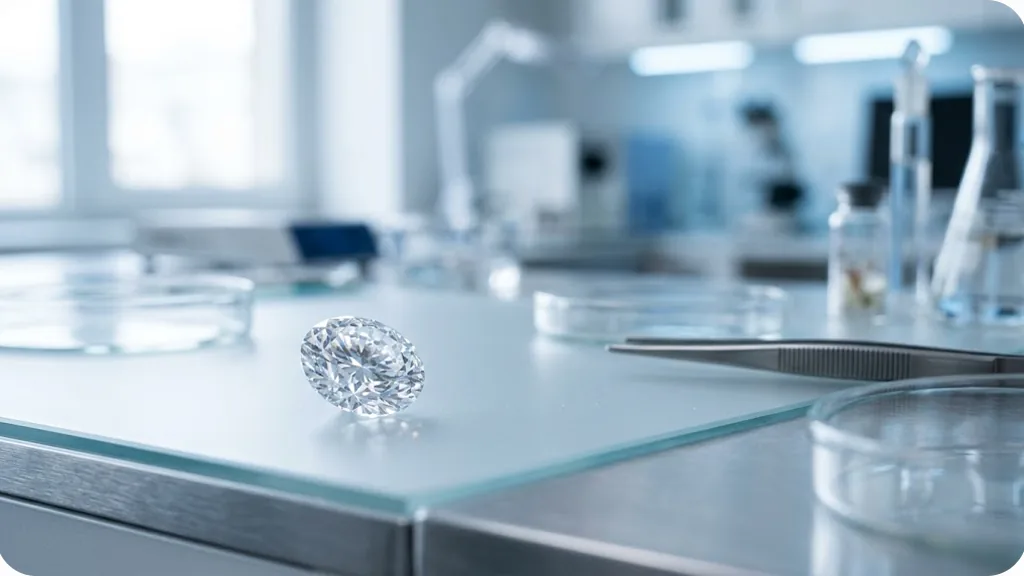
Which Moissanite Cut Is Closest to a Diamond?
We do not sell moissanite, so here is the honest answer: step cuts look most diamond-like, and the round brilliant looks least.
Let us be straight with you before anything else: CarbonstoneUK does not sell moissanite. We make lab-grown diamond jewellery only. So we have nothing to gain from answering this one either way, which is probably why it is worth reading.
The question comes up constantly, and it usually means one of two things. Either “which moissanite cut will people mistake for a diamond?” or “which moissanite cut looks best in its own right?” They have slightly different answers.
First, what actually gives moissanite away
Moissanite is not a diamond. It is silicon carbide — a different material with different optical behaviour. Understanding the difference tells you immediately which cuts hide it and which cuts expose it.
| Diamond (mined or lab-grown) | Moissanite | |
|---|---|---|
| Material | Pure carbon | Silicon carbide |
| Hardness (Mohs scale) | 10 | 9.25 |
| Fire (rainbow flashes) | Moderate | Noticeably stronger |
| Light behaviour | Singly refractive | Doubly refractive — facet edges can look doubled under magnification |
| Certification | Graded by IGI, GIA and others on the 4Cs | Not graded on the diamond 4Cs scale |
The giveaway is fire. Moissanite throws considerably more coloured light than a diamond does. In a shop or in low light this often reads as “extra sparkly”, which many people genuinely like. In bright sunlight, at a size above roughly a carat and a half, it can read as a rainbow flicker that diamonds simply do not produce. Jewellers call it the disco ball effect.
The second giveaway is double refraction. Look through the top of a moissanite under a loupe and the back facet edges appear doubled, like a slightly out-of-focus photograph. A diamond never does this. No cut hides it from a professional.
So which moissanite cut is closest to a diamond?
Step cuts — emerald and Asscher — are the closest.
A step cut has long, straight, parallel facets arranged like a staircase, rather than dozens of small triangular facets. Those broad facets act like mirrors. They produce wide, calm flashes of white light instead of scattering light into hundreds of rainbow points.
Because the rainbow effect is what exposes moissanite, a cut that produces less of it looks far more convincing. An emerald cut moissanite behaves much more like an emerald cut diamond than a round brilliant moissanite behaves like a round brilliant diamond.
Here is how the common shapes rank on this specific question:
| Cut | How convincing | Why |
|---|---|---|
| Emerald | Most convincing | Broad mirror flashes, very little rainbow scatter |
| Asscher | Very convincing | Same step-cut faceting in a square outline |
| Baguette and other small step cuts | Very convincing | Too small for the extra fire to register |
| Oval, pear, marquise | Reasonably convincing | Elongated shapes give long flashes rather than pinpoint sparkle |
| Cushion (chunky, antique style) | Mixed | Large facets help, but it still fires strongly |
| Round brilliant | Least convincing at size | Its whole design amplifies fire — the exact thing that gives moissanite away |
Two other factors matter as much as the cut. Size is the big one: below roughly half a carat, almost nothing gives moissanite away to the naked eye, which is why moissanite accent stones are far harder to spot than moissanite centre stones. And colour matters too — some moissanite shows a faint grey or greenish cast in daylight that no faceting pattern can disguise.
The awkward part of the question
If the aim is for the stone to pass as a diamond, it is worth asking why, because the honest answer changes what you should buy.
If the reason is budget, lab-grown diamond has quietly removed most of the gap. A lab-grown diamond is chemically, physically and optically the same as a mined diamond — not a substitute for one — and it is graded on the same 4Cs by the same laboratories. There is nothing to explain away, and nothing that a jeweller’s loupe will contradict.
Our Solitaire Round Cut Engagement Ring is £657, and our Solitaire Oval Cut Engagement Ring is £557 — both prices correct at the time of writing, both hand-made in solid metal with a free IGI certificate on the centre stone. For many buyers, that is close enough to moissanite territory that the trade-off stops making sense.
If the reason is that you actively prefer the look — and plenty of people do prefer that extra rainbow fire — then buy moissanite proudly and pick whichever cut you like best. There is no need for it to imitate anything.
If you like the step-cut look
The reason step cuts read as “expensive” has nothing to do with sparkle. It is their calm, architectural look: clean lines, an open table, and a stone that shows its shape rather than shouting.
Our Solitaire Emerald Cut Engagement Ring at £672 is the clearest example of that in the collection, and there are six emerald cut designs in all. You can browse the emerald cut collection, or the single Asscher cut design we currently hold.
One honest warning about step cuts in diamond: because those long facets act as windows, they show inclusions more readily than a brilliant cut does. With an emerald or Asscher, put your budget into clarity rather than into carat weight.
Three things that matter more than the cut
If your goal is a stone that reads as a diamond, faceting pattern is only one lever, and not the strongest one.
- Size. This is the biggest single factor. The extra fire in moissanite scales with the size of the stone, so a half carat accent is almost impossible to spot by eye while a two carat centre stone announces itself in sunlight. If you are set on moissanite, staying modest in size helps far more than choosing a clever shape.
- Colour. Some moissanite carries a faint grey, yellow or greenish cast that shows most in daylight and in photographs. No cut hides it. Look at any stone outdoors before you commit, not just under shop lighting.
- The setting. A stone surrounded by small diamonds, or set in a busy design, gives the eye more to look at and less reason to study the centre. A plain solitaire puts the stone on its own, with nothing to distract from how it behaves in light.
It is also worth remembering that lighting does most of the work here. Under warm indoor light, moissanite and diamond look far more alike than they do in direct sun or under a camera flash. If someone tells you they can always tell at a glance, they are usually thinking of bright daylight.
Frequently asked questions
Can a jeweller tell moissanite from a diamond?
Almost instantly. A moissanite tester reads the material directly, and double refraction is visible through a loupe. No cut and no setting prevents that.
Does moissanite scratch or cloud over time?
Moissanite is very hard at 9.25 on the Mohs scale, so it resists scratching well — only diamond, at 10, is harder. It does not cloud. Everyday dulling on any stone is almost always a film of soap and hand cream, which washes off.
Which cut hides moissanite’s rainbow effect best in photographs?
Step cuts again, and elongated shapes second. Camera flash exaggerates fire more than daylight does, so a round brilliant moissanite tends to look most obviously different in photos.
Is moissanite cheaper than a lab-grown diamond?
Generally yes, though the gap has narrowed a great deal as lab-grown diamond prices have fallen. We do not publish moissanite prices because we do not sell it — compare current prices for the exact carat weight and shape you want rather than relying on old guidance.
Do you sell moissanite, or make rings with a customer’s own moissanite?
We do not stock moissanite. We do offer bespoke design at no extra design cost, so if there is a shape or setting you have seen and cannot find, talk to us about having it made in lab-grown diamond.
A last thought
The cut that comes closest to a diamond is the emerald cut, followed by the Asscher — because both play down the one optical trait that separates the two materials. But the more useful answer for most people is that this comparison matters far less than it did five years ago. Have a look at our engagement ring collection and see what your budget now reaches. Free insured UK delivery, 30-day returns, and every centre stone certified.
More guides on this topic
Ready to find your perfect ring?
Explore our lab-grown diamond collection or book a virtual appointment with our team.











