Princess Cut vs Round: Which Is Better, and How Many Carats Is a 7mm Princess Cut?
A 7mm princess cut is about 2 carats. Here is how princess and round compare on sparkle, size, price and durability.
Two questions come up again and again about the princess cut: how many carats a 7mm stone works out at, and whether princess is a better choice than a round brilliant. This guide answers both properly, with the maths explained in plain English.
One honest note before we start. At CarbonstoneUK we do not stock princess cut rings. We are a small North Harrow workshop and we have chosen a focused range of shapes we can cut and set beautifully. If your heart is set on a princess cut, we can make one for you as a bespoke commission at no extra design cost. And if you are still deciding, there are several shapes we do stock that give you the same crisp, geometric look.
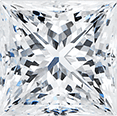
How many carats is a 7mm princess cut diamond?
A 7mm x 7mm princess cut diamond is roughly 2 carats. Most fall somewhere between about 1.90ct and 2.15ct.
The reason it is a range rather than a single number is that carat is a measure of weight, not width. Two stones can both measure 7mm across the top and still weigh different amounts, because one may be cut deeper than the other. Depth is the distance from the flat top of the diamond to its point underneath. A deeper stone hides more weight below the setting, where you cannot see it.
Princess cuts are naturally quite deep. A typical princess has a depth of around 70–75% of its width, whereas a round brilliant sits nearer 60–63%. That is why a princess cut looks smaller face-up than a round of the same carat weight.
Princess cut size chart
| Width (mm) | Approximate carat weight |
|---|---|
| 4.5mm | 0.50ct |
| 5.0mm | 0.75ct |
| 5.5mm | 1.00ct |
| 6.0mm | 1.25ct |
| 6.5mm | 1.50ct |
| 7.0mm | 2.00ct |
| 7.5mm | 2.50ct |
| 8.0mm | 3.00ct |
These are working approximations used across the trade, not measured figures for any individual stone. Always read the actual millimetre measurements printed on the certificate rather than trusting a chart.
Why 7mm sounds small but 2 carats sounds big
People are often surprised that a 7mm stone is a two-carat diamond. It helps to picture it against something familiar. A standard UK 5p coin is 18mm across. A 7mm princess is a little under half that width — about the width of a pencil. On a finger it reads as a substantial, confident stone, because a square shape fills the space between your knuckles more completely than a circle does.
Is princess cut or round better?
Neither shape is objectively better. They are good at different things, and the honest answer depends on which of those things matters to you.
Sparkle
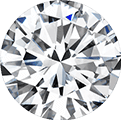
Round brilliant wins on pure light return. It has 57 or 58 facets arranged in a pattern that has been mathematically refined for over a century specifically to bounce light back at the viewer. Nothing else comes close for that white, flashing brilliance.
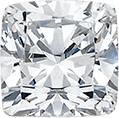
Princess cut is the second-best brilliant-style shape for sparkle. It uses a similar facet approach applied to a square outline, so it does genuinely sparkle — but the corners and the shallower crown mean a little more light escapes out of the sides.
Face-up size for your money
Princess wins here. Because the shape is square, you get more visible surface area per carat than a round of the same weight. A 1ct princess measures about 5.5mm across, but its diagonal — corner to corner — is nearly 7.8mm, so the stone spans more of the finger.
Price
Princess cuts are usually cheaper per carat than rounds. Cutting a round brilliant wastes far more of the original crystal, and that waste is priced in. As a rule of thumb in the trade, not a measured figure, a princess of the same size and quality typically costs meaningfully less than a round. That gap applies to lab-grown diamonds as well as natural ones.
Durability
Round wins. A princess cut has four sharp, unprotected corners, and a corner is the most vulnerable part of any diamond. Diamond is the hardest natural material but it is not unbreakable — a sharp knock on a corner can chip it. Good princess settings use V-shaped prongs that cap each corner. If you choose a princess, insist on that.
Setting styles
Round is the most versatile shape in existence. Halos, hidden halos, three-stone designs, bezels, vintage settings — everything is designed for round first. Princess suits clean, modern, geometric settings and looks superb in channel-set bands, but has fewer off-the-shelf options.
Side-by-side comparison
| Round brilliant | Princess cut | |
|---|---|---|
| Sparkle | Highest of any shape | High, slightly less than round |
| Size for the carat weight | Smaller face-up | Larger face-up |
| Typical price per carat | Highest | Lower than round |
| Chip risk | Very low | Corners need protecting |
| Hides slight tints and inclusions | Very well | Well |
| Choice of settings | Enormous | More limited |
| Feel | Classic, timeless | Modern, architectural |
What we stock instead of princess
If what draws you to a princess cut is the sharp, geometric outline, there are shapes in our collection that scratch the same itch.
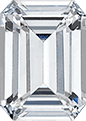
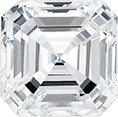
An Asscher cut is the closest square alternative. It is a square step cut — long, straight facets instead of tiny triangular ones — which gives a calm, glassy, hall-of-mirrors effect rather than fireworks. Our Stackable Asscher Cut Wedding Band in Yellow Gold shows that look well.
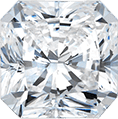
A radiant cut is a rectangle or square with cropped corners and full brilliant faceting underneath. It is the closest thing to a princess in terms of sparkle, with the corner problem designed out. Take a look at the 5 Stone Radiant Cut Engagement Ring in Yellow Gold.
A Bezel Cushion Cut Engagement Ring in Platinum gives you a soft square with rounded corners — the shape princess cuts evolved from, and a good option if you like the outline but want something gentler.
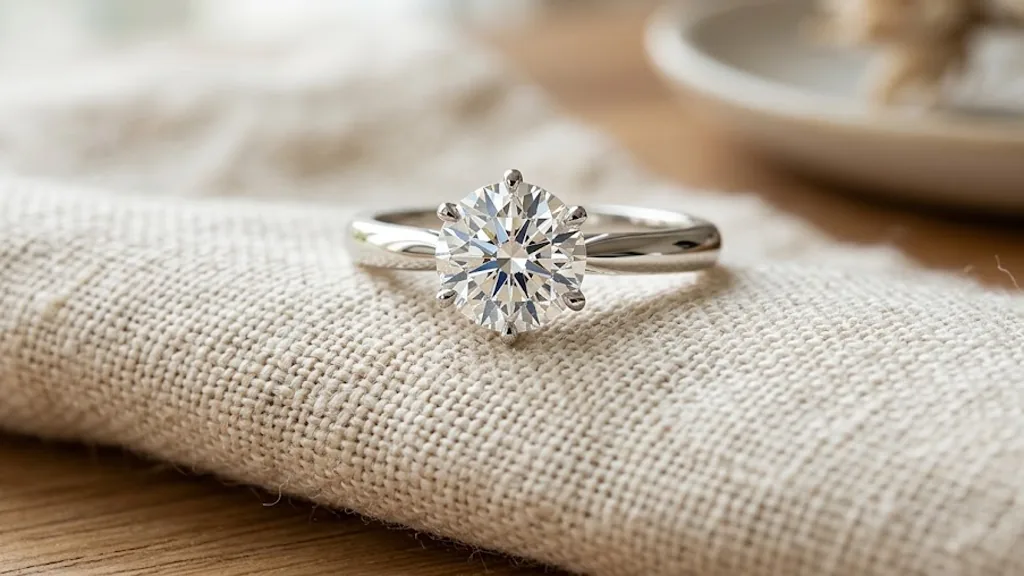
And if you simply want the most brilliant stone available, our Solitaire Round Cut Engagement Ring is the classic, priced at £657 at the time of writing. Every centre stone we sell is a lab-grown diamond with a free IGI certificate.
Frequently asked questions
Is a 7mm princess cut the same size as a 7mm round?
No. They measure the same across, but a 7mm round weighs around 1.30ct while a 7mm princess weighs around 2.00ct. The princess also covers noticeably more of your finger, because a square has more area than a circle of the same width.
Do princess cut diamonds look bigger than round?
Per carat, yes. Compared like for like at the same carat weight, a princess has more visible surface area on top. Compared at the same millimetre width, the princess still looks bigger because of the corners.
Are princess cuts out of fashion?
They peaked in popularity in the 2000s and are less common now than round, oval and emerald. That is not a reason to avoid one — it is a reason it may feel refreshingly different. Buy the shape you love rather than the shape that is currently everywhere.
Can you make me a princess cut ring?
Yes. We do not stock princess cut rings, but bespoke commissions carry no extra design cost. Tell us the carat weight, colour and clarity you want and the setting style you have in mind, and we will make it in solid gold or platinum with a free IGI certificate on the centre stone.
Which is better for a smaller budget?
Princess, usually. You get more visible stone per pound spent. If sparkle is what you actually care about, though, a slightly smaller round often looks livelier than a slightly larger princess.
Where to go from here
If you want to see how the geometric shapes compare in real settings, browse the full engagement ring collection or filter straight to round cut rings. Everything is hand-made in solid gold or platinum, delivered free and insured across the UK, with 30 days to change your mind.
Ready to find your perfect ring?
Explore our lab-grown diamond collection or book a virtual appointment with our team.