What Does an Oval Diamond Symbolise?
An oval diamond has no official symbolism. What the shape is claimed to mean, where that came from, and what an oval verifiably does.
An oval diamond has no official symbolism. No gemmological body, including IGI or GIA, assigns meaning to any diamond shape — they grade cut, colour, clarity and carat only. The meanings commonly attached to the oval, usually individuality and an unbroken continuity, come from jewellery writing and marketing rather than any recorded tradition. What an oval verifiably does is elongate the finger and look larger than a round of the same carat weight.
What does an oval diamond symbolise?
An oval diamond symbolises whatever the couple decides it symbolises, because no authority has ever fixed a meaning to the shape. The associations you will find repeated online — individuality, boldness, eternity, a life that keeps going without a break — are modern jewellery copy. They are not drawn from heraldry, folklore or any documented gemstone tradition. That is not a reason to dismiss them. A meaning chosen deliberately by two people is worth more than one inherited from a brochure.
Does any organisation actually assign meanings to diamond shapes?
No organisation assigns meanings to diamond shapes. The bodies that govern diamonds are grading laboratories, and their remit is measurement. IGI and GIA certificates record carat weight, colour grade, clarity grade, cut and proportion measurements, fluorescence and, for a lab-grown stone, the growth method. There is no field on any certificate for meaning, symbolism or sentiment. Anyone presenting shape symbolism as an established standard is describing a marketing convention, not a recognised one.
Why do people say an oval diamond means individuality?
The individuality association attached to oval diamonds comes from market share, not history. The round brilliant has been the default engagement stone for roughly a century, so choosing anything else reads as a deliberate departure. The oval is the most popular of those departures. The continuity or eternity association comes from simple geometry: an oval is a closed curve with no corners and no start point, the same reasoning applied to plain wedding bands. Both are reasonable stories. Neither is a fact about the stone.
Where does the oval cut actually come from?
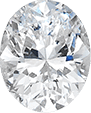
The modern oval brilliant is a twentieth-century cut, not an antique one. It is a brilliant cut, meaning it uses triangular and kite-shaped facets to bounce light back at the viewer, arranged in an elongated outline rather than a circular one. Oval-shaped gems existed long before, but the faceting pattern used in oval engagement rings today is a modern design refined for light return. That makes the oval a comparatively recent shape, which is another reason it carries no old symbolic tradition.
What does an oval diamond actually do on the hand?
An oval diamond does two things that are measurable rather than symbolic. It looks larger than a round diamond of the same carat weight, because the elongated outline spreads the stone’s weight across a wider face-up area — a rule of thumb in the trade, not a precisely measured figure. It also lengthens the appearance of the finger, for the same reason a vertical line lengthens anything. Ovals typically cost less per carat than rounds of comparable quality, which is why an oval is a common answer to wanting visible size on a fixed budget.
What length-to-width ratio should an oval diamond have?
Length-to-width ratio is the number that decides whether an oval looks classic, stubby or stretched, and it is printed on the certificate as two measurements you can divide yourself. The trade generally treats 1.30 to 1.50 as the comfortable range. This table shows how the ratio changes the look — it is trade guidance, not a rule.
| Length-to-width ratio | How it reads on the hand | Typical example (1 carat) |
|---|---|---|
| Below 1.30 | Rounded, close to a circle; loses the elongating effect | around 7.0mm x 5.6mm |
| 1.30 – 1.40 | Classic oval; the most widely chosen range | around 7.3mm x 5.4mm |
| 1.40 – 1.50 | Noticeably elongated; strong finger-lengthening effect | around 7.7mm x 5.3mm |
| Above 1.50 | Long and narrow; starts to read as a different shape entirely | around 8.0mm x 5.1mm |
Millimetre figures are indicative, because two stones of identical carat weight can measure differently depending on depth.
What should you check on an oval diamond before buying it?
Check three things on any oval diamond, none of which appear as a graded symbol on the certificate. First, the bow-tie — a dark band across the centre of the stone caused by the elongated shape blocking light. Most ovals show one; the question is whether it is faint or obvious, and only a photograph or the stone itself will tell you. Second, symmetry, because an oval is unforgiving of a lopsided outline. Third, the length-to-width ratio, worked out from the measurements on the certificate rather than taken on trust.
Is an oval a good choice for an engagement ring, whatever it symbolises?
An oval is a strong practical choice for an engagement ring for reasons that have nothing to do with symbolism. It has no sharp points or corners to chip, unlike a marquise or a pear, so it stands up to daily wear. It suits solitaire, halo, hidden halo and three-stone settings equally well. It reads as larger than its carat weight. The one genuine drawback is the bow-tie, which is a per-stone issue rather than a fault of the shape.
What oval diamond rings does CarbonstoneUK make?
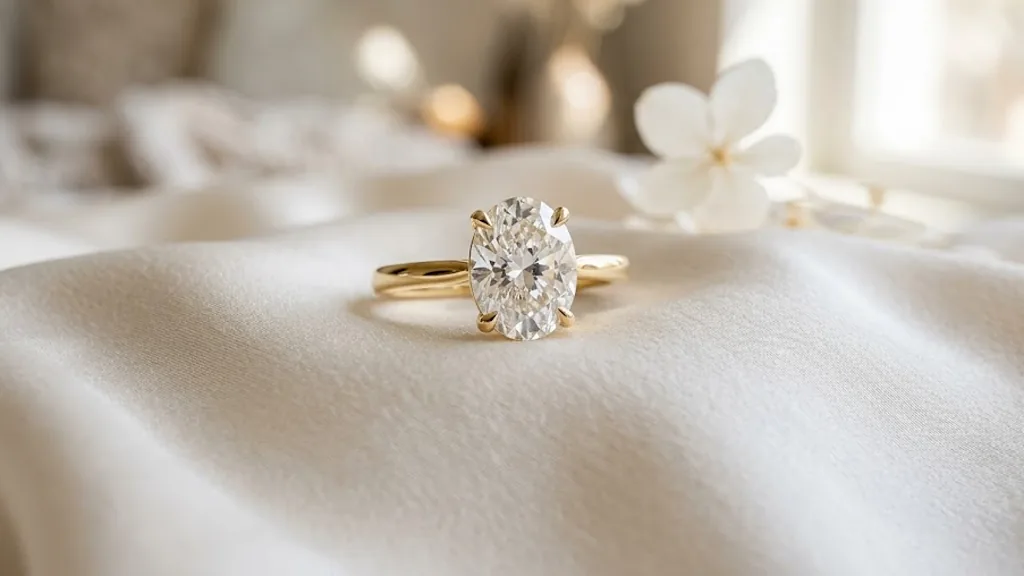
CarbonstoneUK currently holds three oval engagement ring designs, all set with lab-grown diamonds and hand-made in solid gold or platinum. The Solitaire Oval Cut Engagement Ring at £557 shows the outline with nothing competing against it. The Hidden Halo Oval Cut Engagement Ring at £1,021 hides a ring of small stones under the centre, visible only from the side. The Three Stone Oval Cut Engagement Ring at £1,021 flanks the oval with two side stones. All prices correct at the time of writing. Every centre stone comes with a free IGI certificate, and the full range sits in our oval diamond collection.
Frequently asked questions
Does an oval diamond mean eternity?
An oval diamond does not officially mean eternity, though the association is commonly made. The reasoning is that an oval is a closed, unbroken curve, the same logic applied to a plain wedding band. It is a modern jewellery-writing convention rather than a documented tradition, so treat it as a nice idea rather than an established meaning.
What does an oval engagement ring say about a person?
An oval engagement ring says only what the wearer wants it to say. In practice, it usually signals someone who considered the default round brilliant and chose differently, often for the size-per-carat advantage. Jewellers see ovals chosen most often by people who want visible presence on the hand without a round’s price per carat.
Is the oval diamond a modern or a traditional shape?
The oval brilliant is a modern cut. Oval-shaped gemstones are ancient, but the specific brilliant faceting pattern used in today’s oval engagement rings was developed in the twentieth century and refined since. That makes the oval a modern shape with a long-established outline, which is part of why it carries no inherited symbolism.
Do all oval diamonds have a bow-tie?
Almost all oval diamonds show some bow-tie, the dark band across the middle of the stone. Its strength varies enormously between stones and no certificate grades it. Judge it from a clear photograph or the stone in daylight. Our guide to how much ovals sparkle compared with rounds covers what to look for.
Do oval diamonds look bigger than round diamonds?
Yes, generally. An oval of the same carat weight as a round spreads that weight over a longer, wider face-up outline, so more of the stone is visible from above. It is a rule of thumb in the trade rather than a fixed percentage, and it varies with the individual stone’s depth and ratio.
Are lab-grown oval diamonds real diamonds?
Yes. A lab-grown oval diamond is chemically, physically and optically a diamond — the same carbon crystal structure, the same hardness of 10 on the Mohs scale. It is grown in a controlled environment rather than found in the ground. IGI grades lab-grown diamonds on the same 4Cs scale, and the certificate states the origin.
Which settings suit an oval diamond best?
Solitaire, halo, hidden halo and three-stone settings all suit an oval well, because the shape has no vulnerable points to protect. Solitaires show the outline most clearly. Halos add apparent width, which can work against the elongating effect, so consider a hidden halo if you want detail without shortening the stone’s look.
If the practical questions matter more to you than the symbolism, our comparisons of oval against round and what an oval actually costs go further into both. CarbonstoneUK is a lab-grown diamond jeweller based in North Harrow, London, with free insured UK delivery, 30-day returns and bespoke design at no extra design cost.
More guides on this topic
Ready to find your perfect ring?
Explore our lab-grown diamond collection or book a virtual appointment with our team.