Who Invented the Princess Cut? The Real, Slightly Tangled Story
The princess cut is credited to three Israeli cutters around 1980, but earlier designs fed into it. The history, the trade-offs, and the shapes we do stock.
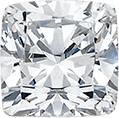
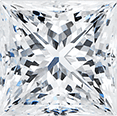
The princess cut we recognise today — square outline, brilliant faceting, sharp corners — is generally credited to three diamond cutters working in Israel around 1980: Betzalel Ambar, Israel Itzkowitz and Ygal Perlman. That is the attribution the trade repeats most often and the one you are most likely to see in reference works.
It is not the whole story, and anyone who tells you the shape has one clean inventor and one clean date is smoothing over a genuinely tangled history. Here is the honest version, along with what the shape’s design actually does, and what to do if you want one from us — because we should say plainly at the outset that we do not stock it.
Why the attribution is not simple
Three separate threads run into the modern princess cut, and different sources weight them differently.
The name came first, attached to something else. A cut called the “profile” or “princess” is associated with Arpad Nagy, a London cutter, in the early 1960s. It was a different design from what we now call a princess cut, but the name travelled.
The technical breakthrough came from South Africa. The barion cut, developed by Basil Watermeyer in the early 1970s, worked out how to give a square stone the brilliance of a round one by adding crescent-shaped facets near the corners. That problem — how to make a square sparkle like a circle — is the one every square brilliant has to solve.
The commercial version came around 1980. The Ambar, Itzkowitz and Perlman design refined the square brilliant into something that could be cut consistently and sold at scale, and that is the cut that took over the market.
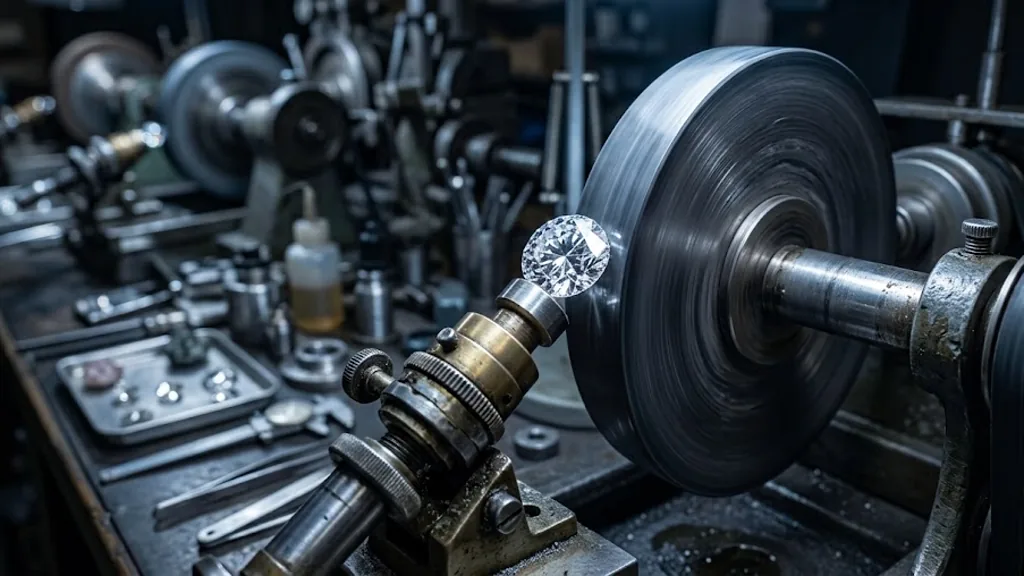
So the fair summary is that the princess cut was arrived at rather than invented in a single moment. Diamond cutting is a craft where several people usually solve overlapping parts of the same problem, and the person who commercialises a design is not always the person who first conceived it.
What problem the cut was solving
Two problems, in fact, and understanding them explains why the shape looks as it does.
The first is waste. Diamond rough often comes in a shape called an octahedron — imagine two pyramids joined base to base. Cutting one round brilliant from it discards a great deal of material. A square cut follows the natural shape far more closely, and in principle two princess cuts can be taken from a single piece of rough. Less waste means a lower price per carat, which is a large part of why the shape succeeded.
The second is sparkle. Square stones traditionally looked flat compared with round ones, because the corners were dead areas where light escaped rather than returning. The faceting arrangements developed through the 1970s solved that, which is what made a square stone competitive with a round one for the first time.
What the shape is like to own
| Strength | Weakness |
|---|---|
| Lower price per carat than a round of similar quality | Corners are the weak point and can chip if not protected |
| Sharp, contemporary, geometric look | Looks smaller face-up than a round of the same weight, because more of the weight sits below |
| Strong brilliance for a square shape | Shows body colour at the corners more than a round does |
| Sits neatly against a straight wedding band | Needs a setting with protected corners for daily wear |
We have written separately about how it compares with other shapes, in our guides to round versus princess cut diamonds and cushion versus princess cut diamonds.
How the shape actually works, in plain terms
A diamond returns light because its facets act as internal mirrors. Light enters through the flat top, bounces off the angled surfaces underneath, and comes back out towards your eye. If the angles are wrong, the light passes straight through the bottom and is lost, and the stone looks dull or see-through.
In a round brilliant this is comparatively easy, because the shape is symmetrical in every direction and the same facet angles work all the way around. In a square stone the corners are much further from the centre than the sides are, so a single set of angles cannot serve both. That is the whole design problem, and the crescent-shaped facets developed in the 1970s are what solved it.
It also explains a practical quirk of the shape: a princess cut usually carries more of its weight below the surface than a round does. Two stones of the same carat weight will not look the same size from above, and the princess will generally look slightly smaller.
Why it became so popular in the 1980s and 1990s
Three things came together. The cut was new, it was cheaper per carat than a round because it wasted less rough, and its hard geometric lines suited the design language of the time.
That last point is worth being honest about. A shape strongly associated with a particular era can read as belonging to it, and some princess cut rings from that period do look distinctly of their decade. The stone is rarely the reason. As with most rings, it is the setting — heavy shoulders, thick channels of small stones, tall mounts — that fixes a ring to its moment rather than the diamond in the middle.
We do not stock the princess cut
Being straightforward about this matters more to us than making a sale. There is no princess cut in our range, and we are not going to send you to a product page for something else and hope the photograph does the work.
What we can do is make one. Bespoke design costs no extra at Carbonstone: you pay for the stone, the metal and the making, not for the design work. We hand-make in solid gold and platinum from our workshop in North Harrow, London, and every centre stone comes with a free IGI certificate. If a princess cut is genuinely what you want, that is the route.
We also do not stock old European cuts, for the same reason and with the same answer.
What we do stock, if you like the square look
Three shapes in our range occupy nearby territory, and each does something the princess does not.
Cushion is a square or rectangle with rounded corners. It is softer and more antique in character than a princess, and the rounded corners are far less vulnerable to chipping. A bezel cushion cut ring in platinum at £904, correct at the time of writing, wraps metal fully around the stone, which is about as protected as a ring gets. A three stone cushion cut ring at £957 gives the same shape a more classical structure.
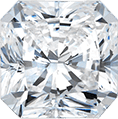
Radiant is the closest of all: a square or rectangular outline with cut corners and full brilliant faceting. It sparkles like a princess and the trimmed corners remove the fragility. Our 5 stone radiant cut ring in yellow gold at £917 shows how the shape behaves.
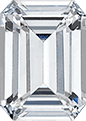
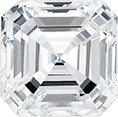
Asscher and emerald are step cuts rather than brilliants, so they give broad flashes of light instead of fine sparkle. Quieter and more architectural. A solitaire emerald cut ring at £672 is the least expensive way into that look in our range.
Frequently asked questions
Who designed the princess cut?
The modern version is generally credited to Betzalel Ambar, Israel Itzkowitz and Ygal Perlman around 1980, building on earlier work including the barion cut. Trade histories differ in how they weight the contributions.
When was the princess cut invented?
The name appears in the 1960s attached to an earlier design; the cut sold today dates from around 1980. Treat single confident dates with caution.
Why is it cheaper than a round diamond?
Because it wastes less of the original rough crystal during cutting. Less material lost means a lower price for the same carat weight.
Do princess cut diamonds chip?
The sharp corners are the vulnerable part. A setting with claws covering each corner, or a protective bezel, largely removes the risk.
Can you make a princess cut engagement ring for me?
Yes, as a bespoke commission at no extra design cost. We simply do not hold it as a stocked shape.
To see the square and geometric shapes we do make, browse our cushion cut collection and radiant cut collection, or the full engagement ring range. Free insured UK delivery and 30-day returns throughout.
Ready to find your perfect ring?
Explore our lab-grown diamond collection or book a virtual appointment with our team.