
What Is the Difference Between Baguette and Emerald Cut Diamonds?
Both are step cuts, but they do very different jobs. A plain-English guide to baguette vs emerald cut diamonds, with real UK prices.
Baguette and emerald cut diamonds are cousins. They belong to the same family, they catch light in the same calm, mirror-like way, and they look wonderful together on the same hand. But they are not interchangeable, and buying one when you meant the other is an easy mistake to make online.
This is a plain English guide to what actually separates them, what each one is for, and what you should expect to pay.
What they have in common
Both are step cuts. That means their facets, the flat polished surfaces cut into a diamond, are long and parallel and arranged in rows, like the steps of a staircase running around the stone.
Step cuts do not twinkle. They flash. Instead of hundreds of tiny sparkles, you get broad sheets of light and shadow moving across the stone as your hand turns. The effect is often described as a hall of mirrors, and it is clean, calm and quite architectural.
The opposite family is the brilliant cut, which includes round, oval, pear and cushion. Those have many small triangular facets and produce a lot of scattered sparkle. Keep that distinction in your head and everything else makes sense.
The three real differences
1. The corners
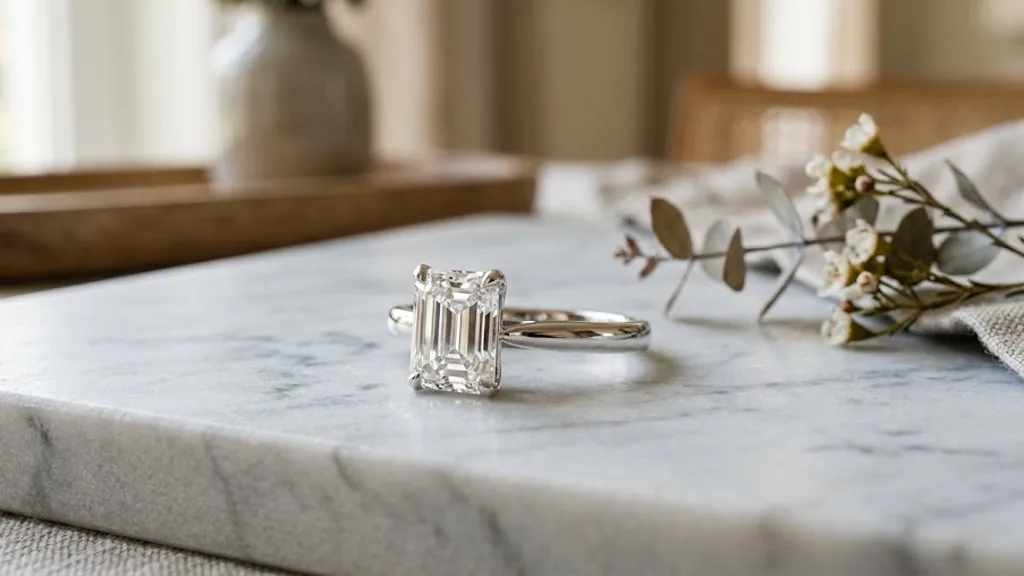
An emerald cut has its corners cut off at an angle. The outline is technically an octagon, though your eye reads it as a rectangle. Those cut corners are not decorative. They remove the most fragile part of the stone.
A baguette keeps its sharp ninety degree corners. It is a plain rectangle, exactly like a small stick of French bread, which is where the name comes from. Those crisp corners are what make baguettes look so precise when set in a row, but they are also the weakest point of the stone.
2. The number of facets
An emerald cut typically has around fifty facets, with rows of steps on the top and more underneath. That is enough to give it real depth and a proper play of light.
A baguette usually has only about fourteen. It is a deliberately simple stone. That simplicity gives it a very clean, glassy look, but it also means it does far less with light on its own.
3. What each one is for
This is the difference that matters most in practice.
An emerald cut is a centre stone. It is bought at one carat, two carats and above, and it is the star of the ring.
A baguette is almost always a supporting stone. Baguettes are small, typically well under a quarter of a carat each, and they are used in rows along a band, as side stones next to a larger diamond, or in geometric Art Deco patterns. You will very rarely see a baguette used as the main diamond in an engagement ring, and there is a good reason for that: a single baguette on its own looks rather flat.
Baguette versus emerald at a glance
| Baguette | Emerald cut | |
|---|---|---|
| Outline | Plain rectangle, sharp corners | Rectangle with the corners cut off |
| Approximate facets | About 14 | About 50 |
| Typical size | Small accent stone | Centre stone, 0.5ct upwards |
| Usual role | Rows, side stones, patterns | The main diamond |
| Light behaviour | Clean, glassy, subtle flashes | Deeper, longer flashes with more life |
| Shows tiny flaws? | Yes, but they are so small it rarely matters | Yes, and it matters a great deal |
| Durability | Corners can chip, so set them protected | Very good, corners already removed |
| Price per carat | Low | Moderate. Cheaper than round, dearer than baguette |
| Variations | Straight or tapered | Classic, or elongated for a longer look |
Straight or tapered baguettes
Worth knowing, because you will see both terms. A straight baguette is the same width at both ends, so a row of them makes a perfectly even line. A tapered baguette is narrower at one end, which lets it sit snugly against a larger centre stone and sweep down towards the band.
If you want a band that works on its own, straight baguettes. If you want side stones flanking a solitaire, tapered.
The price question
Per carat, baguettes are much cheaper than emerald cuts. That is not because they are lower quality. It is because they are small and simple to cut, and small stones always cost less per carat than big ones.
But comparing them per carat is slightly misleading, because you would never buy them for the same job. What actually matters is what a finished ring costs, and there the answer surprises people.
Take two of our wedding bands with the same design. The Stackable Baguette Cut Three Quarter Eternity Band is £1,061, while the equivalent Stackable Emerald Cut Three Quarter Eternity Band is £1,074. A difference of thirteen pounds.
Why so close? Because on a band like this, most of the cost is the solid gold or platinum and the hours of hand setting, not the stones. Setting twenty small diamonds precisely in a row takes the same skilled time whichever shape they are.
If your budget is tighter, a simpler baguette design does bring the price down properly. Our Pavé Baguette Cut Wedding Band is £690, and it gives you that clean run of rectangular stones for a lot less.
For an emerald cut as a centre stone, our Solitaire Emerald Cut Engagement Ring starts at £672. Solitaire means one diamond on its own, and it is the setting that shows a step cut off best, because nothing competes with that clean open top.
The one thing to be careful about with each
With an emerald cut, buy the clarity. Because there is almost no sparkle to distract your eye, you are looking straight into the stone, and any small natural mark inside is visible. We would not go below VS1 clarity on an emerald cut centre stone. VS1 means any marks need magnification to spot. The same applies to colour: for white gold or platinum, stay in the D to F range so the stone looks properly icy.
All our centre stones are lab-grown and come with a free IGI certificate. IGI is an independent grading laboratory, so those grades are confirmed by someone other than us. On an emerald cut, that independence genuinely matters.
With baguettes, buy the setting. Those sharp corners are the vulnerable part. Well-made baguette jewellery either channel sets the stones, meaning they sit in a groove between two walls of metal, or holds them with carefully placed claws away from the corners. Cheap baguette jewellery leaves the corners exposed, and they chip. Ask how the stones are held before you buy.
Wearing them together
Here is the nice part. Because both are step cuts, they are the most natural pairing in jewellery. A baguette band sitting against an emerald cut engagement ring looks like it was designed as one object, because the flat tops and straight lines carry on through both rings.
Both shapes also have another quiet advantage: they sit flush against a straight band. Pointed shapes like pear and marquise usually need a curved or notched band to avoid a gap. Rectangles do not.
Frequently asked questions
Is a baguette a real diamond?
Yes, completely. Baguette simply describes the shape it is cut into. Ours are lab-grown diamonds, which are chemically and physically identical to mined diamonds and are graded on the same scales.
Can you get a baguette as an engagement ring centre stone?
You can, and a few people love the look, but it is unusual. A single baguette has so few facets that at a larger size it can look rather plain and glassy. If you want a step cut centre stone, an emerald cut gives you the same clean lines with far more depth and life.
Which is better value?
For a band of small stones, baguettes give you more length of diamond for your money. For a centre stone, emerald cut is the better value of the two, because it does much more with light at a size where people will actually be looking at it.
Do baguettes chip easily?
They can if the corners are left exposed. Diamond is extremely hard but it can still chip on a sharp knock. Set properly, with the corners protected by metal, a baguette band is perfectly fine for everyday wear.
Should I match my wedding band to my emerald cut engagement ring?
You do not have to, but a baguette band is the most flattering partner there is for an emerald cut. It repeats the rectangle and the step cut in miniature, and the straight edges mean the two rings sit together with no gap.
See them together
Step cuts are one of those things that photographs badly and looks superb in person. If you like clean lines and quiet elegance rather than sparkle, this is your family of shapes.
Every ring is hand-made to order in solid gold or platinum, with free insured UK delivery and 30 days to change your mind. If you want a specific pairing that is not on the site, our bespoke design service carries no extra design cost.
Have a look at our wedding rings for baguette and emerald cut bands, or the full range of engagement rings. We are based in North Harrow, London.
Ready to find your perfect ring?
Explore our lab-grown diamond collection or book a virtual appointment with our team.











