
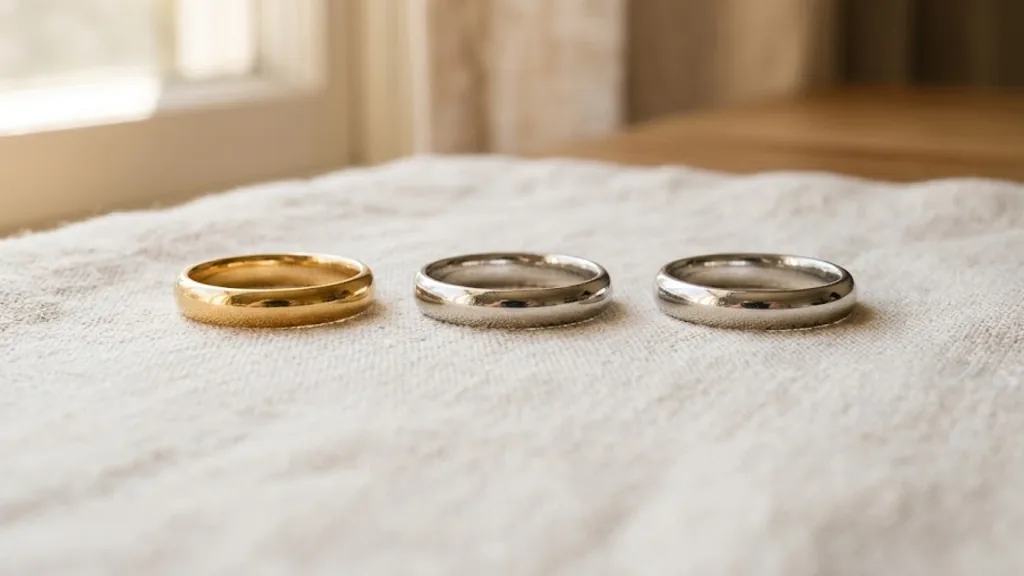
White Gold Rings for Every Occasion
How white gold actually works, why it needs re-plating, which carat to choose, and the best white gold rings for each occasion.
White gold is the most popular metal for rings in the UK, and the least understood. It is not a naturally white metal, it does not stay bright without help, and it is not the same thing as platinum or silver. Once you know how it actually works, choosing a white gold ring becomes straightforward — and you will know what to expect from it in five years’ time.
What white gold actually is
Pure gold is yellow. To make it white, it is alloyed with pale metals — commonly palladium, nickel, silver or zinc — which lighten the colour and harden the metal. The result is a pale gold with a faintly warm or greyish cast.
Most white gold rings are then plated with rhodium, a bright white metal from the platinum family. That plating is what gives white gold its familiar mirror finish. It is a surface layer, typically very thin, and it wears away with use.
This is the single most important thing to know before buying. When a white gold ring starts looking slightly warm or dull after a few years, it has not been damaged and it is not fake. The plating has worn and needs redoing. Every few years is normal, and it is inexpensive.
White gold, platinum and silver compared
| White gold | Platinum | Sterling silver | |
|---|---|---|---|
| Naturally white? | No — alloyed and plated | Yes | Yes |
| Needs re-plating? | Yes, every few years | No | No |
| Tarnishes? | No | No | Yes |
| Hardness | Harder than platinum | Softer, but denser | Softest of the three |
| Wear over time | Scratches; plating wears | Develops a soft patina | Scratches and dents |
| Relative cost | Middle | Highest | Lowest |
A note on hardness that surprises people: white gold is harder than platinum, but platinum is denser and displaces metal rather than losing it when scratched. Over decades a platinum ring keeps more of its material; a white gold ring keeps more of its polish.
Which carat to choose
In the UK you will mainly see 9ct, 14ct and 18ct white gold.
9ct is 37.5% gold. It is the hardest and cheapest, and it holds up well to knocks. Because there is less gold in it, the underlying colour is naturally paler.
14ct is 58.5% gold — a sensible middle ground for daily wear, common in fine jewellery.
18ct is 75% gold. It has more depth of colour, more weight and more value, and it is slightly softer. It is the usual choice for fine bridal jewellery.
For a ring worn every day by someone with a physical job, 9ct or 14ct is the practical choice. For a ring that will be treasured rather than tested, 18ct.
White gold rings by occasion
An engagement ring
White gold is the default choice for engagement rings in the UK, largely because a white setting lets a colourless diamond read as bright and cool rather than warm. A solitaire round cut engagement ring in white gold is the most classic form there is, and at £563 — correct at the time of writing — it shows how far a budget goes with lab-grown stones.
If you want something with more presence, a halo marquise cut engagement ring in white gold surrounds an elongated centre stone with a frame of smaller diamonds, which makes the whole ring read considerably larger.
A wedding or eternity band
White gold bands sit beautifully next to white gold engagement rings, which is most of the reason they are so common. If you are matching to an existing ring, match the metal exactly — a near-match between white gold and platinum reads as a mistake rather than a decision.
A two-stone or milestone ring
For anniversaries and other markers, the toi et moi pear cut ring in white gold puts two stones side by side, which reads as a pair rather than as a single statement. It is a design people wear on either hand.
A bridal set
If you want the engagement ring and band to fit flush without any gap, the two need to be designed together. Our Dutch marquise cut bridal set in white gold is made as a pair, which removes the most common fit problem entirely.
Living with white gold
Re-plating. Expect it every two to five years depending on wear. Rings on the dominant hand and rings worn during physical work need it sooner. It is a routine job.
Cleaning. Warm water, a drop of washing-up liquid, a soft toothbrush, rinsed in a bowl rather than under a running tap. Block the plughole first.
Chemicals. Keep it away from bleach and chlorine, which attack the alloys in gold and can weaken claws and solder joints. That includes swimming pools.
Nickel. Some white gold alloys contain nickel, which a minority of people react to. UK and EU rules limit nickel release in jewellery, but if you have a known sensitivity, ask about the alloy or choose platinum.
Is white gold worth it?
If you want the look of platinum at a lower price and you do not mind occasional re-plating, yes. If the idea of ongoing maintenance annoys you, platinum is the better buy despite the higher upfront cost. If budget is the main constraint, sterling silver costs far less but is softer and tarnishes.
Everything we make uses lab-grown diamonds with a free IGI certificate on centre stones, hand-made in North Harrow in solid gold, platinum or sterling silver. Free insured UK delivery and 30 days to return. If you want a specific white gold design that is not in the collection, we do bespoke at no extra design cost.
How to tell what you already own
If you are trying to match a ring you already have, start with the hallmark. UK jewellery above the exemption weight is hallmarked, and the millesimal fineness mark tells you the metal immediately: 375 is 9ct gold, 585 is 14ct, 750 is 18ct, 950 is usually platinum, and 925 is sterling silver.
The marks are small and usually inside the band. A jeweller will read them for you in seconds, and it removes all guesswork about what you are matching to.
Note that the hallmark tells you the gold content, not the colour. A 750 mark appears on yellow, white and rose gold alike, since all three are 18ct.
Making white gold last
Three habits make a noticeable difference over a decade.
Take the ring off for anything abrasive — gardening, DIY, weight training. Most of the wear on plating happens in short bursts of rough contact rather than steadily over time.
Have the settings checked when you have it re-plated. The ring is with a jeweller anyway, and it is the natural moment to catch a claw that has worn thin before a stone is lost.
Keep it out of chlorinated water. Swimming pools and hot tubs are worse for gold alloys than almost anything else you will encounter, and the damage is cumulative rather than immediate.
Frequently asked questions
Does white gold turn yellow?
The rhodium plating wears and the paler gold underneath shows through, which reads as a warm or dull tone. Re-plating restores it. The ring itself is unchanged.
Is white gold better than platinum?
Different rather than better. White gold is harder and cheaper but needs re-plating. Platinum is naturally white, needs no plating and lasts extremely well, but costs more.
Is white gold the same as silver?
No. White gold is a gold alloy; sterling silver is 92.5% silver. Silver is softer, cheaper and tarnishes, which gold does not.
How much does re-plating cost?
It varies by jeweller and by whether the ring needs polishing first, but it is one of the cheaper jewellery services and takes a few days.
Which carat of white gold is best for an engagement ring?
14ct or 18ct for most people. 18ct has more gold content and depth; 14ct and 9ct are harder and better suited to hands that take a beating.
Browse the engagement ring collection or the wedding and eternity bands to compare metals in context, and see our note on cleaning lab-grown diamonds for keeping any white gold ring bright between plating.
More guides on this topic
Ready to find your perfect ring?
Explore our lab-grown diamond collection or book a virtual appointment with our team.











