Who Buys the Wedding Rings? Modern UK Etiquette
Who pays for the wedding rings in the UK: the tradition, what couples actually do now, and how to split it without a row.
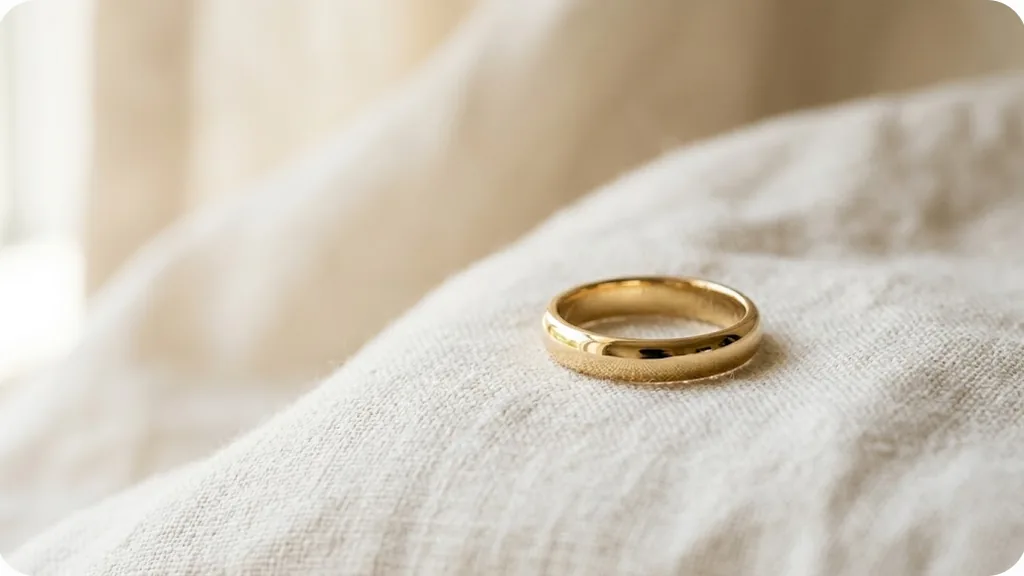
The traditional answer is that each person buys the other’s ring. The realistic answer is that in most UK weddings today the couple pays for both out of shared money, and nobody keeps score. If you are trying to work out who is supposed to reach for the card, this is what actually happens and how to decide it without a row.
The traditional etiquette
Historically, each partner buys the ring their spouse will wear. The bride buys the groom’s band; the groom buys the bride’s. It is a neat symmetry: you pay for the thing you are giving, not the thing you receive.
In older etiquette guides, the bride’s family sometimes covered more of the wedding, and the groom paid for the rings, the licence and the officiant’s fee. That division dates from a time when a wedding was substantially a transaction between two families. It reads oddly now.
The engagement ring is separate and follows a different convention: traditionally bought by the person proposing, and traditionally kept regardless of who pays for what afterwards.
What actually happens now
Four patterns cover almost everyone.
Joint money, both rings. The most common arrangement among couples who already share finances. The rings come out of the wedding budget alongside the venue and the flowers.
Each buys the other’s. The traditional split, kept because people like it rather than because they feel obliged. It works well when the two rings cost roughly the same.
One person pays for both. Usually because one earns considerably more, or because one partner cares much more about the rings and wants a specific budget.
A parent or relative pays. Sometimes as a gift, sometimes because a family ring is being reset. Reasonably common and completely fine, provided everyone is clear it is a gift and not leverage.
The awkward part: rings that cost very different amounts
This is where the traditional split creates friction. A woman’s ring is often diamond-set and a man’s is often a plain band, so the two prices can be far apart.
| Situation | What usually works |
|---|---|
| Both rings similar in price | Each buys the other’s. Clean and traditional. |
| One ring much more expensive | Pay from joint money, or split the total rather than the items. |
| One partner earns much more | Split proportionally, or the higher earner covers both openly. |
| Separate finances entirely | Agree a total budget first, then decide who transfers what. |
The mechanism matters far less than agreeing it in advance. Almost every disagreement about wedding rings is really a disagreement about a budget that was never actually set.
It also helps to know that the price gap is not fixed. Our minimalist round cut wedding band is £687 and our pavé baguette cut wedding band is £690 — both correct at the time of writing. Two rings in a similar bracket makes the whole question easier.
Set the budget before you look at rings
Do this first, and do it as one number for both rings. Looking at rings before agreeing a figure is how people end up in a showroom having a conversation about money in front of a salesperson.
You may have heard rules about spending a month’s or three months’ salary. Those numbers came from advertising campaigns rather than etiquette, and no sensible jeweller repeats them. What matters is what the two of you can spend without regretting it.
What genuinely drives the price is metal (platinum most, sterling silver least), width and weight, total carat weight of stones, and how much hand-setting is involved. Choosing lab-grown diamonds over natural reduces the cost substantially for equivalent size and grade — the two are the same material, and our comparison of lab-grown and natural diamonds sets out the difference plainly.
Should you keep it a surprise?
For the engagement ring, often yes. For wedding rings, rarely.
Wedding rings are worn every day for decades, have to fit alongside an engagement ring, and are usually bought as a pair. Almost every couple we deal with chooses them together, and that is the sensible approach.
Where a surprise element survives, it is usually the engraving inside the band — a date, a name, a private line. That works well and costs nothing extra emotionally.
Timing
Start looking three to four months before the wedding. Hand-made rings take weeks, sizing takes days, and engraving adds more. Leaving it to the final fortnight limits you to whatever happens to be in stock in the right size.
If either ring is a full eternity design, order earlier still. Full eternity rings usually cannot be resized after the fact, because there is no plain metal for a jeweller to cut, so the size has to be right first time.
Who buys the engagement ring?
Conventionally, the person proposing. That convention has loosened considerably. Couples who plan the proposal together often split the cost, and plenty of people buy their own because they know exactly what they want to wear.
If you are buying alone, the practical advice is to keep the design flexible. A solitaire round cut engagement ring in white gold is about as safe a starting point as exists, and it leaves room to add bands later.
What about family rings?
An inherited ring changes the money question entirely, and adds a different one: whether the person wearing it actually wants to.
Be honest about that before anyone gets attached to the idea. A ring worn out of obligation is worn resentfully. Resetting an inherited stone into a new design is often the answer — it keeps the meaning and loses the borrowed taste. We do that as a bespoke commission at no extra design cost.
What we do
Every diamond we set is lab-grown, with a free IGI certificate on centre stones. Rings are hand-made in solid gold, platinum or sterling silver at our workshop in North Harrow, with free insured UK delivery and 30 days to return. If you want two rings designed to relate to each other, we can make them as a pair — bespoke design costs nothing extra.
Buying rings for a second marriage
The etiquette is exactly the same, and the practical questions are slightly different.
There is no rule about the previous rings. Some people sell them, some keep them, and some have the metal or stones reworked into something new. Any of those is fine, and it is the wearer’s decision rather than anyone else’s.
Budget conversations tend to be more direct in a second marriage, largely because both parties have usually done this before and have separate finances. That is an advantage. Agree a total, then decide the mechanism.
Paying for it sensibly
Two practical notes that have nothing to do with etiquette.
Paying by credit card in the UK gives additional protection on purchases over £100 under section 75 of the Consumer Credit Act, which is worth knowing on an item of this value. Check the current rules rather than taking a blog’s word for it.
And arrange insurance from the moment the rings are in your possession, not from the wedding day. Many home contents policies cover jewellery only up to a limit and often only within the home. A ring being carried around a venue by the best man is exactly the situation where the gap shows.
Frequently asked questions
Who traditionally buys the wedding rings?
Each partner buys the other’s ring. In practice most UK couples now pay for both from shared money.
Does the groom pay for both wedding rings?
Not traditionally, and not usually today. Older etiquette had the groom paying for the bride’s ring, the licence and the officiant. Modern couples generally split the total.
Who buys the man’s wedding ring?
Traditionally the bride. Commonly, now, it comes out of the same budget as everything else.
Should we spend the same on each ring?
There is no need. Different designs cost different amounts. What matters is that the total is a figure you both agreed to.
Can parents pay for the wedding rings?
Yes, and some do. Treat it as a gift with no conditions attached, or it becomes complicated later.
When you are ready to look, our wedding ring collection covers plain, shaped and diamond-set bands, and the bridal sets pair an engagement ring with a band made to sit against it. Our guide to how much to spend on a wedding ring goes into the budget question in more depth.
More guides on this topic
Ready to find your perfect ring?
Explore our lab-grown diamond collection or book a virtual appointment with our team.