How Do Jewellers Resize Wedding Rings? Every Step Explained
What actually happens when a wedding ring is resized: cutting, soldering, stretching, sizing beads, timescales and realistic UK costs.
Handing over a wedding ring to be resized is a small act of trust. You are giving away something you cannot replace and getting it back a few days later, hopefully looking untouched. It helps to know what actually happens to it in between.
The work itself is old, careful and surprisingly physical. Nothing about it is mysterious, and once you understand the steps you will find it much easier to judge whether a quote is fair and whether a particular ring should be resized at all.
Why do wedding rings need resizing in the first place?
Finger size is not fixed. It changes with weight, temperature, age, pregnancy, medication, and conditions such as arthritis that can enlarge the knuckle. Most people who wear a wedding ring for decades will need it adjusted at least once.
There is also the simple case of a ring that was never quite right. A ring bought as a surprise, or ordered from a paper sizer at home, is often a half size out.
A ring that is too loose is the more urgent problem. Loose rings spin, wear unevenly on the underside, and get lost down drains and in coat pockets. A ring that is slightly tight is uncomfortable but not usually dangerous unless it cannot be removed.
Step one: what does a jeweller assess before resizing?
Before anything is cut, a good jeweller checks four things.
The metal. Gold, platinum, palladium and silver all behave differently under heat, and each needs its own solder. Titanium and tungsten cannot be resized at all — they are replaced, not adjusted.
The stones. Diamonds tolerate a jeweller’s torch. Many other stones do not: emeralds, opals and pearls can crack or discolour, and some treated stones lose their colour. Those stones come out before any heat goes near them, and go back in afterwards.
How far the stones go round. This is the big one. A plain band or a half eternity band with a plain lower shank can be resized. A full eternity ring set with diamonds all the way round usually cannot, because there is no plain metal to cut. We go into that in detail in can eternity rings be resized.
The existing condition. If the shank is already thin from years of wear, resizing it is a waste of money. It needs new metal fitted first, which is a different job.
Step two: how does a jeweller measure your finger properly?
Your finger is measured with a set of metal sizing rings — not plastic, which flexes and reads small. The jeweller will check the fit going on and, more importantly, coming off over the knuckle.
Measurements should be taken at normal room temperature, ideally mid-afternoon. First thing in the morning fingers are often puffy; after a cold walk they are noticeably smaller. A half size in either direction is easy to get wrong.
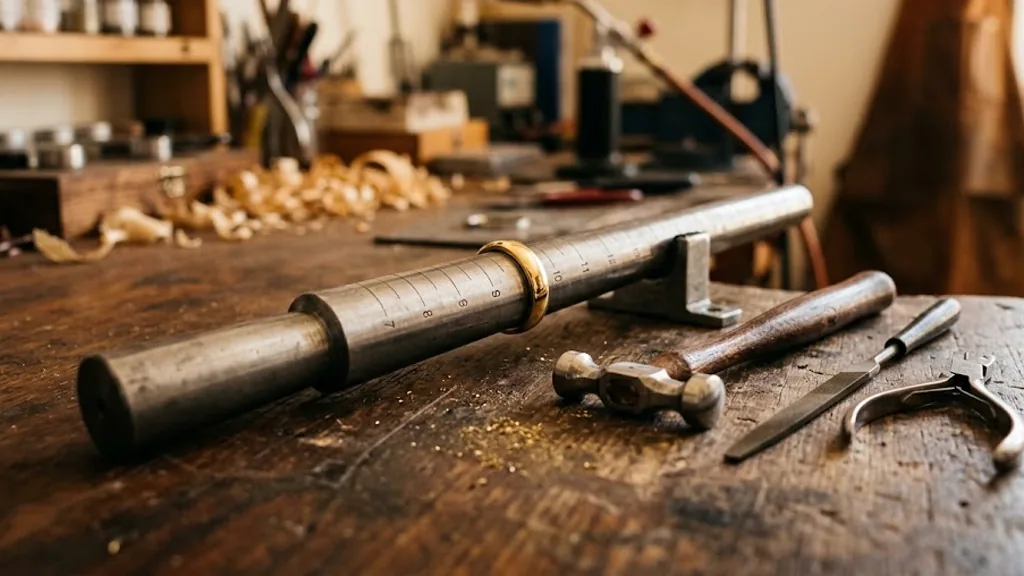
The ring itself is also measured on a mandrel, a tapered steel bar marked with sizes, so the jeweller knows the starting point precisely rather than trusting what is stamped inside.
Step three: how does a jeweller make a ring smaller?
Sizing down is the more common job and the tidier one.
- The ring is cut at the bottom of the shank with a fine jeweller’s saw.
- A calculated length of metal is removed — a fraction of a millimetre matters here.
- The two cut ends are filed dead flat so they meet with no gap. A sloppy join means a weak join.
- The ends are pressed together and soldered. In gold, the jeweller uses a solder of matching colour and carat with a slightly lower melting point than the ring. Platinum is usually laser-welded or welded with platinum itself, which gives an almost invisible seam.
- The join is filed back flush, then emery-papered through progressively finer grades.
- The ring goes on the mandrel and is trued to a perfect circle.
- Finally it is polished, and any stones near the join are checked and tightened.
Done well, you cannot find the join. A plain band such as our Minimalist Round Cut Wedding Band is the ideal candidate — clean metal all round and nothing to work around.
Step four: how does a jeweller make a ring larger?
Sizing up is done in one of two ways.
Stretching. For very small increases, up to about a quarter or half a size, the ring is placed on a mandrel and eased outwards on a ring stretcher. No cutting, no soldering. It thins the metal very slightly and is only suitable for plain or lightly set bands. A jeweller will refuse to stretch a ring with tension-set or channel-set stones.
Adding metal. For anything larger, the shank is cut and a new piece of matching metal is soldered in to bridge the gap, then filed, shaped and polished exactly as above. This is the proper method and it is stronger than stretching.
Adding metal has a limit on decorated rings. On a band with a pattern or a run of stones, growing the plain section shifts the design off-centre. A textured band like our Ocean Wave Round Cut Wedding Band in Yellow Gold can take a modest increase before the pattern starts to look interrupted, which is exactly the sort of judgement a jeweller should tell you about before starting.
Step five: what are the alternatives to cutting the ring?
Cutting is not always the answer, and a jeweller who reaches for the saw immediately is not always doing you a favour.
Sizing beads. Two small beads of metal soldered inside the lower half of the band. They take up slack, stop the ring spinning, and let the ring still pass over a large knuckle. Ideal for anyone whose knuckle is wider than the base of their finger.
A sizing bar or spring insert. A small hinged or sprung fitting inside the band that flexes over the knuckle then holds snug below it. More intervention, but excellent for arthritic knuckles.
Reshanking. If the bottom of the band is worn thin, the whole lower section is replaced with fresh metal, at the correct new size. It costs more than a resize but you get a structurally sound ring rather than an adjusted worn one.
How long does a resize take and what does it cost?
Most independent workshops turn a simple resize around in three to ten working days. Anything involving removing and resetting stones takes longer. Be wary of same-day resizing on a ring you care about — good soldering is not the slow part, but proper finishing is.
These are general guide prices for the UK, to help you sanity-check a quote. They are not a quotation, and any workshop will price your specific ring on sight.
| Job | Typical UK guide price | Notes |
|---|---|---|
| Plain gold band, up or down one size | £40 to £80 | The standard job |
| Plain platinum band | £70 to £130 | Higher melting point, harder to work |
| Diamond-set band with plain shank | £70 to £150 | Includes checking and tightening stones |
| Ring needing stones removed and reset | £150 upwards | Common with emeralds, opals and pearls |
| Sizing beads | £35 to £70 | Quick and reversible |
| New shank fitted | £150 to £350 | For a worn or thin band |
| Rhodium re-plating a white gold ring | £40 to £90 | Often bundled with a resize |
If your ring is white gold, ask for it to be re-plated at the same time. The polishing that follows a resize removes some of the rhodium plating anyway, so doing both together saves you a second trip. Our guide to cleaning a white gold wedding ring explains what rhodium plating is and how often it needs renewing.
What should you ask before you hand the ring over?
- Is the work done in-house, or sent out to a trade workshop? Both are fine, but it affects timing and who is accountable.
- Is the ring insured while it is with you?
- Will the stones be checked and tightened afterwards, and is that included?
- Will the ring be re-polished, and will that affect any engraving inside?
- What happens if it comes back the wrong size?
That last one matters. A reputable jeweller will adjust a size error at no charge.
Frequently asked questions
How many times can a ring be resized?
There is no fixed limit, but each resize means cutting, soldering and polishing the same stretch of metal, and polishing removes a little material every time. After two or three adjustments a jeweller may recommend a new shank rather than another resize.
Will resizing damage the hallmark or engraving?
The hallmark is usually stamped inside the shank, which is exactly where the cut is made. A good jeweller works around it or preserves it, but tell them it matters. Personal engraving inside the band can also be affected by polishing, so flag it in advance.
Can a ring be resized more than two sizes?
Technically yes on a plain band, by inserting a longer piece of metal. But a large change alters the proportions and, on any decorated ring, moves the design off-centre. Beyond about two sizes, remaking the ring is often the better value.
Can titanium, tungsten or ceramic rings be resized?
No. These materials cannot be cut and soldered in the usual way. Some retailers offer a replacement in a different size instead. It is one reason we work only in solid gold and platinum.
Is it cheaper to resize or to buy a new ring?
Resizing is almost always cheaper, and it keeps the ring you were actually given. The exception is a full eternity ring, where a remake is sometimes the only technically sound route.
How do you avoid needing a resize at all?
The best resize is the one you never need. Every Carbonstone ring is hand-made to order in solid gold or platinum, so it is made to your size rather than adjusted into it, and every centre stone comes with a free IGI certificate. If your knuckle is larger than the base of your finger, or your hands change with the seasons, tell us and we will build that into the ring — bespoke work carries no extra design cost.
Have a look through our wedding rings and engagement rings. If you like the idea of a diamond band that can still be adjusted years from now, a half eternity design such as our Baguette Cut Half Eternity Band keeps that option open. UK delivery is free and insured, with 30 days to return.
And if you are working out how band and engagement ring should sit together on the finger, our guide to wearing and stacking the two rings is the place to start.
More guides on this topic
Ready to find your perfect ring?
Explore our lab-grown diamond collection or book a virtual appointment with our team.